|
| China |
| The subsidy and the show: a tale of two expectations | |
|
|
 (ILLUSTRATION BY LI SHIGONG)
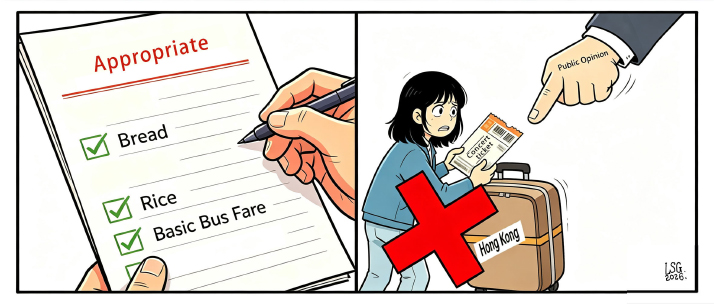
A student from a low-income household in Ganzhou, Jiangxi Province, recently traveled to Hong Kong Special Administrative Region to catch her idol perform live. When she returned, she discovered her family faced the risk of losing its subsistence allowance. According to reports, the girl had funded the trip with money earned from a part-time job and part of the assistance money her family had saved up. The news quickly went viral online, and local authorities say they are still reviewing the case. The controversy now centers on two difficult questions: Should someone from a low-income household be allowed to enjoy an expensive leisure activity while their family continues to receive assistance? Where should the line be drawn between protecting public welfare resources and respecting an individual's right to spend money and enjoy life? Chang Yandao (People.com.cn): Can a low-income household member spend personally earned money on expensive leisure while the family still receives minimum living assistance? This controversy deserves clarification on two levels. First, individual earnings cannot be assessed in isolation from household income. Minimum living assistance is evaluated on a household basis, as members share both income and living expenses. Consequently, it is untenable to claim that a member spends only what he or she earns. Second, assisted households cannot enjoy unlimited consumption freedom. Reasonable spending deserves respect, but freedom has boundaries. As public assistance aims to cover basic needs like food, clothing, housing and transport, spending heavily on entertainment such as watching performances in Hong Kong rightly triggers the monitoring system. These facts reveal the strong institutional rigidity of the welfare policy. Such inflexibility safeguards fairness in social assistance. Funded by public finance, subsistence allowances come from taxpayers and serve the needy; every cent carries society's expectation of fairness and must reach those genuinely struggling. Spending lavishly while receiving aid does injustice to those impoverished by illness, disability or real hardship. From assessing eligibility at the household level to establishing income verification mechanisms and from using big data to identify needy groups to drawing red lines against favoritism, the system has continually closed loopholes and upheld fairness. A household losing assistance can reapply if circumstances worsen. Dynamic monitoring maximizes the safety net's effectiveness. Editorial (Gmw.cn): A low-income household member going to Hong Kong for a concert understandably sparks public skepticism. Such spending seems obviously inconsistent with the general perception of welfare recipients, and taxpayers voicing their concerns is reasonable. After all, minimum living assistance primarily serves as a safety net, and people hope it flows precisely to those genuinely in need. According to a 2021 regulation on subsistence allowance verification, factors such as enrollment in high-fee schools or overseas travel can lead to reassessment. Visiting Hong Kong for a concert clearly goes beyond basic living needs. But the document says consumption behavior plays merely an auxiliary role in assessing eligibility. Whether recipients may spend assistance on non-essential items remains unclear. In fact, the line between necessary and unnecessary, daily life and luxury, is inherently difficult to draw. If a Hong Kong concert counts as luxury, what about a local (cheaper) one? Standards can hardly cover every scenario and may impose an implicit moral demand: Recipients must live according to a "poverty imagination." Using a slightly expensive phone, taking a trip or attending a show invites scrutiny, subjecting their lifestyle to strict, intensive examination. Social security exists to help recipients live basic, dignified lives. The clearer the rules, the less likely such controversies are to divide public opinion. Copyedited by Elsbeth van Paridon Comments to yanwei@cicgamericas.com |
|
||||||||||||||||||||||||||||
|