
|
| China |
| Shanghai conference explores how AI can generate growth and make that growth matter to ordinary people | |
|
|
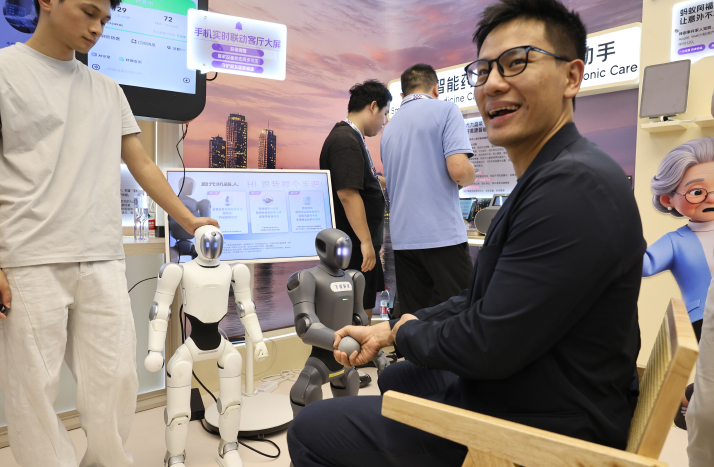 A visitor interacts with a robot capable of measuring a human's blood oxygen levels and heart rate through a handshake at the exhibition hall of the 2026 Inclusion Conference on the Bund in Shanghai on September 10 (XINHUA)
At the entrance to the 2026 Inclusion Conference on the Bund, held in Shanghai on September 9-12, a giant question mark confronted visitors with concerns that no product demonstration could settle. The display, Ten Questions on AI, Technology and Humanity, was collected by the organizers from ordinary people. "Everyone says AI makes us more efficient. So why are we more tired?" asked an office worker. An e-commerce employee wondered whether teaching AI to work meant training a future replacement. A mother worried that her child's reliance on free AI, while others paid for better services, might create a new educational divide. These questions supplied a human touch to the conference's theme of Building the Al Economy Together. Beyond what AI and robots could accomplish lay a harder test: Whether their growing capabilities would create opportunities, ease burdens and distribute benefits more widely. Keeping pace with technology With five editions so far, the conference, hosted by leading Chinese fintech company Ant Group, has offered a window into China's technological priorities. At its debut in 2020, attention centered on the Internet economy. Later discussions explored financial inclusion and blockchain technology. As of 2023, AI was attracting greater interest. In 2024, large language models dominated the conversation. This year, attention shifted toward AI embedded in industries and everyday services. This year's event brought together more than 600 scholars, scientists, entrepreneurs and investors from around the world. Nobel Laureate and economist Philippe Aghion delivered a keynote video address on AI-driven growth. Ant Group CEO Han Xinyi and tech giant Alibaba's Chief Scientist Zhou Jingren joined discussions on agent-based commerce and transaction trust, while founders of embodied intelligence startups explored how robots are entering real-world industries. The discussions kept individual judgment and imagination in view. In a conversation with computer scientist Ma Yi, Dean of the School of Computing and Data Science at the University of Hong Kong, China's famous novelist Liu Zhenyun distinguished imitation from creation. AI could imitate something he had written, he argued, but not a work he had yet to conceive. In addition to the main forum and the industry insights forum, the event also featured a 15,000-square-meter exhibition showcasing more than 300 technology companies. The exhibition focused on two shifts: AI agents moving from generating responses to executing tasks, and robots moving from demonstrations to dependable work, demonstrating skills such as pharmacy sorting, laundry handling and industrial inspection. New sources of growth The exhibition showed how this technological shift can change daily life. At a Starbucks kiosk in the exhibition, visitors could ask Abao, Alipay's AI assistant—Alipay being a mobile payment platform owned by Ant Group—to order an iced Americano every day at 8 a.m. and have it delivered to a specified address. The agent would remember the request, schedule the order and seek confirmation before payment. What Abao and other AI agents are doing is turning complex digital services into a simple "express intent, get results" process. Tasks that once required repeated searches, clicks, navigation and payments can increasingly be handled by AI on the user's behalf. Beyond novelty, the real value lies in greater efficiency, convenience and a smoother everyday experience. Healthcare services offer another example. At the exhibition, visitors can learn about how Ant Group's health agent Afu links health inquiries and medical report explanations to appointment booking and payment. The health agent and doctors work as a team: AI handles the initial responses, while doctors review them. The agent's goal is to support clinicians, not replace them, leaving diagnosis, decision-making and patient communication in human hands. AI will boost productivity. "AI could add about 1.08 percentage points to annual productivity growth over the next decade, a potential impact that may surpass that of the IT revolution," Aghion said. Ant's digital technology team introduced infrastructure that lets companies create, launch, and manage their own AI agents. It comes with over 200 ready-made industry skills and expert templates to start from. This matters because it lowers the barrier: Smaller businesses can now offer specialized support that was previously out of reach. New growth can also come from AI-enabled widening participation in creation. Nine-year-old Luo Ange, who had no programming experience, managed to use natural language instructions to turn a summer camp pottery experience into an online project, winning first prize in the conference's AI coding competition. This demonstrates how AI can lower the technical threshold between having an idea and making something others can use. But there are challenges to overcome. Ant Group CEO Han acknowledged AI agent-based commerce is developing "much more slowly than everyone expected." Robotics executives were similarly candid about the gap between industry valuations and commercial value. Key capabilities are emerging, they said, but turning them into large-scale productivity remains a challenge. A successful demonstration is not the same as a machine ready for dependable daily work. Rethinking efficiency and equity AI has enhanced efficiency. Yet efficiency comes with costs, and its benefits are not automatically shared. At the conference's green technology exhibition, a dashboard made one cost visible. When a visitor asked an AI system created by Alibaba, in Chinese, "Who are you," the dashboard recorded 50 input tokens and 549 output tokens, or the units of text processed by a language model. It put the exchange's electricity consumption at 0.0898 watt-hours, roughly enough to power a 10-watt lightbulb for 32 seconds. A forum on token efficiency addressed the same issue at an industry level. Ant Group Vice President Luo Ji argued that each token should deliver greater intelligence while carrying a smaller energy and carbon cost. The objective is to make useful intelligence more affordable and widely available. Wang Jian, Director of new-type research institution Zhejiang Lab, proposed a broader test: Can one kilowatt-hour of electricity devoted to AI save 10 elsewhere? Framed this way, efficiency concerns the overall outcome, not just the consumption of a model or data center. Ant Forest, launched by Ant Group, encourages users to adopt low-carbon lifestyles by rewarding environmentally friendly actions with virtual "green energy," which can later be converted into real trees planted in desertified regions. The human side of the equation matters just as much. Professor Xiao Yanghua from Fudan University, Shanghai, said prior knowledge, the ability to ask questions and verify answers, guidance from teachers or mentors and the resources to bear the costs of trial and error all affect whether access can turn into real capability and whether people can benefit from AI equally. Faster systems alone cannot ensure that workers gain time, children gain opportunities or smaller firms gain a fair chance. Aghion called for tax and social security measures that would spread the gains and prevent technological progress from widening inequality. The questions at the entrance thus remains relevant beyond the forums and exhibition halls. An AI economy will be judged not only by what its agents and robots can do, but by whether the office worker, the e-commerce employee and the mother can recognize progress in their own lives. (Print Edition Title: Faster, Smarter—and Better?) (Reporting from Shanghai) Copyedited by Elsbeth van Paridon Comments to zhaowei@cicgamericas.com |
|
||
|
||||||||||||||||||||||||||||
|