|
| China |
| Businesses and investors seek opportunities in Xiamen | |
|
|
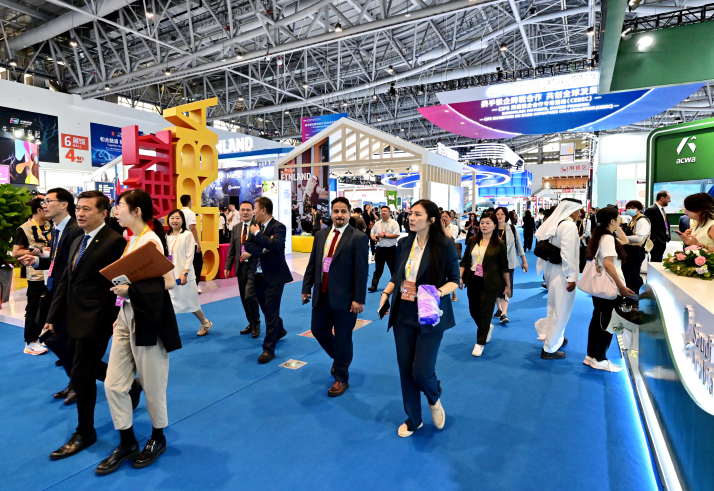 Visitors at the 26th China International Fair for Investment and Trade in Xiamen, Fujian Province, on September 8 (XINHUA)
Walter Döring had little free time during his stay in Xiamen, a coastal city in the southeastern Chinese province of Fujian, in mid-September. The chairman of the Academy of German World Market Leaders moved from meetings with government officials to talks with business representatives, while already planning another trip to China in October. For Döring, the packed schedule was part of the reason for timing his visit to coincide with the 26th China International Fair for Investment and Trade (CIFIT). "You don't have the chance to trust one another if you don't meet very often," he told Beijing Review at the fair. He said closer contact was particularly important at a time when economic and trade disputes were complicating relations between China and Europe. First launched in 1997, CIFIT is the only national-level investment-themed expo in China and one of the world's most influential platforms for international investment. Held on September 8-11, CIFIT 2026 took place against a difficult backdrop for global investment. Trade policy uncertainty, geopolitical tensions and concerns over economic security are increasingly affecting where companies put their money. The exhibition area expanded from 120,000 square meters last year to 200,000 square meters, with more than 1,200 government and business delegations from 129 countries and regions and 30 international organizations registered to participate. Addressing the opening ceremony on September 8, Chinese Vice President Han Zheng said uncertainties and destabilizing factors in the world are increasing, but the trend toward openness and cooperation remains unchanged. Investment in both directions For Finnish Ambassador to China Mikko Kinnunen, the emphasis on two-way investment is one of CIFIT's defining features. "CIFIT is an event dedicated to both inbound and outbound investment," Kinnunen told Beijing Review. He noted that Finnish companies have been investing in China for more than 30 years, citing forestry products company UPM's mill in Changshu, Jiangsu Province, and elevator manufacturer KONE's factory in Kunshan, also in Jiangsu, which the company describes as its largest manufacturing base. Kinnunen said Finnish companies continue to invest in China for several reasons, including "fast and effective" supply chains, access to certain raw materials, skilled workers and the size of the Chinese market. Finland and Saudi Arabia were CIFIT's first ever dual guest countries of honor this year. Finland's presence included its first national pavilion at the fair, focusing on areas including the circular economy and smart manufacturing. Saudi Arabia brought a large economic delegation and highlighted opportunities in energy, chemicals and advanced manufacturing. Elsewhere in the exhibition halls, the movement of investment in the other direction was equally visible. Victor Queiroz, chief representative for the Asia-Pacific region of the Brazilian Trade and Investment Promotion Agency, or ApexBrasil, came to Xiamen with two goals. One was to bring more Brazilian products to Chinese consumers, including by working with Chinese coffee chain Luckin Coffee to promote Brazilian coffee beans and Brazilian culture. The other was to attract Chinese investment to Brazil, particularly in sustainable development and energy projects. Chinese investment in Brazil is expanding into sectors including automobiles, power batteries and energy storage, Queiroz said. During this year's CIFIT, ApexBrasil also unveiled its Xiamen representative office, which will serve the south China region. He described the fair as a venue that can "connect all the world in one place." The same two-way investment focus was on full display at the Italian National Pavilion. Themed Italy: A Land of Opportunities, it showcased a range of high-potential sectors for Chinese investors, including automobiles, aerospace, green supply chains, the circular economy and life sciences. A new investment map Alongside the main fair, another gathering, the Second Future Investment Conference looked further ahead. The topics at the conference reflected a broader shift in how investment decisions are made. "Ten or 20 years ago, companies often invested where costs were the lowest," Sean Doherty, head of international trade and investment and a member of the Executive Committee at the World Economic Forum, told Beijing Review. Doherty emphasized that cost still matters, particularly logistics and energy costs, but companies are also paying closer attention to the security of their investments, regulatory policies and connectivity between economies. "Investors want to know whether an investment will still allow them to obtain supplies and reach destination markets several years down the road," he noted. According to Doherty, China's outbound investment is an important part of this changing picture. Chinese companies that have developed strong innovation capabilities and competed successfully in a large domestic market can bring technology, know-how and experience to the economies where they invest, he said, adding that such investment could also create jobs and local capabilities. The concentration of investment in advanced technologies also raises a question for developing economies. The United Nations Conference on Trade and Development estimates that low- and lower-middle-income economies attracted only about 10 percent of global investment in strategic sectors between 2020 and 2025. Doherty said developing countries still need to improve trade and investment facilitation while identifying areas in which they have particular advantages, whether in natural resources, clean energy, access to large consumer markets or specialized capabilities. As companies diversify their sources of supply, he said, countries "don't necessarily need to be the absolute lowest-cost supplier." Being a dependable partner can itself help attract investment. Confidence built through engagement For companies, however, investment decisions are not based solely on economic fundamentals. Political relations play an increasingly important role. Michael Hart, President of the American Chamber of Commerce in China (AmCham China), said 2025 had been "a very tough year" for China-U.S. trade relations, but that 2026 had brought greater stability. AmCham China members continue to see China as an important market, he told Beijing Review. What they want most is "stability and predictability," he said, adding that high-level engagement between the two countries gives businesses greater confidence to continue operating and investing. American companies are also exploring opportunities beyond traditional industries. In healthcare, research and development investment is substantial and collaboration with Chinese partners continues to expand. The same trajectory is also evident in chips, robotics and AI sectors. Döring likewise sees an urgent need for closer contact between China and Europe. He refuted the idea that competition necessarily makes companies adversaries. In areas such as automobiles and power batteries, he said, European and Chinese companies can be competitors and partners at the same time. "Competition is something that is quite normal," he said. "You just have to be open-minded for competition. A competitor may become your partner and create opportunities for innovation on both sides." Döring also emphasized the importance of firsthand experience in shaping European companies' perceptions of the Chinese business landscape. In his view, an entrepreneur who has successfully operated in China can often convince peers more effectively than a politician or journalist. He said he hopes more German business leaders will visit China, engage with their counterparts and assess the operating environment for themselves. That need for direct contact was also one reason Doherty saw value in gatherings such as CIFIT. With uncertainty causing some investors to hold back, he said meetings among businesses, investment promotion agencies, government departments and international organizations can give companies a clearer picture of government intentions and help enhance their confidence to move forward. For Döring, the starting point is simpler: People need to meet in person. In an investment environment increasingly shaped by security, technology and geopolitical concerns, the crowded halls and packed schedules in Xiamen offered room for productive engagement. (Print Edition Title: Where Investment Goes Next?) (Reporting from Xiamen, Fujian Province) Copyedited by G.P. Wilson Comments to liwenhan@cicgamericas.com |
|
||
|
||||||||||||||||||||||||||||
|