
|
| China |
| Reaching for the stars, together | |
|
|
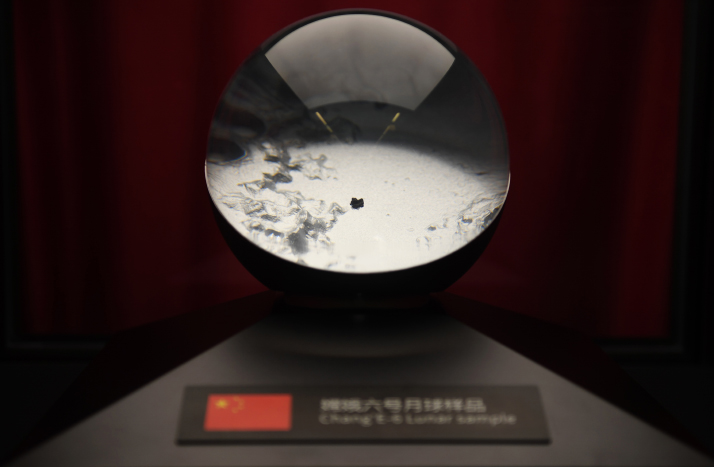 A lunar sample, collected from the far side of the moon by China's Chang'e-6 mission, in Vienna, Austria, on September 14. On that day, China presented the lunar sample to the United Nations Office in Vienna, where the sample will be permanently exhibited (XINHUA)
On September 14, at the United Nations Office in Vienna, Austria, China donated a lunar sample collected in 2024 by the Chang'e-6 mission. It was the first time a lunar sample from the far side of the moon had been presented to the UN.
At the ceremony, Shan Zhongde, Administrator of the China National Space Administration, said China is ready to share the fruits of space development with countries around the world, share opportunities and create prosperity together, so that advances in space science and technology can better benefit people of all countries. The gesture made headlines, but it is just one of many China is making. Alongside the sample lies a web of institutional arrangements that China has been building over the past year, arrangements designed to make deep space exploration a genuinely shared enterprise rather than a solo pursuit. 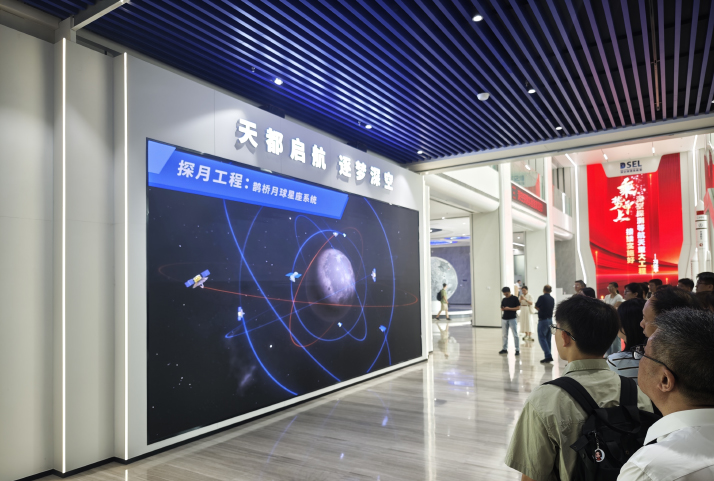 Visitors learn about China’s lunar exploration programs at the Deep Space Exploration Laboratory in Hefei, Anhui Province, on August 5 (LU YAN)
More opportunities Aarti Holla-Maini, Director of the United Nations Office for Outer Space Affairs, said China's donation of the lunar sample and sharing of scientific research data illustrate that outer space is a common domain of all humanity. She also expressed hope that the lunar sample would continue to tell the story of humanity's exploration of the moon in Vienna and contribute to advancing the global governance of outer space. The Austrian capital is not the only place where that story is being written. Another chapter began a little more than a week earlier in the eastern Chinese city of Hefei, Anhui Province, also based on the principle of sharing. In early September, China kicked off an ambitious space project that will place a swarm of small satellites into the space between Earth and the moon, known as cislunar space, creating a kind of "satellite net." The initiative, called the International Cislunar CubeSat Constellation Program, aims to deploy 30 CubeSats, a type of miniature, standardized satellite used for space research, education and commercial tasks, each roughly the size of a carry-on suitcase and weighing under 30 kg. The satellites will be held in stable elliptical orbits by the gravitational forces of both Earth and the moon. All satellites are scheduled for launch and deployment around 2030. Once in place, the satellites will split into two teams: one monitoring space weather, the other hunting for gamma-ray bursts, the most powerful explosions in the universe. Together, they will provide continuous, networked coverage of a region that has so far been observed only through scattered, one-off probes. They will also carry out lunar resource exploration, providing data to support the construction of future lunar bases. The payoff is practical. If astronauts are going to spend long stretches in cislunar space, or live on a future lunar base, they need to know what the radiation and particle environment is like, much like the way explorers need weather forecasts before heading into unfamiliar territory. The network will also support navigation and communication for lunar missions, making landings and dockings safer and cheaper. What makes the project unusual is how it shares the load. Participating countries will jointly design missions, cover their own costs and share scientific data. China will provide them with free instruments, respectively to detect high-energy particles, measure magnetic fields and spot gamma-ray bursts. The arrangement is designed to let developing countries join deep space exploration without having to build cutting-edge instruments from scratch. Thailand, Serbia, Egypt, Senegal, Indonesia and several other countries have already signed on. First-phase engineering work is underway, and the overall design for satellites, payloads and ground control is nearing completion. The initiative was jointly launched by the Deep Space Exploration Laboratory (DSEL) and International Deep Space Exploration Association (IDSEA), with support from the Asia-Pacific Space Cooperation Organization. The DSEL and IDSEA are China-initiated global scientific institutions dedicated to deep space science, engineering and international cooperation. Both organizations are based in Hefei. The DSEL was inaugurated in February 2022, and has since established partnerships with more than 60 international research institutions. In July 2025, the laboratory and several other institutions jointly proposed the establishment of IDSEA, the first China-based international academic organization for deep space exploration. "We look forward to working with partners around the world to push the boundaries of the human knowledge of deep space," Hu Zhaobin, Vice Chairman of the IDSEA, said at the International Deep Space Exploration Conference 2026 held in Hefei on September 3-4, when the International Cislunar CubeSat Constellation Program was launched. The conference attracted more than 400 guests from over 40 countries and regions. Shared enterprise China's international cooperation in deep space exploration has a long history, and the modes of cooperation have continued to diversify. In June 2024, when the Chang'e-6 mission traveled to the far side of the moon to complete its first sample return, it carried four international payloads and satellites, including a radon detector from France, a lunar surface negative ion analyzer from the European Space Agency, a laser angle reflector from Italy and a cube satellite from Pakistan. The Chang'e-7 mission, originally scheduled for launch in the second half of this year but postponed to next year, plans to carry six international payloads from seven countries or organizations: Egypt, Bahrain, Italy, Russia, Switzerland, Thailand and the International Lunar Observatory Association. Beyond flying instruments, China is also opening up its sample archives. The China National Space Administration has said that from Chang'e-5 and Chang'e-6 lunar samples to future asteroid and Mars samples, applications are open to scientists worldwide. During a side event on the margins of the 69th Session of the Committee on the Peaceful Uses of Outer Space on June 11, Li Song, China's Permanent Representative to the UN and Other International Organizations in Vienna, said, "The exploration of the vast cosmos cannot be accomplished by any single country alone. Throughout its efforts in outer space exploration, China has consistently pursued international cooperation in the space sector on the basis of equality and mutual benefit, peaceful use and inclusive development." That principle was reiterated at a different venue and in a different register. Chinese Foreign Ministry spokesperson Guo Jiakun put it more directly at a news briefing on China's 2026 Space Day on April 24, "Space is not an arena for major country competition. China will continue to work with various countries for open space cooperation and advance the common endeavor of humanity in exploring outer space." (Reporting from Hefei, Anhui Province) Copyedited by G.P. Wilson Comments to luyan@cicgamericas.com |
|
||||||||||||||||||||||||||||||
|