
|
| China |
| Weathering Summer | |
| How Chinese cities are coping with extreme heat and floods | |
|
|
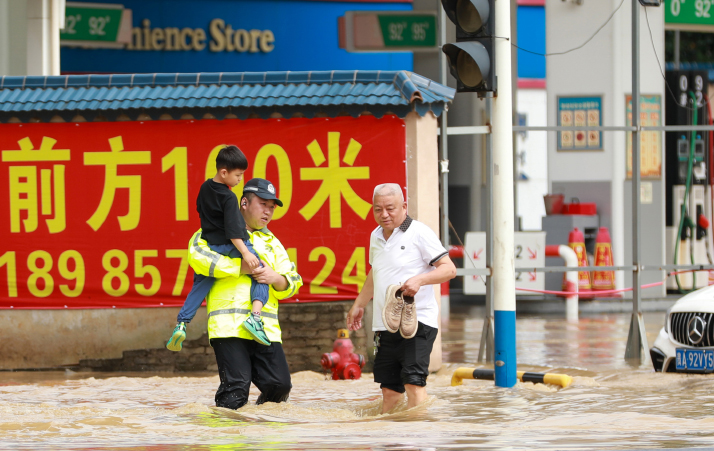 A traffic police officer carries a child across a waterlogged street during heavy rain in Duyun, Guizhou Province, on May 19 (XINHUA)
In summer 2026, much of the northern hemisphere is sweltering under record-breaking heatwaves. From Europe to Asia, thermometers sometimes exceeded 40 degrees Celsius, straining power grids, endangering vulnerable populations, and exposing the limits of urban infrastructure designed for a cooler past. Yet amid this global crisis of rising temperatures, erratic downpours and urban flooding, a transformation is taking place in Chinese cities, offering a glimpse into how densely populated urban centers can systematically mitigate climate shocks. In Xuzhou, Jiangsu Province, residents of the Fifth Phase of Rongshengcheng residential complex in Quanshan District are experiencing summer in an entirely different way. There is no hum of air-conditioning units, no dry blast of cold air and no spike in electricity bills. Instead, 408 households are enjoying a constant, silent 25 degrees Celsius, a coolness not from compressors, but from abandoned coal mines 100 meters underground. Guo Yongchang, one of the first residents to use the system, is unequivocal in his praise. "The temperature stays steady at around 25 degrees Celsius across every room. There's no wind, no noise, and it's very gentle on elderly people. It feels wonderful," he told Economic Daily newspaper. This summer, Xuzhou became the first Chinese city to pilot a district-cooling project using water from abandoned coal mines. The flooded mines hold groundwater that stays at a constant 19 degrees Celsius year-round. By pumping this cold water through the city's existing heating pipes—the very same network that carries hot water in winter—the system delivers radiant floor cooling to households. The water is fully recharged back into the mine after drawing thermal energy, consuming nothing in the process. Across China, many places are proactively developing systemic resilience to confront threats such as extreme heat, torrential rain and urban flooding, through a combination of hard engineering, grassroots innovation and digital governance. At its core lies a singular commitment: safeguarding people's livelihoods in the face of a climate that no longer follows old rules. Cooling down The Xuzhou project is built around the closed Woniu Mountain Coal Mine, once a major project of Xuzhou Mining Business Group, a state-owned coal conglomerate that previously operated 17 mines in and around the city. Most of these mines have been closed in recent years as the city pivoted away from heavy industrial extraction. The project is led by the group's heating subsidiary, which operates the city's heating network. The technical hurdles were significant: The mildly acidic mine water is corrosive, and cooled floors can easily collect condensation in humid summers. Working with the Yunlong Lake Laboratory of Deep Underground Science and Engineering and China University of Mining and Technology, the team cracked both problems, achieving stable indoor humidity below 50 percent. The pricing is straightforward: 4 yuan ($0.59) per square meter, or 400 yuan ($59) for a 100-square-meter apartment for the entire summer. In contrast, a conventionally air-conditioned home of comparable size in Xuzhou's heat would typically rack up 1,500 yuan to 2,500 yuan ($223 to $372) in electricity bills over four months, and that excludes routine maintenance, refrigerant top-ups and eventual compressor replacement. When depreciation and upkeep are included over the full lifecycle, the economic edge of the mine-water system widens considerably. Beyond large-scale engineering, community-level responses are increasingly focused on precision care. In Beijing's Haidian District, a "three-minute cooling circle" was rolled out: a network of cooling stations that includes one main service center, six rest stops, five commercial districts and 32 residential communities, so that help to those needing an escape from the heat is never more than three minutes away. Local businesses joined in too. Forty-two companies and institutions have opened their lobbies as cooling shelters, handing out free water and stocking first-aid kits. In Jianyang, Sichuan Province, free cold-drink stations and air-conditioned rest stops have become a welcome refuge for couriers, delivery riders and other outdoor workers who spend their days in the scorching heat. Technology is also easing the burden on those who must work through the heat. In Xuanwu District in Nanjing, Jiangsu, sanitation workers have been equipped with cooling vests. Tiny fans at the waist of the vests circulate air to accelerate heat dissipation, making summer shifts slightly more bearable. In Jiaxing, Zhejiang Province, smart live-line operation robots now handle electrical line work in hazardous conditions where ground temperatures exceed 60 degrees Celsius, remotely controlled by staff and dramatically reducing human exposure to heat. Holding back water Between July and August, three typhoons—Bavi, White Dolphin, and Saudel—made landfall in succession at the very same place: Kanmen Subdistrict in Taizhou, Zhejiang. With a land area of less than 26 square km, it was an unprecedented test for its emergency response system. The top priority, each time, is evacuating people. Local officials focused on coastal homes, low-lying areas and sites vulnerable to geological hazards. Zhang Yangshun, an official of the subdistrict, admitted that while the first evacuation went smoothly, the second and third rounds were harder. "Some residents felt that since they had safely ridden out the previous storms, they didn't need to move again," he said. Community workers went door to door, patiently persuading each family to leave.  Delivery couriers take a break and enjoy watermelon at a care post for couriers and outdoor workers at a hotel in Shijiazhuang, Hebei Province, on July 4 (XINHUA)
After each storm, the subdistrict and community teams regrouped to review what worked and what didn't. White Dolphin had brought flooding that overwhelmed parts of the city, so ahead of Saudel, they pre-deployed large drainage trucks and high-capacity pumps alongside the river and reservoir systems. When Saudel finally passed, crews moved quickly to clear roads, inspect facilities and assess damage, restoring basic services first, then getting businesses back on their feet in an orderly manner. This same logic of foreseeing problems before they happen and responding faster when they arise is being used around the country, not just in coastal towns facing typhoons, but in inland cities grappling with sudden, violent downpours. On July 28, a sudden rainstorm hit Zhengzhou in Henan Province. In the late afternoon, a yellow rainstorm warning was issued. Minutes later, a red warning dot flashed on the screen at Zhengzhou's smart city operations center. The duty officer pulled up live video and spotted flooding at the Zijingshan Overpass and immediately dispatched a team. "We've got over 30 cm of water. Pumping it out now," reported Yang Qing, a flood control official, via video link. An orange hose was draining the water into the city's stormwater network. Within 20 minutes, the scene was clear. What made this possible was a digital system called the Flood Control Map launched in June. It connects thousands of flood-related sites, including rain gauges and reservoirs, with live cameras and 682 sensors across the city. When a warning goes out, the system translates it into specific tasks for each person, telling them who goes where and what to do. Responses are tracked in real time. "Now the system delivers the plan directly to each position," Dan Dong, head of operations, told local news portal Zhengguannews.cn. "Every response is tracked. It's a closed loop." BR Copyedited by G.P. Wilson Comments to luyan@cicgamericas.com |
|
||||||||||||||||||||||||||||||
|