
|
| China |
| Sky-high ambition | |
| Unmanned air taxis and self-driving street sweepers are rewriting the rules of urban mobility from the ground up | |
|
|
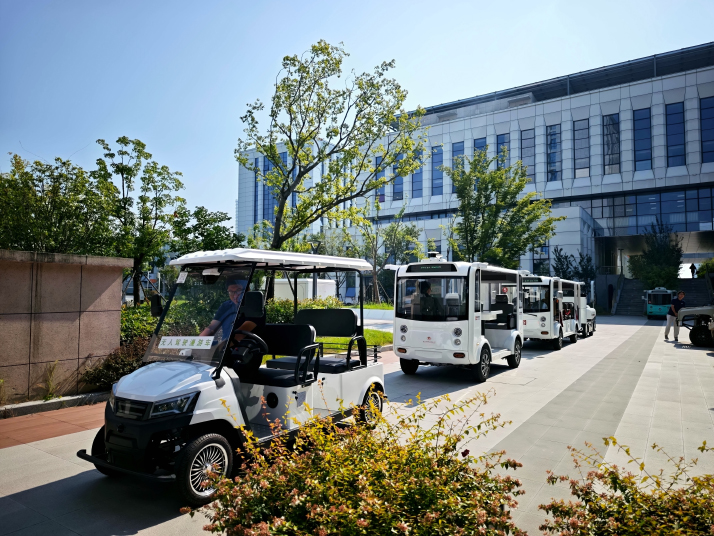 Autonomous shuttle buses produced by Juche Technology Co. Ltd. run at the industrial park of the Hefei Institute of Technology Innovation in Hefei, Anhui Province, on August 4 (LU YAN)
In the sweltering summer heat, an EH216-S unmanned passenger-carrying aerial vehicle lifts smoothly into the air at the takeoff and landing pad of the Hefei Luogang Park Air Traffic Operations Center in Hefei, Anhui Province. After several minutes of flight, it touches down precisely at its designated spot. With no pilot on board, the vehicle relies entirely on a pre-programmed route—executed with precision through digital technology. This is an ordinary day following the issuance of one of the world's first operating certificates for commercial unmanned passenger aircraft. The company behind it is Hefei Heyi Aviation Co. Ltd., a local firm whose business covers aviation operations support, unmanned aerial vehicle (UAV) sales and aviation services. The drones have turned the sci-fi fantasy of "air taxis" into a viable commuting option. The EH216-S aircraft is capable of reaching speeds up to 130 km per hour and covering a maximum distance of 35 km, a vivid testament to just how fast urban air mobility is accelerating. And this is only the beginning: Future applications will extend to logistics, firefighting and rescue, opening up new possibilities for city life, according to Gu Yong, the company's marketing manager. Hefei, China's rising hi-tech hub, is going all in on the low-altitude economy and autonomous flight and driving. The city has already built over 180 takeoff and landing facilities, launched the country's first city-level low-altitude (under 1,000 meters) flight service center, and cultivated an ecosystem that now draws more than 300 related companies, spanning airframe manufacturing, core components, flight control systems, operation services and more. Your air taxi has arrived Heyi Aviation was founded on March 29, 2024. Just one day before its first anniversary, on March 28, 2025, the company received one of the world's first operating certificates (OC) for commercial passenger-carrying civil unmanned aircraft, issued by the Civil Aviation Administration of China (CAAC). The certification was a formal green light for unmanned low-altitude flights to enter commercial service in China. Prior to that, the company's EH216-S model had already become the world's first unmanned passenger electric vertical take-off-and-landing (eVTOL) aircraft to secure all three major certifications from the CAAC: the type certificate, the standard airworthiness certificate and the production certificate. "Earning an airworthiness certificate only proves that the product meets technical and safety standards. But safe, stable and sustainable commercial operations are the real bottleneck for this industry to take off," Gu said. In the more than one year since receiving the OC, Heyi Aviation hasn't rushed to launch paid services but has focused on fine-tuning its operational systems instead. Across its two bases in Hefei and Guangzhou, Guangdong Province, the company has completed over 3,000 test flights. The EH216-S platform has logged more than 90,000 flights across 22 countries on five continents, accumulating a wealth of real-world flight data and hands-on experience. Using that data, the team has continuously refined its standardized operating procedures and management systems. They've established safety protocols layer by layer, covering everything from pilot training and maintenance support to aviation insurance and scenario-based operations. The result is a scalable, replicable commercial operations framework for unmanned passenger aircraft that could serve as a blueprint for the industry at large. Heyi Aviation's long-term vision is to build a full-scale urban air mobility network, using city-based transit hubs and its unmanned fleet to offer everything from short hops to medium-haul air travel. The company plans to start with sightseeing and urban flight experiences, then expand into commuter transport, eventually bringing its Air Taxi model to cities as an everyday commuting option. "We're entering the market through low-altitude sightseeing for now," Gu told Beijing Review. "As airspace and route conditions continue to improve, we'll gradually roll out fixed point-to-point routes. That's when urban air commuting will become a reality." Beyond passenger transport, Heyi Aviation has also developed a firefighting version of its UAV, designed to tackle a persistent challenge for high-rise urban buildings as conventional fire ladders simply can't reach high enough. The aircraft can overcome the challenge by reaching up to 600 meters to extinguish fires. Equipped with six window-breaching projectiles to shatter glass and a high-pressure water cannon for precision firefighting, the drone has already been integrated into routine training exercises with the Hefei Fire and Rescue Department. Gu said the company's fast development wouldn't have been possible without Hefei's proactive push into the low-altitude economy. The city recently released the country's first municipal-level white paper on low-altitude economic scenarios, outlining 260-plus routes across five broad categories and 36 specific use cases. And the numbers are already adding up: Since the beginning of this year, Hefei has recorded nearly 29,000 flights, with total flight time reaching over 8,000 hours and total distance covering nearly 190,000 km, according to official city statistics. On the safety front, Hefei has also built a city-wide intelligent connectivity system for low-altitude flights, pulling together low-altitude radar, spectrum monitoring and electro-optical tracking technologies. Think of it as a "smart brain" that coordinates UAV operations at scale, providing the real-time oversight needed to keep large-scale drone flights safe and orderly. From lab to road While the low-altitude sector expands skyward, a parallel revolution is unfolding on the ground in Hefei. Juche Technology Co. Ltd. specializes in the research, development and industrialization of intelligent mobile robots and autonomous driving technologies. Its product range includes self-driving passenger cars, autonomous shuttle buses and driverless delivery vehicles. Take the Xiaoqing C01, an autonomous street sweeper, as an example. Powered by a 4.3-kilowatt-hour lithium-ion phosphate battery, it can operate continuously for four hours on a full charge, covering 3,000 to 3,500 square meters of road surface per hour, roughly the size of half a soccer pitch. Li Jian, the company's Executive Vice President, said these sweepers are already in use at industrial parks and university campuses. They are especially valuable in situations where manual cleaning is difficult, such as severe weather conditions or overnight hours. "Staff simply assign a cleaning task through a mobile app," he told Beijing Review. "And the vehicle completes the job autonomously." The company's self-driving shuttles are also operating on real roads. They navigate turns and avoid pedestrians automatically, with no human intervention required. Yuan Sheng, co-founder and technical director of Juche, noted that the team's roots trace back to 2008, when they began developing autonomous driving software algorithms at the Hefei Institutes of Physical Science, a research institution under the Chinese Academy of Sciences. At the time, they were among the earliest research groups in China to focus on self-driving technology. In 2014, the institute partnered with the Hefei Municipal Government to establish the Hefei Institute of Technology Innovation, a platform dedicated to commercializing scientific research outcomes. Seizing this opportunity, Juche moved into the industrial park of the innovation institute in 2017 and officially incorporated as a company in 2018. The team started with just a handful of engineers; today, it has grown to more than 160 employees. "Most tech startups don't survive the early stages because of a shortage of capital, scarcity of specialized talent and lack of paying customers. These were the three hurdles right in front of us," Li remembered. What fills the gap for many tech startups in this city is the full-cycle incubation system built by the Hefei Institute of Technology Innovation. It provides support at every stage: direct capital injection, assistance in recruiting technical professionals and sustained coordination with both industrial and application-scenario resources. "The platform brings together a vast pool of industry-chain resources," Li said. "It naturally connects us with large enterprises and research institutions that are looking for cutting-edge technologies. These open-minded customers give us the room to keep iterating our products, and that's how we achieve growth." BR (Reporting from Hefei, Anhui Province) Copyedited by Elsbeth van Paridon Comments to luyan@cicgamericas.com |
|
||||||||||||||||||||||||||||
|