
|
| China |
| A New Horizon for First Aid | |
|
|
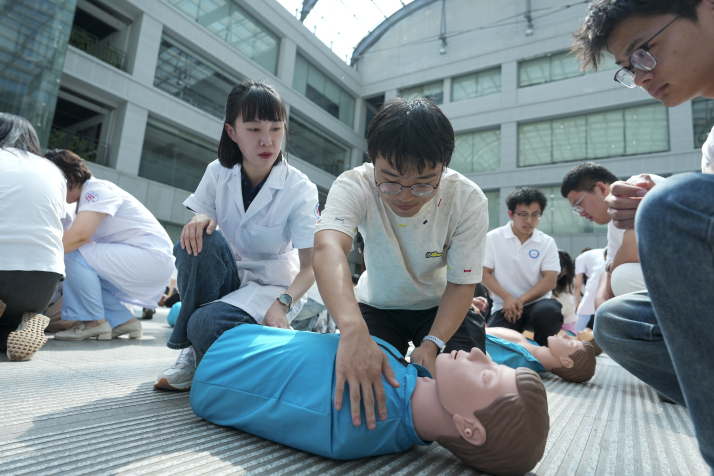 Students from Harbin Engineering University receive practical training in emergency response, including cardiopulmonary resuscitation techniques, on May 28 (XINHUA)
In late August, the global emergency medicine community turned its gaze to Dubai for the inaugural IFRC First Aid World Cup. The Red Cross Society of China's three teams delivered a powerful performance across all three competition categories, clinching global championship titles in the Innovative First Aid and Resuscitation event and Scenario-Based First Aid and Resuscitation Response event, while securing runner-up in the Public Awareness Campaign event. The IFRC First Aid World Cup is an event jointly organized by the International Federation of Red Cross and Red Crescent Societies (IFRC) and the Dubai International Humanitarian Aid and Development Conference and Exhibition. A total of 162 teams from 85 Red Cross and Red Crescent national societies took part in regional qualifiers, with 16 advancing to the global finals. While China's victories offered international validation of the country's professional emergency management standards, the true story of China's progress lies not in an arena, but in the streets, residential alleys and digital infrastructures of its cities and rural areas. China is currently moving from a siloed, hospital-centric emergency model toward a community-integrated system that aims to conquer the deadliest enemy in pre-hospital care: time. In the realm of emergency medicine, the Golden Four Minutes is a phrase that carries the weight of life and death. When a person suffers a sudden cardiac arrest outside of a hospital, the cessation of blood circulation causes irreversible neural damage within roughly 240 seconds. According to the Report on Cardiac Arrest and Cardiopulmonary Resuscitation (CPR) in China (2022), China witnesses hundreds of thousands of cardiac arrests annually. With a meager 1 percent survival rate for out-of-hospital arrests, the statistical outlook for victims is grim. The primary impediment has long been geographical. In China, ambulance response times often range between eight and 13 minutes, a consequence of traffic congestion resulting from high urban density. The aforementioned report shows that 70 to 80 percent of cardiac arrests occur in homes and residential compounds. This necessitates a shift in rescue strategies: The first responder can no longer be solely envisioned as a medical professional; they must increasingly be the neighbor, the family member or the passer-by. To bridge the gap between the onset of an emergency and the arrival of professional paramedics, a community-led rescue model is rapidly taking shape across China. First aid heroes On May 26, Ye Huizhen, an emergency response volunteer in Songyang County, Zhejiang Province, received a call from the emergency dispatch center that operates the national medical emergency hotline, 120. An elderly resident in a local sub-district was experiencing severe dizziness, requiring immediate assistance. Ye opened the Renrenjiu (Everyone Saves) app, an innovative emergency response platform designed to connect nearby trained volunteers with patients in crisis. She accessed the caller's contact information, confirmed the precise location, grabbed her emergency kit, and rushed out. Within a mere two minutes, she was at the patient's home. "The elderly person was slumped by the bed, complaining of dizziness, accompanied by nausea and physical weakness. The family was extremely anxious," Ye told People's Daily newspaper. She immediately began to calm the distressed family while simultaneously conducting a rapid assessment of the patient's condition. 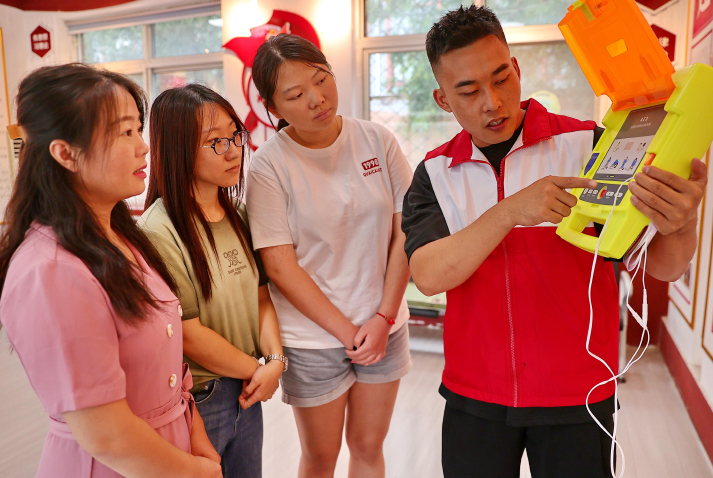 A Red Cross first-aid instructor from Qinhuangdao, Hebei Province, educates local residents on how to use an automated external defibrillator on August 28 (VCG)
Through inquiries, Ye learned that the patient had no history of dizziness. Considering the day's high temperatures, the patient's recent outdoor activity, dehydration, and the presence of vomiting and an elevated body temperature, Ye suspected heatstroke. Working with the family, she facilitated the patient's movement to a well-ventilated area, applied wet towels for cooling and provided small sips of lukewarm water. Ten minutes later, the ambulance arrived. Ye handed over the case to the medical personnel, detailing the patient's medical history, her on-site observations and the immediate interventions she had performed. The attending physician later acknowledged that Ye's prompt and accurate assessment, coupled with her appropriate handling, had secured a critical window for subsequent treatment. Ye is one of Zhejiang's 170,000 registered First Aid Hero volunteers. For the past five years, Zhejiang has continuously reformed its emergency medical response system. Previously focused primarily on critical interventions such as cardiac arrest, airway obstruction and severe hemorrhage control, the training now encompasses a broader range of critical situations, including the management of heatstroke, snakebites, drowning and fainting. This expansion is designed to cultivate a team of volunteers equipped with more comprehensive emergency response capabilities. This dedicated volunteer corps has achieved remarkable reach, now covering over 90 percent of Zhejiang's villages and communities. The Lianjia model While Zhejiang's model relies on the spontaneity and reach of individual citizens, the Lianjia initiative offers a "fixed-node" strategy that provides structural reliability, proving that there is no single solution to urban emergency response. On August 20, Beike, a leading integrated online and offline platform for housing transactions and services, along with its affiliated real estate chain Lianjia, launched the Life-Saving Community Stores initiative in Beijing, in partnership with tech giant Tencent. The program's inaugural automated external defibrillator (AED) device was installed at a Lianjia branch office in Shijingshan District. On the same day, the first cohort of Lianjia agents underwent intensive training in CPR and AED deployment. Upon successfully passing their certification, these agents were formally inducted into Beijing's expanding ranks of social emergency volunteers. The distinct strength that Beike and Lianjia bring to this mission is rooted in their extensive local footprint. With a nationwide network encompassing nearly 60,000 branches and 500,000 agents, these offices are physically embedded within the very fabric of residential neighborhoods. Historically, social rescue efforts have relied heavily on volunteer systems, but these volunteers were often mobile, and their availability could be erratic. The unique value of the Lianjia model lies in its strategic combination of "fixed nodes and mobile tentacles." The store serves as a stable, anchored base, while the agents function as a dynamic, mobile network of potential responders. Technologically, this initiative is powered by Tencent's Penguin Emergency platform. This system integrates the 120 dispatch centers, registered volunteers, AED locations and the callers into a unified digital ecosystem. The platform manages the entire chain of survival: from the initial distress call to real-time positioning, dispatching, remote guidance and rescue. When a 120 operator logs an emergency, the system functions akin to a ride-sharing dispatch, intelligently identifying and notifying certified volunteers within a specified radius, typically within 3 km. While this technological infrastructure is critical for bridging the gap between emergencies and intervention, the success of such an ecosystem also relies on addressing the legal concerns that weigh on potential rescuers. Ma Liang, a professor of digital governance at the School of Government at Peking University, told Economic Information Daily newspaper that agents acting as volunteers should not be held liable if their rescue attempts prove unsuccessful, noting that such legal protection is essential for encouraging social participation. This safeguard is already anchored in China's Civil Code, which includes a "Good Samaritan clause" explicitly stipulating that voluntary rescuers are not liable for civil damages resulting from their emergency assistance. Copyedited by G.P. Wilson Comments to jijing@cicgamericas.com |
|
||||||||||||||||||||||||||||
|