
|
| China |
| Exploring human-wildlife coexistence on the Qinghai-Xizang Plateau | |
|
|
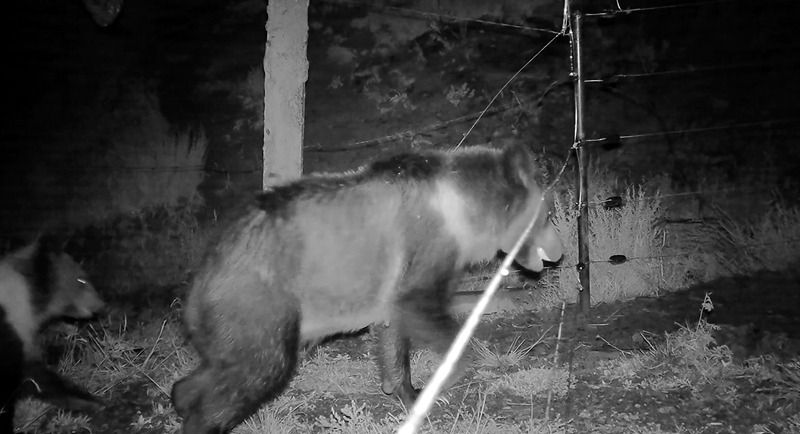 Electric fencing offers an innovative solution to keep bears out of human settlements, as the animals learn to avoid the fences after initial shocks (COURTESY PHOTO)
Recently, members of the People's Procuratorate of Yushu Tibetan Autonomous Prefecture, Qinghai Province, once again captured footage of a massive brown bear calmly crossing a road in a residential area. While the encounter may seem fascinating and cinematic, it also underscores a growing local dilemma. In recent years, natural world heritage sites in the province, including Hoh Xil and Sanjiangyuan, which serve as global biodiversity hotspots, have witnessed a rapid rebound in their wildlife populations, a remarkable outcome of intensified ecological conservation efforts. Yet as Tibetan brown bears and other species on the plateau increasingly venture into human settlements, incidents of damaged homes, livestock predation and even resident casualties continue to mount. At the same time, bears themselves face the threat of retaliatory killing. How can societies address the paradox that better ecology brings new tensions between wildlife and people? At a sideline event on world heritage education during the 48th Session of UNESCO's World Heritage Committee in Busan, the Republic of Korea, in July, the Chinese project Exploring the Coexistence of Humans and Bears in Plateau Natural Heritage won a Global Challenge for World Heritage Education Innovative Case award. Originating in Yushu, the project builds a smart bear community model centered on local residents, rooted in traditional culture, supported by technology and underpinned by the rule of law. It offers a practical approach to harmonious coexistence between humanity and wildlife.  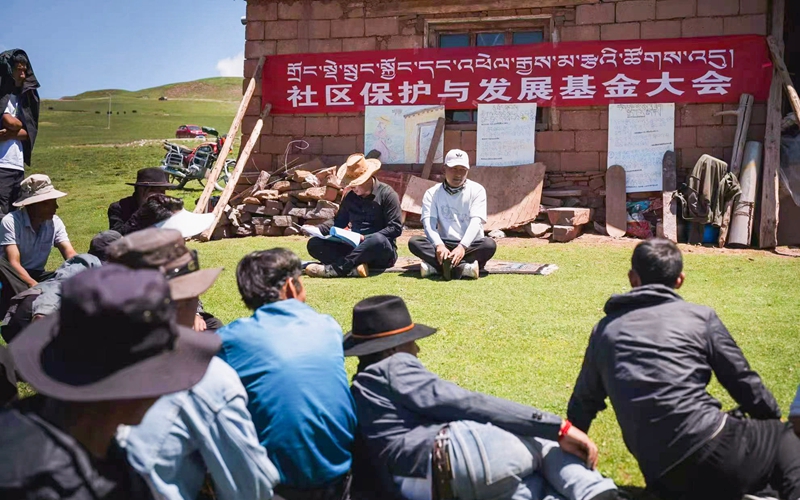 Stakeholders discuss the establishment of a community-based fund to mitigate human-bear conflict in Yushu Tibetan Autonomous Prefecture (COURTESY PHOTO)
Tug‑of‑war In 2021, field research in Qinghai conducted by the Public Interest Litigation Department of the Supreme People's Procuratorate (SPP), China's prosecutorial authority, found that as ecological and wildlife conservation yielded growing results, mitigating human‑bear, human‑wolf and other human‑wildlife conflicts had emerged as a pressing governance challenge. "China has advanced the development of a nature reserve system centered on national parks, effectively safeguarding 90 percent of terrestrial ecosystem types and 74 percent of key wildlife species. Most protected species have seen notable population recovery, and biodiversity levels keep rising," Han Rong, an associate professor at the Department of Sociology and Ecological Civilization, the Party School of the Communist Party of China Central Committee (National Academy of Governance), told newspaper The Procuratorate Daily. Han has documented in her fieldwork that run‑ins with predatory animals are not limited to Qinghai and Xizang Autonomous Region. Similar incidents are unfolding in Inner Mongolia Autonomous Region and Heilongjiang Province that serve as vital habitats for large wildlife. In provinces in east China such as Jiangsu and Zhejiang, wild boar populations have surged, with densities far exceeding natural baseline levels in some areas. Yin Hang, Executive Director of the Qinghai Gangri Neichog Research and Conservation Center, has been drawn to wildlife since childhood. An ecology major in university, she later settled in Sanjiangyuan to devote herself to conservation work on the plateau. The Sanjiangyuan area contains the headwaters of China's three major waterways, the Yangtze, Yellow and Lancang rivers. Today, she also serves as a volunteer of prosecution services, bridging local ecological knowledge with legal advocacy. Yin traces the roots of the problem to a profound shift in local lifestyle. For generations, herders on the plateau moved with the seasons, but as settlements became permanent, so did the waste they left behind. In winter, in particular, open-air dumps in villages became brown bears' dinner tables. Before 2000, herders carried shotguns for protection, and bears kept their distance. After guns were banned, people turned to firecrackers to scare off any intruders. It worked for a while, until the bears realized there was no real threat behind the noise. Xiawu Zhuoma, a deputy to the National People's Congress, China's top legislature, spent considerable time visiting herding communities across the plateau, listening to their grievances about wildlife-related losses and tracing the root causes of recurring conflicts. She has much confidence in procuratorial public interest litigation, considering it a crucial mechanism for striking a human-wildlife balance. "This is not a zero-sum choice between protecting wildlife and safeguarding people's livelihoods," she said, stressing that the rule of law is the way to reconcile the two. The procuratorates in Qinghai's Chindu and Zhidoi counties moved swiftly and urged related authorities to take immediate action, including the installation of safety warning signs and pulse-operated electronic fences, through pre-litigation consultations and formal procuratorial recommendations. Yin explained that the fences work through psychological deterrence rather than physical harm, warning bears to keep their distance without inflicting injury. The results have been promising: At landfill sites equipped with pulse fences, an 80-percent deterrence rate was achieved while the system was active, effectively severing the bears' dependence on manmade garbage as a food source. A new compact In May 2022, prosecutors in Zadoi County identified 10 public interest litigation leads related to human-wildlife conflicts across their jurisdiction. Brown bear intrusions were widespread, yet in many areas, local governments had failed to adequately communicate their wildlife damage compensation policies, leaving residents without sufficient protection for their safety and property. In June of that year, prosecutors in Yushu uncovered similar shortcomings in eight townships, where compensation mechanisms remained largely ineffective. In August 2025, procuratorial inspections in Qumarleb County, particularly around monasteries where tourists and herders converge, revealed a lack of frontline preventive measures against human-bear encounters, posing serious safety risks. In response, prosecutors turned to public interest litigation to prompt concrete improvements. Zadoi secured a dedicated fund for conflict mitigation and purchased wildlife accident liability insurance for more than 70,000 herders across the county. Yushu and Zhidoi launched bilingual campaigns in Tibetan and standard Chinese, covering bear prevention tips and the claims process for insurance payouts. Qumarleb distributed bear spray to surrounding communities. For Han, the legal process itself can be infused with a degree of soft governance. For example, before filing lawsuits, prosecutors can convene consultations and public hearings, bringing herder representatives, conservation organizations, government agencies and scholars to the same table. This judicially driven approach transforms litigation into a platform on which local voices are heard, collective wisdom is tapped and differences are bridged. It resonates deeply with the philosophy behind the Smart Bear Community model. The plateau carries a rich heritage of nomadic traditions and ecological wisdom. In the oral narratives of local elders, brown bears were once revered as masters of the land. The Smart Bear Community model reframes the bear not as a mere symbol of threat, but as an integral part of the region's cultural identity. Even more nuanced is the establishment of community-based bear management funds and contractual mechanisms. Under this arrangement, herders contribute 10 to 15 percent of the costs and sign maintenance agreements. The protective infrastructure is no longer something given to them by outsiders, but something they build themselves. As a result, when bears do cause damage, residents are not merely waiting for compensation. Instead, through a series of proactive measures, they transform human-bear conflicts into opportunities for community-driven development. Rule of law If community engagement forms the first line of defense in human-bear coexistence, then the rule of law is what keeps that defense unbreakable. According to Han, when brown bears and other animals pose a serious and immediate threat to herder lives and property, prosecutors step in through public interest litigation to push local governments toward establishing comprehensive early warning, protection and compensation systems. This approach holds the local government accountable for its statutory duty to safeguard public safety, ensuring that compensation reaches those who need it and that protective fencing projects are implemented as intended. In July 2022, the People's Procuratorate of Qinghai, together with the provincial public security department, forestry and grassland authorities, as well as the administration of the Sanjiangyuan National Park, signed a collaborative framework agreement. The document was designed to strengthen coordination between administrative enforcement and procuratorial public interest litigation in addressing human-wildlife conflicts within the Sanjiangyuan and Qilian Mountain (Qinghai section) national park areas. Recent figures speak to the power of legal oversight. Over the past five years, procuratorates in Yushu have handled 26 human-wildlife conflict cases, resulting in the installation of 191 warning signs, the repair of 22 protective facilities and regular patrols in high-risk areas. This is a picture of multi-stakeholder governance, with prosecutors working alongside local communities, conservation organizations and government agencies. Moving from individual case handling to systemic oversight, the procuratorate's involvement has driven deeper institutional improvements at the national governance level. With the help of volunteers, the Public Interest Litigation Department of the SPP has adapted Qinghai's human-bear conflict resolution model to the Tibetan context, translating it into actionable litigation with encouraging early results. Procuratorates in Xizang's Bomi and Banbar counties have already taken up similar cases. In September 2025, the Banbar County People's Procuratorate led a coordinated effort with local natural resources and forestry authorities to address the bear intrusion problem and prevent further attacks on residents. What makes this approach stand out is its collaborative nature, bringing together different government departments, specialized institutions and community stakeholders, showcasing the shared governance philosophy that lies at the heart of modern environmental stewardship. Since taking effect on August 15, China's Ecological and Environmental Code has introduced a comprehensive framework covering wildlife population regulation for biodiversity, ecological compensation and commercial insurance compensation to address the growing friction between humans and wildlife on the Qinghai-Xizang Plateau. "The Ecological and Environmental Code places strong emphasis on safeguarding public health and ecological interests, and on promoting ecological conservation. This gives procuratorial organs a much firmer legal foundation to tailor their public interest litigation efforts to local conditions in addressing human-wildlife conflict," Qiu Jinghui, Deputy Director of the Public Interest Litigation Department of the SPP, said. The procuratorates in Qinghai, Xizang and other regions will be guided to work alongside state agencies and social organizations, striking a careful balance between development and protection, and between development and security. The goal is to steadily improve the quality and effectiveness of public interest litigation in human-wildlife conflict governance, and to advance the broader vision of harmonious coexistence between humanity and nature. The exploration of human-bear coexistence on the Qinghai-Xizang Plateau stands as a successful example of community governance in areas surrounding natural heritage sites under the Other Effective Area-based Conservation Measures framework, while also offering replicable lessons for resolving human-wildlife conflicts worldwide. Other Effective Area-based Conservation Measures, recognized under the UN Convention on Biological Diversity, are lands that maintain healthy ecosystems through ongoing human management. "This case does not frame humans and bears as adversaries in a zero-sum game. Instead, through scientific research, community co-management and technological innovation, it seeks a balance where both can thrive. This sends a powerful message to the world that conservation and development are not locked in binary opposition, and that harmonious coexistence is truly achievable," Han said. (Printed Edition Title: Sharing the Land With Bears) The author is a reporter for The Procuratorate Daily newspaper Copyedited by Elsbeth van Paridon Comments to liqing@cicgamericas.com |
|
||||||||||||||||||||||||||||||
|