
|
| China |
| Hunan after hours | |
|
|
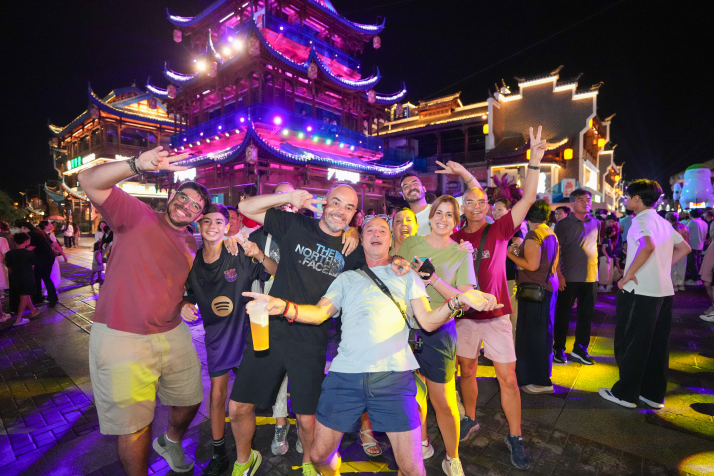 Spanish tourists pose for a photo at Dayong Ancient City in Zhangjiajie, Hunan Province, on August 14 (XINHUA)
Step into Changsha, the capital of Hunan Province, well past midnight and you will find a metropolis that is not winding down, but just getting started. Traffic is still jammed at 1:00 a.m. By 2:00 a.m., the line outside a snack shop snakes around two full corners. Neon signs cut through the midnight haze, illuminating a crowd that shows no sign of slowing down. As one netizen puts it: "Coming to Changsha means you literally have to deal with jet lag without ever leaving the time zone." As one of China's premier night-economy hubs, Changsha has turned its after-dark scene into a thriving industry and a hallmark of the city's identity. "Nighttime spending accounts for 64 percent of the city's daily consumption, supporting over a million flexible jobs," Shen Yumou, head of the Department of Commerce of Hunan, told reporters on August 10. "While many Chinese cities quiet down by 10 p.m., Changsha hits its peak spending hour at that exact time, with crowds flooding the streets." He added that over the past decade, Changsha has seen a net inflow of 1 million people, providing a major boost to its core consumer base. 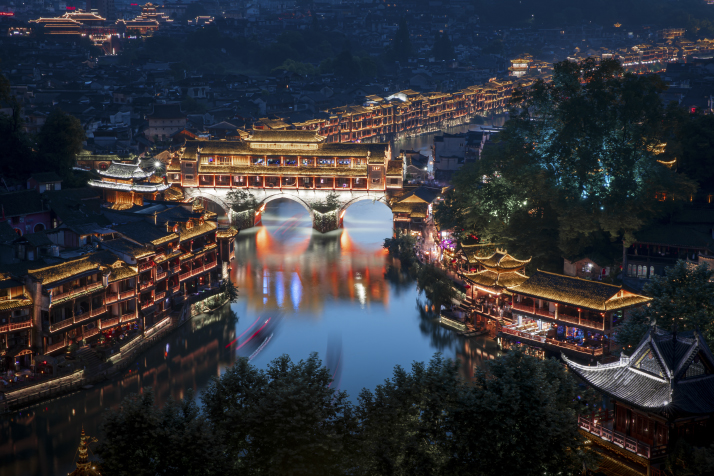 Nighttime view of Fenghuang Ancient Town, Hunan (COURTESY PHOTO) The night-owl rhythm With long, oppressive summers, Changsha's climate shapes every contour of daily life. The suffocating heat has forged both a fierce local appetite for bold, spicy flavors and a nocturnal habit among the youth, who retreat indoors by day only to spill into the streets long after the skies have turned dark. The result is a city operating on a collective night-owl rhythm. "In Beijing, I usually stay home at night. But as soon as I get to Changsha, I automatically shift into nightlife mode—it's just so lively here after dark," a Beijing tourist told Beijing Review. Night markets saturate the city in every shape and scale, anchored along avenues or quietly hidden within a web of narrow alleys. As dusk falls, the air blows thick with the intoxicating aromas of sizzling skewers, fragrant broth and crispy fried delicacies, drawing crowds to bustling stalls beneath glowing neon lights.
Venues like foot massage parlors and KTV venues run around the clock, and customers can choose to sleep overnight right on the massage tables. Patrons can feast on spicy local rice noodles and, if a customer craves it, the staff will sprint down the street to fetch a fresh cup of Chayan Yuese, a well-known local milk tea brand. Indeed, a visit to this homegrown boba brand is essential for almost every traveler, with outlets gracing nearly every corner of the city. Changsha has thoughtfully curated a booming night economy. This summer, the Hunan Museum launched its Night at the Museum series, featuring a virtual reality experience that draws inspiration from artifacts excavated at the Mawangdui Tombs, an archaeological site in Changsha dating back to the Han Dynasty (202 B.C.-A.D. 220). Running parallel to these visual attractions, traditional tea houses and intimate small theaters are flourishing across the city. According to the Department of Commerce of Hunan, Changsha's small theaters have achieved a clear cluster effect, hosting over 50 daily performances embedded directly into commercial districts and neighborhood corners. A standout attraction is Changsha, an immersive, interactive street play produced by the Hunan Provincial Drama Theater. Performed predominantly in the local dialect, the play chronicles two decades of urban transformation and everyday life from 1992 to 2012 through the eyes of ordinary residents. "Although a significant portion of the play is in the Changsha dialect, nearly half of our audience consists of tourists from outside the province—some even travel to Changsha specifically for the show," cast member Qu Lan told Beijing Review. 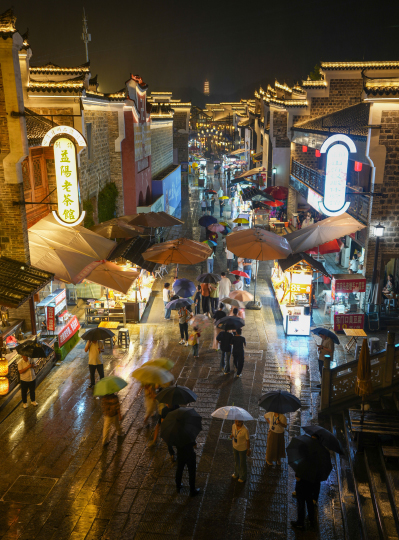 A historic and cultural district in Yiyang City, Hunan, on August 12 (XINHUA)
Flowing illumination Changsha is by no means the only place in Hunan that boasts a lively night scene; the energy extends far beyond the capital. Crisscrossed by four major river systems, most cities in the province grew up along waterways. These rivers thread through urban centers, infusing them with dynamic energy and creating rich possibilities for nighttime culture and commerce. In Changde, an immersive, site-specific theatrical production takes place every evening along the Chuanzi River as it meanders through the city. Spectators first don life jackets and board boats to take in the performance from the water, then step ashore to follow actors through historic lanes and alleys, before finally gathering in an intimate theater to watch the final act. Moving from boat to street to stage, audiences experience the story through the characters' eyes, tracing Changde's transformative history from 1921 to 1945. Blending state-of-the-art 3D holography with advanced lighting and audio design, the show places visitors directly inside the narrative, turning onlookers into active participants in history. In Furong Town, located in the Xiangxi Tujia and Miao Autonomous Prefecture in west Hunan, nighttime visitors now account for 70 percent of total tourists. The historic town, which first captured national attention through the acclaimed 1987 film of the same name, once struggled with the growing pains of early tourism development. "Eight years ago, it was a completely different place," recalled Zhong Fei, Chairwoman of Huaxia Investment Group, the firm behind the town's revitalization. "After 5:30 p.m., the shops would close one by one, and the town would fall silent." In 2018, the town launched a comprehensive revitalization campaign, beginning with a dramatic transformation of its nightscape: mounting decorative lighting on traditional stilted houses, illuminating its iconic waterfall and burying power lines beneath the flagstone streets. Every evening at 7:30, the waterfall and the stilted architecture light up in unison, casting a golden glow over the entire settlement. Alongside these aesthetic upgrades came sweeping infrastructure improvements, including upgraded drainage systems and the removal of unauthorized structures. Nighttime operations were standardized, extending operating hours from 6 p.m. to midnight. Through it all, local residents have maintained their traditional way of life—shopping in the morning market, running family shops in the afternoon and visiting neighbors after dusk. As tourists wander the stone pathways, everyday local life unfolds right beside them. "The performances, business operations and consumer spaces are all ultimately designed to help visitors slow down, stay and immerse themselves in the local atmosphere," Zhong added. Also located in west Hunan, Fenghuang Ancient Town comes alive most vibrantly after dark. The town boasts over 2,800 commercial venues, more than 98 percent of which remain open through the evening. During the peak summer season, tourists fill the streets each night in a bustling display of local night energy. Built along the Tuojiang River, the historic town invested over 50 million yuan ($7 million) to launch an immersive night cruise that blends lighting technology with Miao ethnic traditions, making it China's first river tour structured around a Miao cultural narrative. As boats glide along the Tuojiang, passengers are immersed in local heritage as animated water-screen displays showcase classic Miao ethnic customs, including traditional weddings, batik craft and the pounding of glutinous rice cakes. Equipped with satellite positioning systems, the vessels enable visitors to interact with the performance via their mobile devices in real time—projecting digital animations of phoenixes, egrets, sky lanterns, fishing boats, butterflies and koi fish onto the water's surface, elevating the evening into an interactive, multi-sensory spectacle. 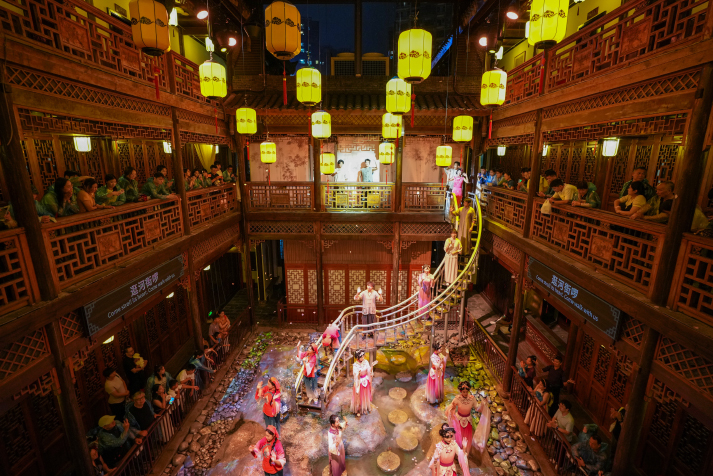 An immersive performance in Changde, Hunan, on August 13 (XINHUA)
Cultural afterglow Intangible cultural heritage (ICH) forms a defining feature of Hunan's vibrant nightlife, and blending heritage crafts with the night economy has become a standout driver of the province's tourism. Over 80 ICH projects line Changde's historic Hejie (River Street). A traditional heritage theater is set up on the street to stage multiple cultural performances daily, with young people making up more than half the audience. During this year's May Day holiday on May 1-5, Hejie introduced a "Traditional Chinese Medicine (TCM) Street," drawing crowds of visitors to try AI-powered TCM health consultations, cupping therapy and therapeutic massages. In the historic Ming (1368-1644) and Qing (1644-1911) alleyways of Yiyang City, 14 ICH traditions have found a home. Wang Qingyun, a provincial-level master of Dongting wood carving, made an important business pivot here. He extended his studio's hours into the evening and launched an end-to-end experience combining visual art, hands-on craft workshops and cultural retail. To appeal to younger audiences, he began incorporating popular modern cartoon characters into his traditional woodcarvings. Nighttime revenue now accounts for more than 60 percent of his income, driven by steady sales of creative ornaments and DIY crafting kits. Just a few dozen meters away sits the studio of Sheng Lan, a sixth-generation practitioner of Yiyang Tanci (a traditional form of musical storytelling). Sheng recalled that during the 1960s and 70s, Tanci was a staple of neighborhood teahouses, deeply woven into daily life, but it nearly faded away as teahouses went out of business. The district's campaign to integrate ICH into tourism destinations aligned perfectly with her vision to revive the art form. She said she believes that embedding cultural heritage into scenic spots not only exposes travelers to local heritage, but also gives the art form a wider, more dynamic audience. "Spectators can enjoy up-close performances, and interested visitors can even learn a line or two, offering them an immediate, hands-on connection with the living tradition," she said. In Zhangjiajie, ICH is connecting with younger generations in an even more dynamic way. Every year, the Zhangjiajie National Forest Park, a world-renowned destination, attracts millions of domestic and international visitors. To provide these travelers with an engaging venue after the park closes for the day, the newly renovated Dayong Ancient City was brought to life. The Hunan Broadcasting and Television Group partnered strategically with Zhangjiajie to design a nighttime paradise tailored for youth. By integrating popular variety show intellectual properties and creative night markets, the district offers an immersive experience. Here, young visitors can try their hand at making the traditional brocade of the Tujia ethnic group or use 3D printing and augmented reality technology to create their own traditional art, making heritage interactive and fun. "Our goal is to make ICH more entertaining and youthful, embrace the younger generations and consistently offer them meaningful emotional value," Zhou Yang, General Manager of Zhangjiajie Mango Cultural Tourism Co. Ltd., said. (Reporting from Hunan Province) Copyedited by Elsbeth van Paridon Comments to yuanyuan@cicgamericas.com |
|
||||||||||||||||||||||||||||
|