
|
| China |
| How Yiwu builds a global marketplace | |
|
|
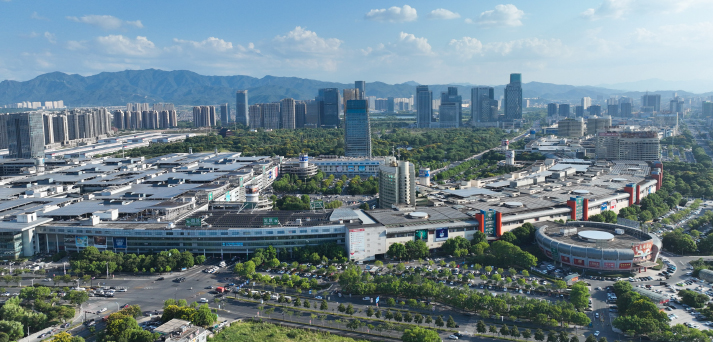 The Yiwu International Trade Market in Yiwu, Zhejiang Province, on September 6, 2024 (XINHUA)
When overseas buyers visit Yiwu in Zhejiang Province, they usually arrive with a specific purpose: finding products that can be sold thousands of kilometers away in their home countries. A buyer from the Middle East may be comparing different styles of umbrellas. A European importer may be looking for Christmas decorations months before the holiday season begins. Inside the Yiwu International Trade Market (YITM), the world's largest wholesale market for small commodities, these buyers can move from one supplier to another, compare designs, negotiate prices and arrange shipments within days. The city has earned the nickname "the world's supermarket" because its small commodities have reached markets across more than 200 countries and regions. Home to a population of around 1.9 million, Yiwu's economy is built around hundreds of thousands of wholesalers, manufacturers, logistics companies and service providers that together form one of the world's most active trading networks. The evolving market Yiwu's connection with trade began long before overseas buyers started arriving at its marketplaces. For generations, residents of this small city made a living through petty commerce. The most famous example was the practice known as "chicken feathers for sugar," in which local traders exchanged sugar for collected chicken feathers that could later be processed into fertilizer. The practice can be traced back to the Ming and Qing dynasties (1368-1911), and the trade helped establish a habit of traveling for business, finding buyers and responding to changing demand. That tradition continued as Yiwu entered a new era of economic development. As China's market reforms, launched in late 1978, opened more opportunities for private businesses, thousands of local residents began selling small commodities at street stalls and temporary markets. Over time, these scattered trading spaces evolved into larger and more organized marketplaces. According to Yiwu's Market Development Commission, a government body overseeing market, e-commerce, logistics, port and exhibition affairs, the city's market infrastructure has undergone six relocations, 13 expansions and six rounds of upgrading. What began as a local trading venue has evolved into a global marketplace covering more than 8 million square meters, with more than 80,000 booths and over 2.1 million types of products. At the core of this development is YITM, operated by the Yiwu China Commodity City Group. The market provides a place where merchants can display products, meet buyers and connect with supply chains. Over the years, its role has expanded from managing physical market spaces to providing broader trade services, including digital platforms and business support. Foreign buyers can find translation assistance, logistics services, customs support, business consultation and financial services all within the market. Through Yiwu's international trade service platforms, overseas buyers can handle procedures such as foreign exchange settlement more conveniently. The latest stage of Yiwu's development is focused on building what local authorities describe as a "sixth-generation market." The concept is rooted in the integration of traditional market advantages with digital technologies and emerging trade models. Through platforms such as Chinagoods.com, merchants can display products online and communicate with buyers overseas. Cross-border e-commerce and AI tools are also becoming part of daily operations. The underlying enterprising spirit Behind Yiwu's international reputation are generations of entrepreneurs who have learned how to serve customers across different cultures and markets. Jiang Jiangping, owner of a Christmas product store in YITM, entered the industry in 1998, when Yiwu was still developing its global presence. He has witnessed the evolution of the local industrial chain over nearly three decades. The Christmas business requires careful timing. Products need to be designed, produced and shipped before seasonal demand arrives. Customer preferences also change quickly, requiring merchants to introduce new designs while retaining popular products. For Jiang, the ability to respond quickly is one of Yiwu's greatest advantages. "We can complete the process from design to shipment within half a day," Jiang told Beijing Review. Currently, his business serves customers from Europe, the Middle East, Africa and Latin America. The competitiveness of Yiwu merchants comes from staying close to the market. Zhang Jiying has built her umbrella business through years of engaging with overseas buyers. Having welcomed customers from more than 170 countries and regions, she has a deep understanding of how product design is often shaped by cultural preferences. "Customers from different countries have different tastes," Zhang told Beijing Review. "For example, Saudi buyers prefer white and green umbrellas, while many European customers favor simpler colors such as navy, gray and black. Russian customers, however, often opt for brighter, floral designs." At the same time, a younger generation of entrepreneurs is expanding their business horizons. Wang Jiacheng grew up in a family that undertook contract manufacturing for overseas underwear brands. As competition intensified and profit margins narrowed, Wang began looking for a new direction. "We used to have meat to eat. Now there's hardly even soup left," he said. He now sells smart farming equipment and agricultural drones at YITM. To help customers understand the products, Wang leases a rice field where they can watch drones perform tasks such as spraying, sowing and applying fertilizer. Beyond his current business, Wang has even greater ambitions. OEM stands for original equipment manufacturer, a company that produces parts or products to be sold under another company's name. "OEM and contract manufacturing are Yiwu's past. Building our own brands is the key to future survival and growth," Wang said. For him, the transition is challenging, but success ultimately translates to greater control over products, services and long-term relationships with customers. 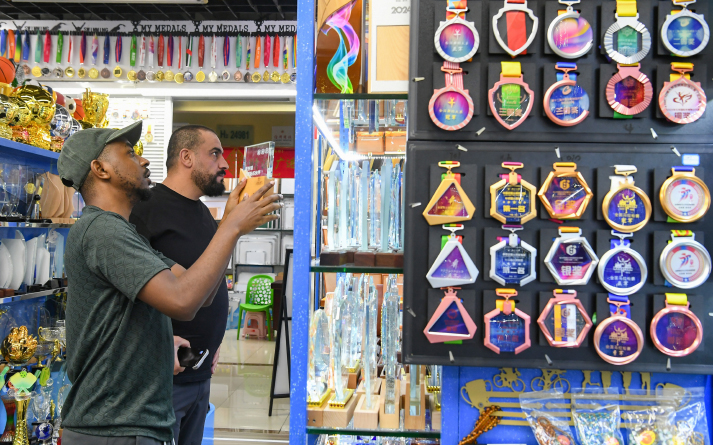 Buyers browse sporting goods at the Yiwu International Trade Market in Yiwu, Zhejiang Province, on September 15, 2025 (XINHUA)
Building an ecosystem A thriving marketplace depends on more than merchants and products. Yiwu's development has been supported by a wider ecosystem involving government services, industry organizations, educational institutions and an international business community. Government departments have been dedicated to cultivating a robust business climate where enterprises can thrive. By coordinating resources across trade, logistics, exhibitions, digital platforms and international services, they are committed to helping local businesses navigate new challenges and maintain connections with global markets. Cross-border e-commerce has become an important area of development. Many traditional merchants built their businesses through face-to-face transactions, but online platforms have changed how global trade works. The Yiwu Cross-Border E-Commerce Association helps businesses adapt through training, platform connections and technology services. For small businesses, digital transformation can be hard. Necessary practices such as promoting products online, creating customer profiles and introducing cutting-edge sales tools all require constant learning. Industry organizations provide support that allows merchants with traditional backgrounds to acquire new skills. Yiwu Industrial and Commercial College is dubbed as a "university built on the market." Its entrepreneurship programs are designed around real-world business practice, which allows students to learn international trade, e-commerce and business operations through direct market participation. The college has also developed a full pathway for international students who want to start businesses in China. After learning Chinese language, culture and business-related policies, graduates will receive support for entrepreneurship, including company registration, work permits, resource matchmaking and skills training. In 2022, the college launched an international youth entrepreneurship incubation base to serve as a launchpad for foreign entrepreneurs. By 2025, 47 student-founded companies had been registered there, generating annual revenue of 300 million yuan ($44 million), according to Lu Jun, Deputy Director of the School of International Education at the college. Kamalou-Dine Adissa Akinocho, a student from Benin, is a prime example of this initiative's success. While studying in Yiwu, he founded an import and export company that supplies Chinese hardware and small commodities to African markets. His business now reaches customers in five countries including Benin, the Republic of the Congo and Burundi. "Partners trust my company because the registered address is inside the college," he said. The college has also adjusted its training programs as Yiwu moves deeper into digital trade. Its cross-border live-commerce (a combination of live-streaming and e-commerce that allows consumers to interact with brands and purchase products in real time) courses allow students to work with real products, online accounts and supply chains provided through cooperation with business partners. Students also hone their livestreaming skills at Yiwu International Trade Market, where they introduce products directly to global audiences. "We hope to help international students become entrepreneurs who have the confidence, willingness and adeptness to start businesses," Lu emphasized. (Print Edition Title: Beyond Small Commodities) (Reporting from Yiwu, Zhejiang Province) Copyedited by G.P. Wilson Comments to liwenhan@cicgamericas.com |
|
||
|
||||||||||||||||||||||||||||
|