|
| China |
| Into one another's worlds | |
|
|
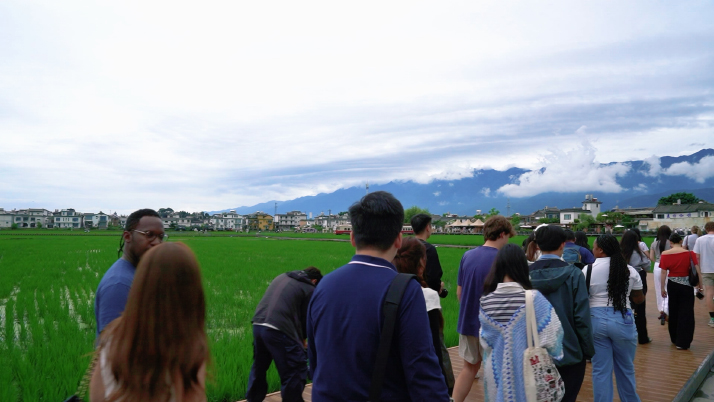 Chinese and U.S. delegates walk along a rice paddy in Xizhou Ancient Town of Dali Bai Autonomous Prefecture, Yunnan Province, on July 19 (ZHANG WEI)
In Dali Bai Autonomous Prefecture in the southwestern Chinese province of Yunnan, local authorities have pursued a long-term strategy to restore Erhai Lake, a highland freshwater lake designated for priority national protection, while maintaining the economic viability of surrounding agricultural communities. Through targeted environmental policies, farmers are treated as partners rather than simply policy recipients. Partnership among governments, universities, researchers and rural communities have enabled local residents to adopt more sustainable practices while maintaining their income. To Cecil Brooks, the initiative demonstrates how seriously the Chinese people take their environment and how ethnic minority communities maintain cultures that keep them deeply connected to the land. "All these things made me challenge my initial perceptions and find more things to appreciate about the country," he said. Brooks visited Dali as part of the 2026 Across the Pacific: China-U.S. Youth Dialogue for a Shared Future, a three-week cross-cultural exchange program that took place from July 3 to 23. Co-hosted by the China International Communications Group Center for the Americas and the U.S.-based International Student Conferences, the event brought together young delegates from China and the United States to explore common challenges and potential pathways for cooperation in education, technology, agriculture and cultural communication. At the closing ceremony in Beijing on July 23, the participants presented their findings from panel discussions, interviews and field research conducted along the way. Drawing on their firsthand experiences, they examined issues ranging from AI's impact on critical thinking and learning to the challenges facing rural households and the role of cultural exchange in international relations. They believe that while China and the U.S. have different approaches to tackling these issues, many concerns are shared and require continued dialogue and collaboration. Thinking alike During the program, the students visited the Chongyang Institute for Financial Studies at Renmin University of China in Beijing, where they participated in panel discussions with resident scholars on topics including the use of AI. Yi Yingnan, a researcher at the institute, said China's technological development has always been driven by a commitment to inclusiveness. He noted that the rapid expansion of mobile payments, food delivery services, agricultural assistance programs and accessible healthcare and education reflects the country's consistent push toward inclusive technology that benefits society. Brooks told Beijing Review that he has learned how people in China are using technology, especially AI, to address social issues. The student got a firsthand look at how Chinese technology works in everyday life. He noted that "technologies connect people in China, and that can be a very informative model for what the rest of the world can do with technologies and how much they can connect other people around the world." An over-reliance on AI proved a common concern for both countries. According to the young delegates, universities in both China and the U.S. are adopting AI tools while grappling with challenges such as academic integrity, misinformation and independent thinking. "This isn't an American or a Chinese issue. This is a global issue," Branson Chi, an undergraduate student from the U.S., said at the closing ceremony, noting that technology has brought people together, and it is a global responsibility to make sure that technology continues to do so. The participants also examined the challenges facing rural households in Montana and Yunnan, focusing on how agricultural communities are adapting to climate change, environmental policies and shifting economic circumstances. Both countries are seeking to balance productivity with environmental sustainability, although their approaches differ considerably. In the U.S., agricultural policy operates through a federal-state-local framework, while China's agricultural governance is a multi-level system linking national strategies with local implementation, according to their research findings. Climate change is a major challenge for farmers in both regions. Liu Yajing, a Chinese student native to Yunnan and majoring in agriculture, said at the closing ceremony that she had interviewed many local farmers throughout the trip in Yunnan. "They rotate crops, leave farmland fallow properly and protect mountain water sources to keep the soil fertile. But old methods cannot fight natural disasters well," she said. According to Liu, local farmers are trying to merge traditional paths with modern, eco-friendly techniques to keep their land productive. 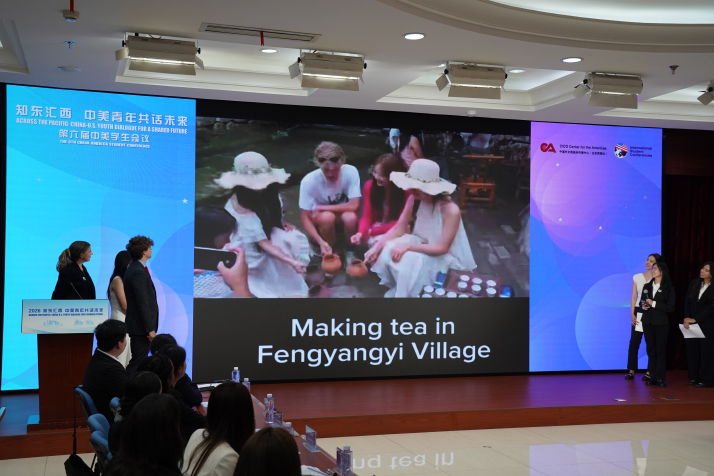 Delegates from China and the United States present their research findings at the closing ceremony of the 2026 Across the Pacific: China-U.S. Youth Dialogue for a Shared Future in Beijing on July 23 (ZHANG WEI)
Bridging cultures The students also explored how everyday interactions can promote mutual understanding, with major channels including food, trade and social media. According to Chinese student Huang Ziqing, conversations about food can naturally lead to deeper discussions about traditions, family values and cultural identity. "When it comes to intercultural communication, food is often the first thing that comes to mind. Like a window, it offers a chance for people to ask questions and share stories," she said. Social media is another arena for interaction across cultural boundaries. Users in China and the U.S. are diving deeper into the other side's online trends involving fashion, food, music and so on. "Intercultural communication extends beyond formal diplomacy and is embedded in everyday experiences," Valerie Marie said. Chinese student Bai Yiwen noted that young people in both China and the U.S. are increasingly learning about each other's cultures through social media. Earlier this year, a trend called "I'm in a very Chinese time of my life" went viral in the U.S., with social media users imitating some Chinese daily habits like drinking warm water instead of ice water. "Social media allows users to recreate each other's trends and learn about diverse cultures," Bai said, adding, "It gives us a glimpse into what life looks like on the other side of the world." The youth dialogue planted seeds of understanding that will outlast the journey itself. Student Evelyn Neff said she realized that, even though a language barrier exists, she has much in common with her Chinese peers. "When it comes down to it, we all love to listen to music, watch movies or chat about what goes on in our daily lives. Even the small things can unite us," she said. Following the three-week journey, Chinese participant Liu Yuxuan felt a deeper connection with her U.S. peers. She said that experiencing America's diverse cultures was her greatest takeaway, and that U.S. and Chinese youth have far more in common than they might expect. "I believe that misunderstandings and perceptions can only be changed through real experience," she said. "That's how we gain new insights." BR Copyedited by Elsbeth van Paridon Comments to lixiaoyang@cicgamericas.com |
|
||||||||||||||||||||||||||||
|