
|
| China |
| Rail on the Roof of the World | |
|
|
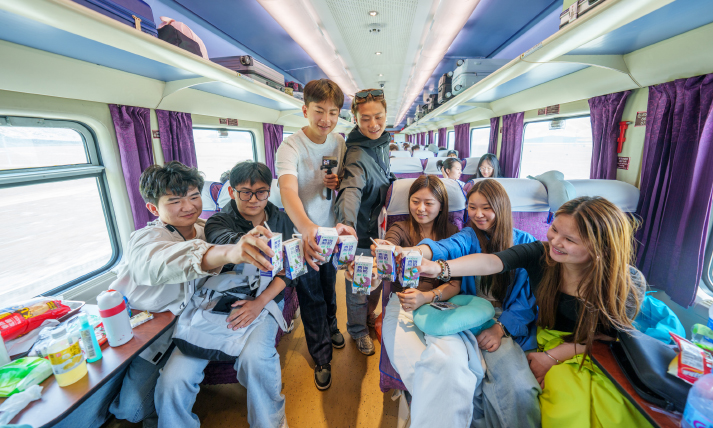 Passengers on a train to Lhasa toast with packs of yoghurt, enjoying their journey on the Qinghai-Xizang Railway, on June 14 (XINHUA)
On a remote stretch of the Qinghai-Xizang Plateau, Pingcuo Langjie gazes at the horizon, ready to salute the train as it roars into view. The salute is a ritual—one he has performed for every passing train along the 52-km section of track he has guarded for the last 20 years.
For him, the gesture bridges past and present: a tribute to the workers who braved the permafrost, a nod to those who had died before the line opened 20 years ago, and a warm greeting to the passengers inside the trains. The line is the Qinghai-Xizang Railway, 1,956 km of pure engineering audacity linking Xining, capital city of Qinghai Province, to Lhasa, capital city of Xizang Autonomous Region. Upon its completion in 2006, the line redefined the limits of infrastructure, setting records as the highest railway on Earth, the longest plateau line, and the home of the world's highest-altitude station. Two decades later, those records still stand unchallenged. A native of Xizang's Amdo County in Nagqu City, Pingcuo Langjie is one of 157 guardians managing a treacherous stretch that averages 4,700 meters in elevation, an altitude at which the air is agonizingly thin for outsiders. 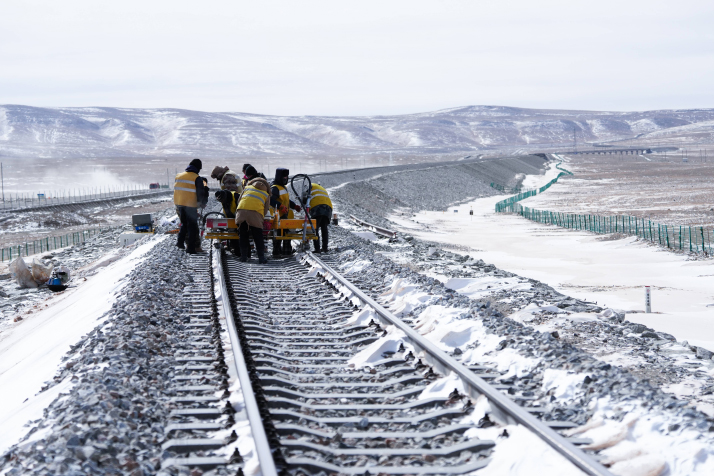 Employees of China Railway Qinghai-Xizang Group Co. Ltd. carry out maintenance work on the railway in the hinterland of the Kunlun Mountains on February 6 (XINHUA)
The battle beneath the tracks To know of the immense difficulties in building these tracks is to understand the true weight of the guardian's salute. At its inception, the railway was stalked by three formidable enemies: fragile ecosystems, suffocating alpine oxygen levels, and, most precarious of all, permafrost. Roughly 960 km of the line sits above 4,000 meters, where the air holds just 60 percent of the oxygen found at sea level. For about 550 km, the tracks run over frozen ground so sensitive to temperature that the slightest warming could cause the entire foundation to sink. Permafrost is a shapeshifter; it expands and contracts as ice thaws and refreezes, destabilizing anything built upon it. "Conventional permafrost engineering relied on insulation—raising embankments and adding protective layers to shelter the ground from heat," Ye Yangsheng, Chief Engineer of China State Railway Group, told the People's Daily newspaper. But in a warming global climate, passive defense against heat wasn't enough. "Ice cannot be preserved indefinitely by simply covering it with a blanket," Ye said. The breakthrough was an unprecedented shift from passive insulation to active cooling. To pull heat out of the ground rather than just blocking it, engineers turned to a technology never before attempted on this scale: thermosiphons, commonly known as "heat pipes." Each heat pipe is a 12-meter metal rod, with nine meters buried deep within the frozen earth and three meters protruding into the open air. Inside, a core of liquid ammonia boils at an incredibly low temperature. When the plateau air turns freezing, the liquid vaporizes and ascends; as it hits the cooler exposed top, it condenses, releases its trapped heat into the air, and trickles back down. This continuous loop effectively acts as a subterranean refrigerator, pumping warmth out of the earth to keep the permafrost frozen. The breakthrough catapulted China to the forefront of global permafrost engineering. Today, that innovation has entered its second generation: solar-powered heat pipes. By harnessing the plateau's piercing solar radiation and sharp day-to-night temperature swings, the upgraded system achieves combined photothermal cooling. "This means these solar-assisted pipes can operate year-round, boosting cooling capacity by 1.5 times over conventional pipes, all while remaining entirely zero-carbon," said Liang Dong, Secretary of the Communist Party of China Committee of the Northwest Research Institute of China Railway Group Ltd. More than 37,000 of these pipes now stand like silent sentinels across the snowy plateau, anchoring the embankment for the last two decades. Because of them, trains still glide through these volatile permafrost zones steadily at 100 km per hour, the fastest speed on Earth for a railway built on frozen ground. The impact of the technology has radiated far beyond Xizang. The experiences gained on the roof of the world laid the exact groundwork needed to conquer similar permafrost challenges years later to build the high-speed rail networks that now cut across northeast China. Beyond the shifting ground, the thin alpine air also posed a mortal threat. To combat severe oxygen deficiency during construction, the project established 17 oxygen-generating stations and 25 hyperbaric chambers along the route, spacing out medical clinics every 10 km. No worker was ever more than a half-hour away from life-saving care, and all 40,000 construction workers were required to inhale oxygen for at least two hours a day. The same protective cushion has been extended to travelers on the line. To keep acute altitude sickness at bay, every carriage is armed with a dual-layer oxygen system. The first is a diffuse oxygen supply system resembling a central air system that keeps the overall cabin oxygen at over 80 percent of that at sea level. For passengers who still feel the mountain air taxing their lungs, individual oxygen masks are built directly into every seat for immediate, direct relief. And in preparation for emergencies, a doctor and nurse ride aboard every single train, patrolling the aisles to identify passengers in need of medical care. 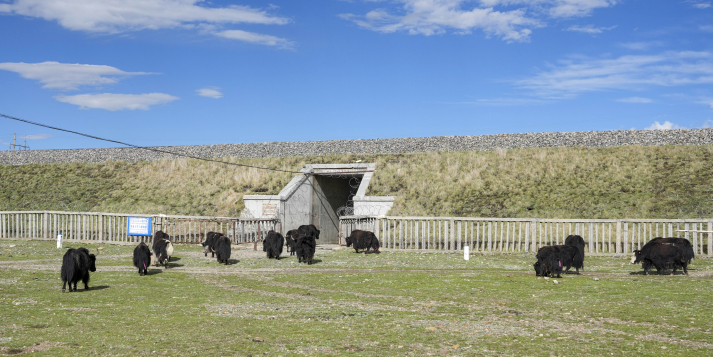 Yaks pass through a culvert on the Qinghai-Xizang Railway in Seni District of Nagqu City in Xizang on June 18 (XINHUA)
Sky-rail guardians Due to the plateau's volatile geography and brutal climate, the railway's survival has always hinged on an army of track patrollers. For 20 years, these workers have battled hypoxia, sub-zero temperatures and gale-force winds, standing as a human shield between the elements and the trains. Their relentless vigilance has been the bedrock of the line's flawless record. In recent years, a digital transformation has been introduced. By weaving AI and the Internet of Things into its very fabric, the Qinghai-Xizang Railway is re-engineering plateau maintenance. The frontline of this shift is mechanical. Autonomous track-inspection robots armed with phased-array ultrasound now glide along the rails, slashing required crew size by three fourths, and shrinking a grueling two-hour manual inspection into a swift 40 minutes. Looking out from above, an intricate web of high-definition cameras provides a continuous, real-time digital eye over the wilderness, while an automated wind-monitoring system spans 1,120 km of track, instantly calculating and enforcing speed limits when blizzards strike. These eyes are backed by intelligent train controls, centralized dispatching networks, automated track-side snow melters, and specialized rail-joint reductions designed to minimize structural wear. The payoff of this tech-driven monitoring and maintenance is historic. Today, 53 of the 58 stations along the grueling Golmud-Lhasa stretch, or 91 percent, run completely unattended. For two decades, the line has experienced few service disruptions from equipment failure or extreme weather. By enabling 24/7 remote monitoring, the system has virtually eliminated the need for dangerous, manual overnight maintenance at the death-zone altitudes, solidifying the project as a masterclass in independent, self-made plateau engineering. 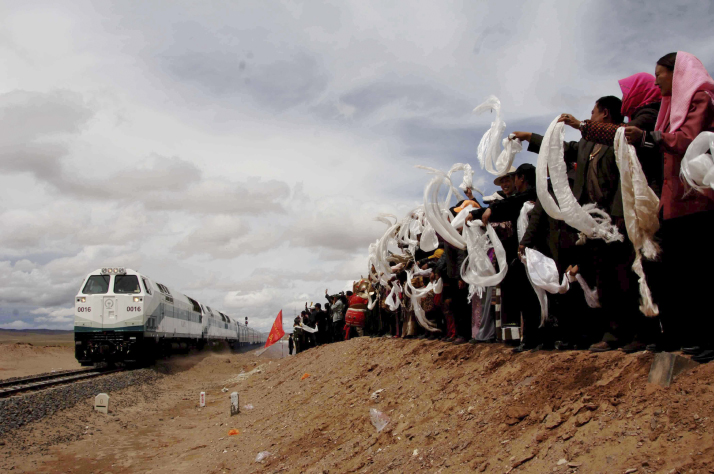 Local residents greet the Qing 1 train, the first train from Golmud in Qinghai Province to Lhasa in Xizang at the Tuotuo River Bridge in Qinghai on July 1, 2006, the day the entire 1,956-km Qinghai-Xizang Railway was fully opened (XINHUA)
Eco-guardians The railway running across the Qinghai-Xizang Plateau traverses an exceptionally fragile ecosystem, including a complex tapestry of pristine grasslands, ecologically significant wetlands, and ancient wildlife habitats. The project was the first in China's engineering history to embed an environmental supervision system directly into its design. To keep migratory routes open, engineers constructed nearly 60 km of dedicated wildlife passages, elevating tracks so that culverts and bridges could double as safe wildlife corridors. The animals, however, had to learn to trust the steel giant. Zhao Xinlu, former head of the Sonam Dargye Protection Station in Hoh Xil, remembers the early years when the shadows cast by the elevated bridges terrified the local wildlife. "The herds of Tibetan antelopes would freeze at a distance, scanning the underpass for any sign of danger," Zhao told China News Service. "The alpha antelope would step forward hesitantly, testing the crossing over and over. When they finally braced themselves to cross, they would actually leap completely over the bridge's shadow, terrified to step on the darkened earth." Today, however, the Tibetan antelopes have fully adapted to these custom migration corridors. No longer afraid of the structures looming above, they cross the tracks with ease and even gather to rest leisurely in the cool shade beneath the railway bridges. That shift in behavior is part of a historic revival. In the 1990s, poaching and habitat loss had decimated Hoh Xil's Tibetan antelope, leaving fewer than 20,000 alive. Today, their population has soared past 70,000. The plateau's fragile skin presented yet another hurdle. Across this high-altitude wilderness, the vital topsoil layer is impossibly thin, in some areas measuring a mere 20 to 30 cm deep. Knowing a single tear in the turf could permanently scar the landscape, construction crews carefully peeled each patch of sod during the construction, put it to a safe place and nurtured it like a delicate crop, and replanted afterward with specialized replanting techniques. Today, more than 90 percent of that original turf has been successfully transplanted and reestablished, greening the corridor once more. Over the past two decades, these environmental safeguards have steadily evolved, shifting from simple ecological restoration to a broader blueprint for sustainable infrastructure. In windswept corridors where blinding sandstorms once choked the tracks, workers erected a three-dimensional sand-control system built entirely from the land itself. Weaving together local stones, salt blocks and reeds, they sculpted sprawling checkerboard barriers, anchoring them with towering sand fences. Working in tandem, these low-tech, high-ingenuity grids have successfully locked the shifting desert dunes in place. These targeted battlefronts are backed by a staggering, line-wide greening campaign. Over the last 20 years, workers have blanketed approximately 1,000 km of the railway corridor with vegetation, transforming nearly 95 percent of all plantable sections. Today, more than 3.5 million trees and hardy shrubs guard the nearly 8 million square meters of reclaimed plateau. Through this massive, coordinated effort, the sandstorm risks that once threatened to choke the tracks have been virtually wiped out. Two decades after the first train rolled through, the railway testifies to a living green legacy safeguarded by its keepers, proving that engineering and ecology can thrive together. 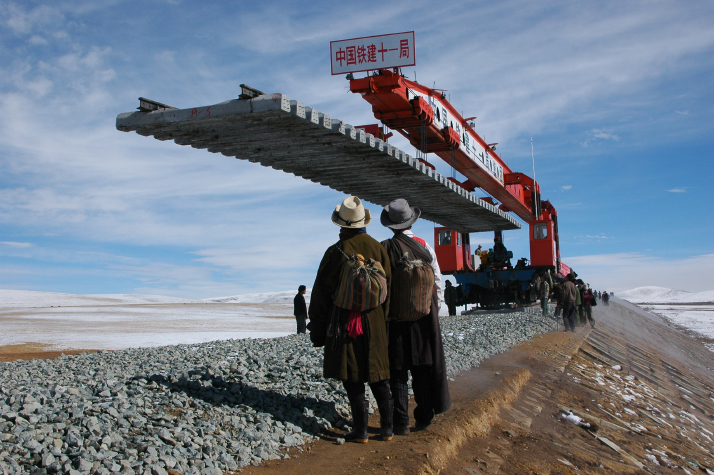 Two young herders visit a construction site to watch the Qinghai-Xizang Railway being built in Nagqu City, Xizang Autonomous Region, on October 9, 2004 (XINHUA)
The railway's economic surge Since operation began on July 1, 2006, the Qinghai-Xizang Railway has long acted as a vital economic artery, pumping life into the remote communities along its path and offering countless plateau residents their very first passage to the outside world. That profound shift is captured in a single, now-iconic photograph from 2006. In it, a herder named Baima Lamu stands in Lhasa's Damxung County, holding her young daughter, Nima Lamu, as they watch a train roll past for the first time. Sixteen years later, that little girl would board that very train to claim a future her mother could have only imagined. In 2022, Nima enrolled at a university in Jiangsu Province, more than 2,000 km away. Throughout her college years, the railway became her lifeline, an iron bridge carrying her back and forth between the snowy plateau and the bustling Yangtze River Delta each winter and summer break. After graduating last year, Nima's journey came full circle. Armed with a medical degree, she returned to her hometown to work at the Damxung County People's Hospital, using her skills to heal the very plateau community that watched her grow. For Tanggulashan Town, which is the final town in Qinghai before the tracks cross into Xizang, the railway has brought about nothing short of a resurrection. Perched at an average altitude of over 4,700 meters, this remote settlement of 2,000 residents was once suffocated by its isolation. Before the tracks arrived, basic survival was an uphill battle: Getting children to school meant an arduous journey of hundreds of kilometers, and medical care was a distant dream. In medical emergencies, patients routinely waited days for a transfer. The train has turned what were once multi-day trials into easy half-day trips. Livestock and local goods, once trapped by geography, now ride the rails to major national markets. The economic impact is staggering: By the close of 2025, the average annual income per resident had skyrocketed from a meager 2,300 yuan ($340) two decades ago to 38,600 yuan ($5,700). Riding alongside this economic surge is a steady, lucrative stream of tourism, breathing new life into stops that were once completely desolate. Consider Yanshiping Station in Nagqu's Amdo County, the highest railway passenger stop on the planet. When the line first opened on July 1, 2006, Yanshiping was merely an unattended station where trains briefly pulled aside to let others pass. But as roads improved and global travelers began craving the high altitude adventures, the demand became impossible to ignore. In December 2025, the station officially opened its doors to passenger services, transforming a technical checkpoint into a gateway to the roof of the world. After the Qinghai-Xizang Railway began full operation in 2006, railway development in Xizang did not grind to a halt. The plateau's iron arteries have continued to expand: The Lhasa-Shigatse extension was completed in 2014, followed by the Lhasa-Nyingchi line in 2021. Over two decades, the rail network across Qinghai and Xizang has nearly doubled, expanding from 2,207 km to a sprawling 4,060 km, an 83.9-percent surge. The Sichuan-Xizang Railway, currently being constructed between Chengdu in Sichuan Province and Lhasa, stands as the most formidable super project ever attempted in railway history, with the entire line scheduled for completion by 2030. These iron threads across the roof of the world are weaving isolated communities together and unlocking a future that once felt entirely out of reach. Copyedited by G.P. Wilson Comments to yuanyuan@cicgamericas.com |
|
||||||||||||||||||||||||||||||
|