
|
| China |
| The Chongqing experience | |
|
|
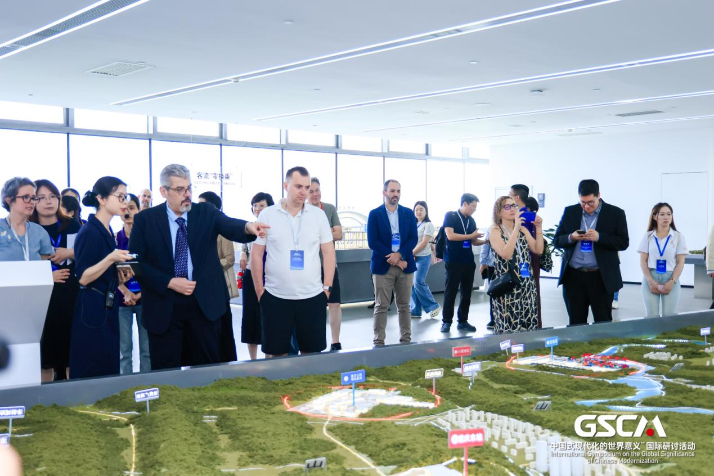 Participants of the international symposium visit the Inland International Logistics Hub Exhibition Center in Chongqing Municipality on June 16 (COURTESY PHOTO)
On June 18, an international symposium on mutual learning and the development of the Global South and Chongqing's Practice of Chinese modernization was held in Chongqing Municipality. The aims of the event were summed up well by Pablo Vommaro, Secretary General of the Latin American Council of Social Sciences (CLACSO), "We gather not merely to examine an economic or technological transformation, but to reflect on a much broader question: What new pathways are emerging for human development in the 21st century, and how are we redefining modernity and modernization through innovation, green transition, holistic approaches and coordinated synergy?" Co-hosted by the Publicity Department of the Chongqing Municipal Committee of the Communist Party of China (CPC), the Academy of Marxism of the Chinese Academy of Social Sciences (CASS) and CLACSO, the event brought together some 200 Chinese and international guests from 11 countries, including Singapore, Hungary, Brazil, Argentina, Australia and Peru. Redefining modernization Vommaro noted that for a long time, the Global South has been fed a predetermined narrative that there is only one path to modernization, inevitably equating to Westernization. Yet this model, driven by extractive growth, profit maximization and zero-sum competition, has often resulted in growth without poverty reduction, widening social inequality and increasing ecological pressures. Against this backdrop, Chinese modernization has drawn significant attention. "The Chinese experience shows that development can advance in strides without discarding cultural identity, national autonomy, social cohesion and international cooperation. Furthermore, it proves that technological progress can align with public welfare, long-term planning can synergize with iterative innovation and economic transformation can go hand in hand with sustainable development and cultural preservation," he said. Luo Wendong, Secretary of the CPC Committee of the CASS Academy of Marxism, pointed out that Chinese modernization is socialist modernization pursued under the leadership of the CPC, which has united and led people of all ethnic groups across the country through over a century of struggle. It follows the general laws of modernization while remaining grounded in China's national conditions and rooted in Chinese civilization. It is distinguished by its pursuit of common prosperity for all, material and cultural-ethical advancement, harmony between humanity and nature, and peaceful development. Wang Wen, Dean of the Chongyang Institute for Financial Studies at Renmin University of China, said the greatest global significance of Chinese modernization lies not in exporting a fixed template, but in demonstrating that developing countries can forge a sustainable and dignified modernization path of their own, without dependency, without confrontation, without sacrificing the underprivileged and without destroying the environment. As Australian sinologist Roland Boer, a professor in the School of Philosophy at Renmin University of China, noted, modernization shares a universal goal, namely improving human wellbeing. However, given that every country has its own distinct historical backgrounds, cultural traditions and political frameworks, a successful model in one country may not fit all. The success of Chinese modernization, he observed, is precisely a localized experience iterated through continuous practice. 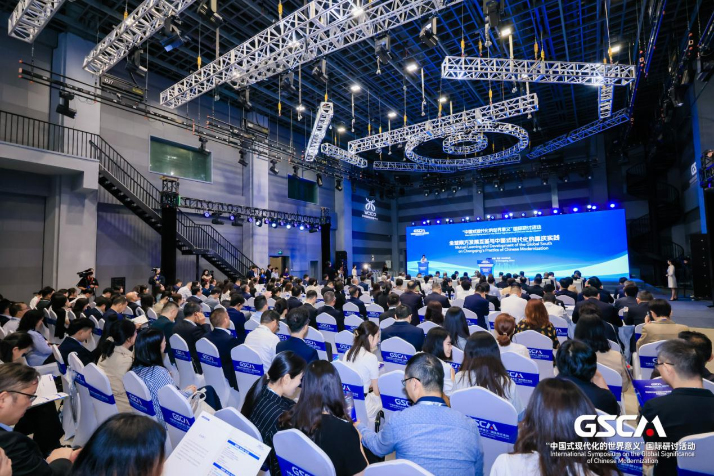 The international symposium on mutual learning and the development of the Global South and Chongqing’s practice of Chinese modernization underway in Chongqing on June 18 (COURTESY PHOTO)
Cooperation and knowledge sharing Yu Yunquan, Vice President of the China International Communications Group (CICG), said the successful experience of Chinese modernization has broken the myth that modernization equals Westernization, created a new form of human civilization, offered a brand-new alternative for modernization theory and practice worldwide, and provided both the confidence and a reference for the Global South to independently explore development paths. Yu added that the CICG will continue to leverage its multilingual, multimedia and cross-cultural expertise to contribute to global exchange on governance experience and to advance the common modernization and sustainable development agenda. Vommaro said CLACSO has partnered with colleagues in Chongqing to publish the Spanish-language edition of Six Perspectives on Chinese Modernization report, which is expected to facilitate mutual learning. "This reflects our commitment to open science and collaborative learning, enabling genuine dialogue across regions and intellectual traditions, and making good use of academic diplomacy as a channel. We do not seek to copy any external experience; rather, we are looking for inspiration, dialogue and shared endeavors, to forge a development path that is fairer, more inclusive, more democratic and more autonomous," he noted. Luo emphasized that modernization is neither a single-choice question nor a one-way street. As countries of the Global South share similar historical circumstances and development aspirations, and face common challenges such as climate change, the digital divide and uneven development, he said they can certainly work together through mutual learning to open up new paths for modernization that are fairer, more sustainable and more inclusive. Peter Sitas, Deputy Director of the Danube Research Institute in Hungary, said China's pursuit of modernization is not only a domestic policy but also a significant driving force behind global sustainable innovation. Two-way empowerment between China and Central and Eastern European countries has strengthened their partnerships in industrial capacity and technological innovation, cementing China's role as a key contributor to global supply chains and Europe's green supply chain transformation. At the event, Zhou Yan, a researcher at Fudan Development Institute at Fudan University in Shanghai, shared firsthand observations of a decade-long shift in how Brazilians view China, moving past old stereotypes to study its governance models and technological growth. This shift is mirrored in academia, where researchers have moved from debating China's rise to analyzing its governance philosophies and approaches. Chongqing's practice From June 16 to 17, participating experts conducted field visits across Chongqing, which offers a highly compelling regional case study of Chinese modernization. Chongqing is a mega-city built on complex terrain, a perfect illustration that modernization does not mean leveling a country into a single template, but rather rests on creative adaptation and long-term strategic vision, Vommaro said after the visits. He pointed out that Chongqing's urban-rural and infrastructural evolution demonstrates how technology can serve people, communities and the environment, while the city's role in the New International Land-Sea Trade Corridor, a key logistics network connecting China's western regions to global markets, shows how long-term planning and political commitment can transform geographic constraints into opportunities for regional integration and global connectivity. Daniela Perrotta, an expert from CLACSO, said Chongqing is a strategic bridge between west China and global markets, but its importance extends beyond logistics or transportation. It represents a new model of territorial development, in which inland regions become active hubs of global connectivity, rather than peripheral spaces. Chongqing's experience of development not necessarily following a single coastal export model is valuable for Latin America, not only as an economic case study but also a source of learning on development strategies, she added. Boer said Chongqing, as a large city with broadly comparable living standards between urban and rural residents, deserves in-depth study. He sees Chinese modernization as a localized, distinctive modernization, with each region possessing its own characteristics, a reflection of the diverse and integrated nature of Chinese culture. Development is not an insular goal but a process that can generate shared benefits with the world. The consensus among the participants of the symposium was that the global significance of Chinese modernization lies not in a monolithic model to be copied wholesale, but in pioneering a development path based on openness and cooperation. At a time when geopolitical competition and ecological challenges are intertwined, the vision of a community with a shared future for humanity serves as a timely reminder that multilateral dialogue and international cooperation must grow stronger. BR Copyedited by G.P. Wilson Comments to taoxing@cicgamericas.com |
|
||||||||||||||||||||||||||||||
|