|
| China |
| In a fast-paced China, the importance of family still holds firm | |
|
|
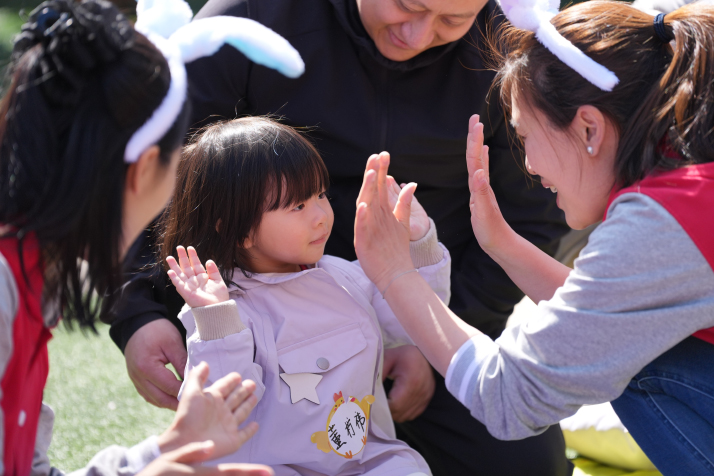 A parent and her child play games at a kindergarten in Beijing on April 1 (XINHUA)
Many all over the world talked about inequality and child wellbeing, a theme chosen by the UN for this year's observance of International Day of Families, on May 15. Across China, however, the conversation centered on a national priority—promoting positive views on marriage and childbearing to build a birth-friendly society. In Shanghai's densely populated Putuo District, the day celebrating family had a futuristic twist. At a local library, an event titled AI Lights Up Happiness at Home showcased an AI-powered parenting assistant that analyzes parent-child conversations, reads emotional cues, and offers constructive responses. Meanwhile, in Beijing's suburban Yanshan area, the focus was on legal literacy, with neighborhood workshops on the family education law and anti-domestic violence measures. Traditional Chinese culture attaches great importance to family. Family values are deeply embedded in Confucian ethics, including filial piety. Even with modern changes, many of these values persist, such as strong intergenerational bonds, support for elderly parents and the importance of family gatherings during festivals like Chinese New Year.
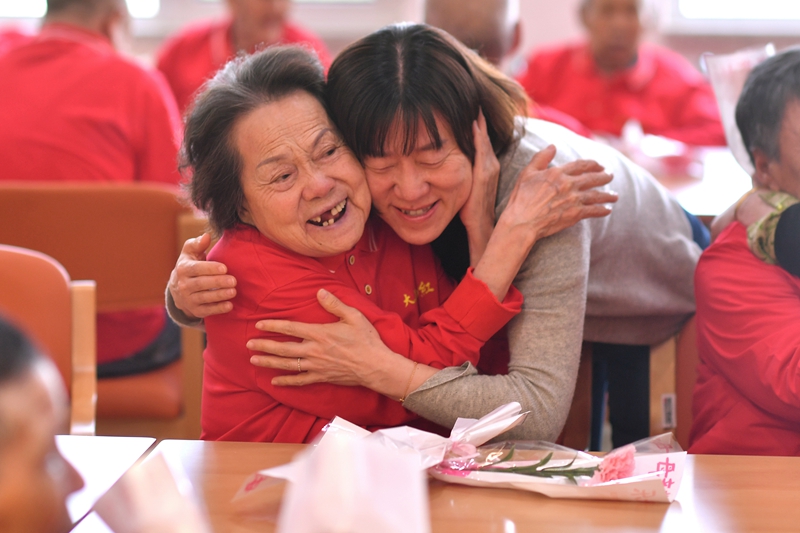
A mother and daughter embrace at a senior care service center in Qingdao City, Shandong Province, on May 10 (XINHUA) Every day is family day Each month, on the 10th, 32-year-old Lu Lu and her husband transfer 5,000 yuan ($735) to his parents, about one sixth of her family's monthly income. They call it "salary." Born in rural areas in Harbin, in northeast China's Heilongjiang Province, Lu and her husband are both working in Beijing, but they live across the provincial border in Yanjiao, a community in Hebei Province where rents are lower and life moves slightly slower than in the country's capital. Their 2-year-old son spends his days with his paternal grandparents, who live in a small apartment Lu's family bought for them—a 10-minute walk away. The arrangement is precise. The grandparents handle daytime childcare, plus some housework and cooking. "We tell them not to do too much," Lu told Beijing Review. "They're both over 60. We don't want them to be exhausted. But they still clean the kitchen. They still mop the floors. They always say, 'We're here anyway, we might as well.'" To Lu, the so-called "salary" is an expression of filial piety, the old Confucian duty of children to parents. For millennia, the Chinese family was understood as a fused whole—pooled resources, clear hierarchies and lifelong obligations. Parents raised children without a ledger. Children cared for aging parents without a price tag. The household was not a collection of individuals but a single organism, stretching across generations. In China, it is common for grandparents to take on the job of raising their grandchildren. A 2025 study by Weng Tangmei, an associate professor of sociology at Henan Normal University, analyzed data from the China Longitudinal Aging Social Survey, a national survey project conducted by Renmin University of China. The research examined how care and support flow between generations in rural families. The study found that a large proportion of rural grandparents are involved in caring for their grandchildren. But that sacrifice does not go unrewarded. The study found that grandparents who help raise their grandchildren also receive more financial support and practical care in return. What stands out is that financial support is strongly linked to better long-term physical health and short-term emotional wellbeing for the elderly. In other words, giving money to grandparents actually benefits their health. This helps explain why Lu and her husband insist on sending the monthly transfer and why her parents-in-law, who initially refused to accept it, now do. The money is a way of making their effort visible and acknowledging their contributions. Lu and her husband both work demanding jobs with unpredictable schedules in Beijing. Overtime is routine. Without his parents' help, they would have no idea what to do with their son. He is too young to go to kindergarten full time, and hiring a nanny would cost nearly as much as Lu's monthly salary. Daycare centers are not ideal options either. "He's so little," she said. "I just wouldn't be able to relax knowing he was with strangers all day." Lu said many of her friends are in a similar situation. "If the grandparents didn't help, one of us would have to quit job. Or we would send our son back to our hometown, which means we would only see him during holidays. Neither option feels right." In this landscape, grandparents are not just a convenience. They are the only people many parents trust with their most precious possession. It is also an economical choice for millions of young Chinese couples who need to work to pay the mortgage, save up for their children's education and support four aging parents. "They are our safety net," Lu said. "Without them, our whole life would collapse." Recognizing such struggles young couples have in rearing children, the Central Government has in recent years doubled down on its efforts to foster a birth-friendly society, announcing new policies including strengthened support for families with multiple children to purchase homes and encouraging employers to adopt flexible working hours so that employees can better take care of their families. 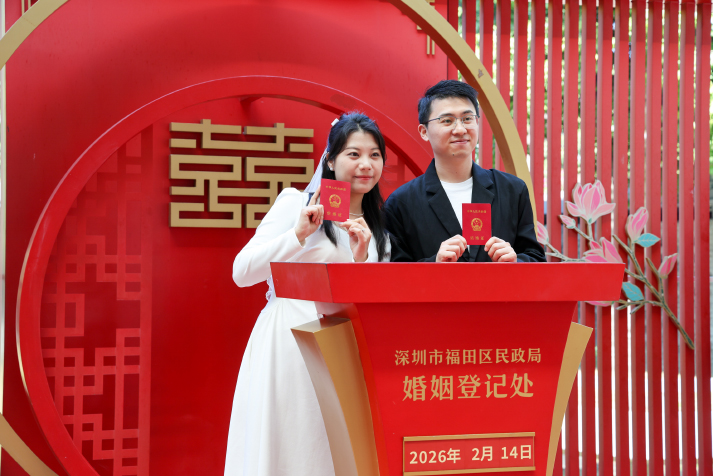 Newly weds pose for photos in a ceremonial hall in September in Shenzhen, Guangdong Province, on February 14 (XINHUA)
When the helpers need help But what happens when the grandparents can no longer lend a helping hand? This is the question millions of Chinese families are asking, including Lu's. Her father-in-law has high blood pressure. Her mother-in-law's knees ache, though she never complains. They are both in their 60s. In a decade, or maybe less, they will need care themselves. By the end of 2025, more than 320 million people in China were aged 60 or above, accounting for 23 percent of the total population. This number is expected to exceed 400 million within a decade. As a result, senior care has become an increasingly pressing national issue. China is racing to prepare. Most recently, in April, 11 government departments, including the Ministry of Civil Affairs, jointly issued a policy document to promote the development of mutual-aid elderly care services, as the country steps up efforts to address the challenges of an aging population and meet the increasingly diverse needs of older residents and families. The guideline defines mutual-aid eldercare as voluntary, non-profit services delivered through mutual assistance among neighbors or residents within villages and communities. It calls for developing community-supported, home-based mutual-aid services, including the formation of volunteer teams to provide help with meals, hygiene, mobility and emergency assistance for seniors in need. According to the document, by 2030, 70 percent of urban and rural communities are expected to be equipped with elderly care facilities capable of providing mutual-aid services. Supportive policies are a solid start to ease the nationwide senior care pressure. "It's good to know the government is thinking ahead. My in-laws have each other and us for now, but it's comforting to see that communities are being prepared for when more help is needed," Lu said.
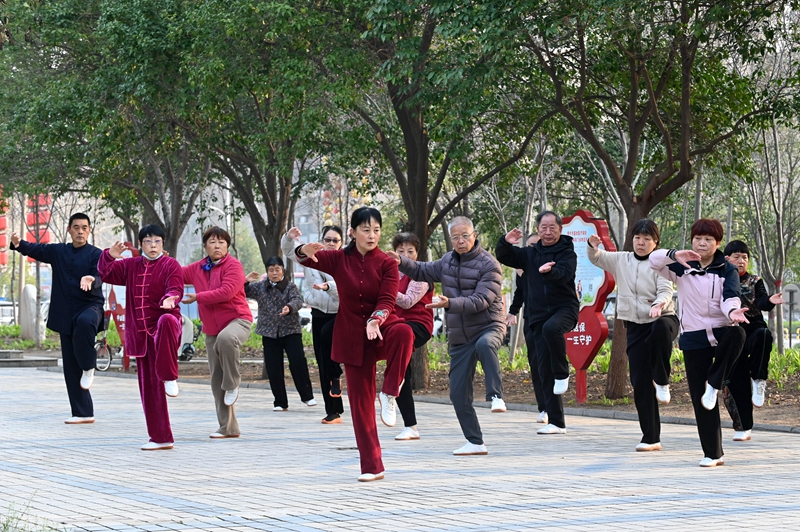
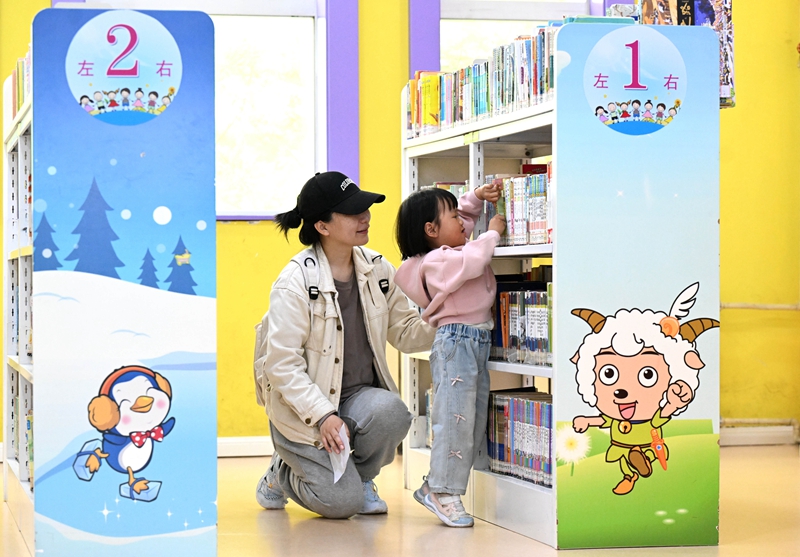
Enthusiasts practice taijiquan (tai chi) in Qinyang, Henan Province, on March 21 (XINHUA) Smaller but closer According to the China Population Situation Report 2026 published by Zeping Macro, a company specializing in macroeconomic research and consulting founded by famous economist Ren Zeping, the average Chinese household has shrunk from 4.4 people in 1982 to 2.5 people in 2024. The once commonplace "four generations under one roof" family model is giving way to three-person, two-person and even single-person households. More and more young people are leaving their hometowns for work faraway and choose to live independently. At the same time, a declining desire to have children is also a major factor, according to the report. Marriage registrations fell by nearly 50 percent between 2013 and 2022, though a modest rebound appeared in 2025 after the government simplified the registration process. This trend toward smaller households is not unique to China. Across the world, falling fertility rates, later marriage, higher rates of non-marriage and divorce and increased migration have all pushed household sizes down, according to Zeping Macro. In Japan, the average household has about 2.27 people. In the United States, it is 2.53. In the Republic of Korea, it is 2.4. Yet smaller does not mean less connected. Even as Chinese households shrink in size, the bonds between family members have, in many ways, grown tighter. Digital tools further strengthen these ties. Video calls, instant messaging and group chats allow family members to share daily moments whenever they like, even when separated by hundreds of kilometers. Many young urban workers check in with their aging parents every day, a practice less common in traditional big families where coliving made regular checkups unnecessary. This shift from physical co-presence to intentional connection is also reshaping the most sacred of Chinese rituals: the Chinese New Year reunion. The 2026 Spring Festival travel season, from February 15 to 23, offered a vivid example. While millions still journeyed to their hometowns, with over 2.6 billion cross-regional trips made during the nine-day holiday, a notable shift known as "reverse Spring Festival travel" is gaining ground. In the past, "family reunion" almost always meant young people studying or working in big cities going to great lengths to return to their parents' hometown. But now, that pattern is being reversed. Data from online travel agency Qunar.com showed that during the holiday, first-tier cities like Beijing, Shanghai, Guangzhou and Shenzhen became the most popular flight destinations for travelers over 60. More and more elderly parents are now flying to the cities where their children work, bringing with them hometown flavors. The reunion no longer has a fixed geographic center. It happens wherever the family chooses to be. A mother selects books with her child at a library in Shijiazhuang, Hebei Province, on April 23 (XINHUA) Copyedited by Elsbeth van Paridon Comments to luyan@cicgamericas.com |
|
||||||||||||||||||||||||||||
|