
|
| China |
| Washed up or wanted? The truth about scientists coming home | |
|
|
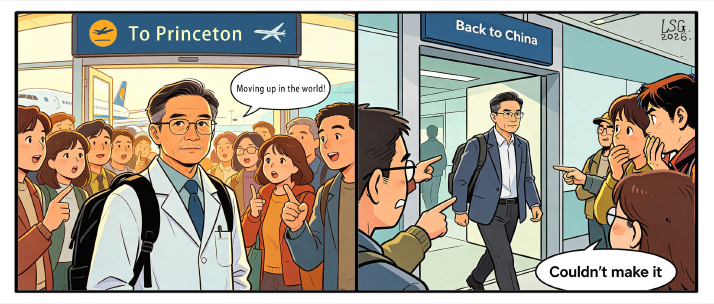 LI SHIGONG
A recent post by Yan Ning, a renowned cell biologist, on Chinese microblogging platform Sina Weibo sparked heated online debate. In 2022, Yan resigned from her teaching post at U.S. Ivy League Princeton University and returned to China to help establish the Shenzhen Medical Academy of Research and Translation in Guangdong Province. She now is a member of the Chinese Academy of Sciences, the highest academic accolade in the field of science and technology in China. In her post, Yan shared her latest research findings and responded to skeptics who suggested that she came back simply because she was "no longer good enough for Princeton." She also called on netizens to recognize China's improving environment for research and talent development. The public weighed in. Li Yue (Shenzhen Special Zone Daily): Yan's response has debunked the bias that "going abroad is moving up, while returning home means failure." Today's China, especially innovation hubs like Shenzhen, can provide a world-class science research environment for top-tier scientists, supporting them in pursuing more challenging and cutting-edge explorations. Recently, Yan's team, together with their collaborators from Tsinghua University, published their research on glycans, one of the four types of biomacromolecules that govern cellular functions, in the Science journal. In May 2024, she became one of five laureates of the 2024 L'Oréal-UNESCO for Women in Science International Awards, recognized for her groundbreaking research in the life and environmental sciences. These stellar achievements serve as the strongest rebuttal to the ridicule that she could no longer carry on her work in the United States. A healthy public opinion environment is important for a healthy research ecosystem, and a rational, inclusive social atmosphere is key to attracting talent. When it comes to scientific research, ordinary people can engage in rational inquiry and objective discussion, but should avoid unfounded speculation. As more scientists like Yan stand up to doubts with solid achievements, and as public discourse begins to show greater understanding and respect for scientists, the entire research and innovation ecosystem will move toward a more virtuous cycle, thereby driving scientific progress forward. Chang Yandao (People.com.cn): In March, The Economist magazine published an article titled China Is Winning the AI Talent Race, which claims that "America has become a less attractive destination. Funding cuts and visa uncertainty have unsettled would-be applicants." China's appeal to returning overseas talent today lies not only in the emotional call to serve the motherland, but also in its excellent research environment, well-developed industrial system, vast application scenarios and expansive market. China has made forward-looking arrangements in many key scientific research areas and emerging industries. These preparations have set up a broad stage for entrepreneurship and are appealing to talent from across the globe. From the older generation of scientists, who went abroad to study and returned with expertise, to today's growing number of young scholars active at the forefront of global innovation outside China, open exchange has always been a primary driver of scientific progress. We encourage our talent to go global and broaden their horizons, and we also welcome talent from around the world to pursue their scientific dreams in China. The series of science and technology development plans recently unveiled by the country serve both as opportunities for key sectors and as a "global call for talent." Neither blindly glorifying "overseas experience" nor groundlessly questioning "the choice to return" is the proper attitude we should have regarding talent mobility. BR Copyedited by Elsbeth van Paridon Comments to yanwei@cicgamericas.com |
|
||||||||||||||||||||||||||||
|