
|
| China |
| Global city leaders convene in Xi'an to discuss how culture and technology are reshaping modern cities | |
|
|
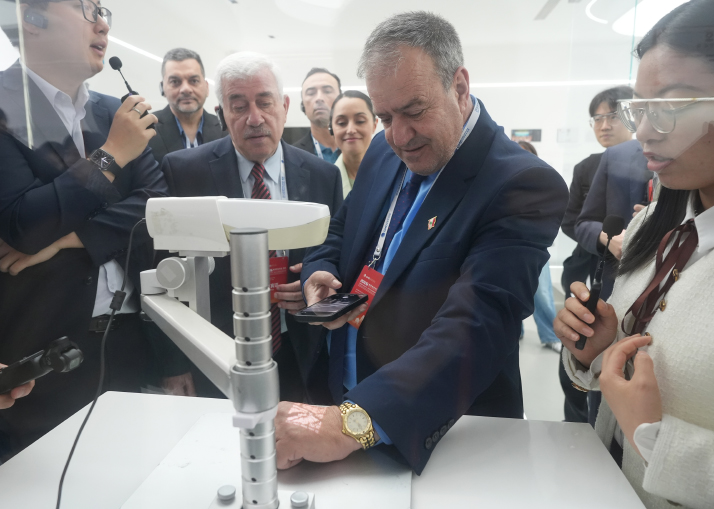 A guest of the 2026 Global Mayors Dialogue tries out an augmented reality vascular navigation system at the exhibition hall of a medical equipment enterprise in the Xi'an Hi-tech Zone in Shaanxi Province on April 28 (XINHUA)
Around 2,000 years ago, Xi'an (then known as Chang'an) served as the eastern terminus of the ancient Silk Road, witnessing the ebb and flow of Eastern and Western civilizations. Two millennia later, the city once again became a crossroads for global exchange—this time for mayors and other representatives from seven countries: Jordan, Egypt, Lebanon, Iraq, New Zealand, Tunisia and Oman. They gathered under the theme Starting Point of the Ancient Silk Road and Harmonious Coexistence: Empowering High-Quality Urban Development through Technology and Culture, a fitting tribute to Xi'an's dual identity as a guardian of history and a pioneer of innovation. From April 27 to 29, the 2026 Global Mayors Dialogue took place in this historic city, the capital of Shaanxi Province. Guided by the State Council Information Office of China, the program aims to showcase the modernization achievements in Chinese cities and foster international trust and mutual learning. Since its launch in September 2024, the dialogue has traveled 10 Chinese cities, each bringing its unique character and developmental story to the table. The journey began in Hangzhou, Zhejiang Province, followed by Nanning in Guangxi Zhuang Autonomous Region, Shanghai, Tianjin, Qingdao in Shandong Province, Dunhuang in Gansu Province, Jingdezhen in Jiangxi Province, Nanjing in Jiangsu Province and Harbin in Heilongjiang Province. Each stop has highlighted a different facet of China's urban transformation, from Hangzhou's digital economy and Shanghai's green innovation to Nanjing's waterfront revitalization and Harbin's winter economy. What sets this initiative apart is its emphasis on immersive experience. Rather than confining discussions to meeting rooms, the dialogue takes foreign mayors into the heart of Chinese cities, to smart traffic command centers, ancient heritage sites, hi-tech manufacturing plants and citizen service hotlines. This approach turns abstract governance principles into tangible, lived experiences. A convergence of ancient and modern In Xi'an, mayors and other representatives learned how green energy and advanced manufacturing are driving the city's modernization. At the manufacturing base of Chinese carmaker Geely Auto, participants of the dialogue found that main processes such as stamping and painting are 100 percent automated, producing a new-energy vehicle (NEV) every minute on average. Tania Tapsell, mayor of Rotorua, New Zealand, showed strong interest in the production lines. Noting that Rotorua's geothermal resources could support green energy cooperation with China, she told reporters: "I think what's really inspiring me here is seeing how you have been resilient through your sustainable use of energy. So we look forward to learning about the technology innovation and incorporating more AI." Jamal Abu Obeid, Chairman of the Al-Ramtha New Municipality in Jordan, pointed out that Chinese solar panels and NEVs are exactly what his country needs to address energy shortages and support its green transition. He expressed his hope of translating the dialogue into concrete projects in digital technology applications, smart city development, cultural heritage protection and youth exchanges. Ye Niuping, Mayor of Xi'an, shared his city's experience in balancing historical preservation with modern development. Xi'an has deepened reforms in urban planning, construction and governance, he explained, strengthening coordination between cultural relic protection and construction initiatives. The city has used technology to drive the creative transformation of historical and cultural resources, developing new scenarios that integrate culture, technology and tourism. Tapsell spoke of how Rotorua integrates Maori culture into urban development and public services, with traditional culture serving as a magnet for tourism. For many of the visiting mayors, the dialogue's most striking revelations came from the way Xi'an has harnessed digital technology to breathe new life into its ancient heritage. Home to more than 3,200 immovable cultural relic sites, Xi'an has integrated heritage preservation into its entire urban planning process, leveraging AI and extended reality (XR) to create immersive night tours and digital cultural experiences. Shady Yehia Elmashad, Deputy Governor of Beheira in Egypt, argued that digitalization is more than automation—it is fundamentally a tool to increase resource efficiency and reduce waste. Emperor Qinshihuang's Mausoleum Site Museum, home to the world-famous Terracotta Warriors, left a deep impression on the visiting mayors. Hussain Al Lawati, a member of Oman's Shura Council and representative of Muttrah City in Oman, marveled at the digital technologies used in artifact protection and restoration. He noted that technology has enabled researchers to rediscover the original colors and facial features of the warriors, and even to determine the correct ranks of these ancient officers. "Using that technology is definitely going to help us understand what was our history so we can build our future upon it," he remarked. The immersive experiences continued outside the museum. At Xi'an's XR film industry base, participants experienced cinematic presentations through XR headsets, and saw history coming alive before their eyes. Goran Rasheed Muhammad, Director of the foreign affairs office of Sulaymaniyah Provincial Government in Iraq and special representative of the governor, articulated what many felt: Sulaymaniyah possesses more than 2,000 historical sites, and there is an urgent need for digital technologies to assist in relic restoration and preservation. He expressed a strong desire to deepen cultural exchange and learn from Xi'an's mature digital cultural experiences. Sharing management experience Xi'an's story, however, is not just about preserving the past. It is also about building a smarter, more efficient future. The dialogue took participants into the nerve centers of modern urban governance, showcasing how technology is reshaping everything from traffic management to services. At Xi'an's 12345 Citizen Service Hotline Center, participants witnessed a round-the-clock operation handling consultations, complaints and emergency requests. City authorities revealed that in 2025 alone, the hotline received approximately 5.8 million requests, achieving a case completion rate of 99.8 percent and a public satisfaction rate of 97.5 percent. For Elmoula Abdelbaki, Director of municipal affairs in Tozeur Governorate, Tunisia, the hotline embodied a people-centered governance philosophy applied at scale—a successful model for grassroots governance and public service delivery. The city's traffic command hall offered another glimpse into the future of smart urban management. A giant screen displayed real-time road network data, traffic signal statuses, congestion points and police patrol trajectories. Elsawy Abdelrahem, a professor of philosophy at Benha University in Egypt and coordinator for Egypt-China relations, said Xi'an's smart mobility system is sophisticated and widely applied, with remarkable achievements in easing traffic congestion, emergency rescue and public convenience services. Perhaps most revealing were Xi'an's applications of AI. Xiao Qi, Vice Mayor of Xi'an, explained that the city has built a smart governance model featuring "full-domain perception, intelligent early warning and efficient data application." Intelligent devices on patrol vehicles enable AI visual recognition to detect road surface defects at the millimeter level; digital sensors on urban bridges monitor structural health around the clock; streetlights automatically adjust brightness according to traffic flow at night. For many visiting mayors, these examples offered a blueprint for bringing greater efficiency, precision and intelligence to their own urban operations. The Xi'an Consensus After three days of intensive dialogue and exploration, Mayor Ye joined his international counterparts in releasing the Global Mayors Dialogue—Xi'an Consensus on Silk Road Urban Development. The consensus outlines four pillars for deepening cooperation among Silk Road cities: preserving civilizational heritage to enrich urban development, deepening technology-driven governance to modernize public services, advancing green transformation to foster sustainable growth and strengthening people-to-people exchange to expand mutual understanding. Underlying these pillars is a recognition that cities—as the primary sites of modernization, cultural transmission and cross-border cooperation—must take the lead in transforming strategic understandings into tangible outcomes. "Protecting heritage while fostering innovation is a key challenge for all cities," Ye noted, calling for deeper international cooperation in preservation and mutual learning. For the visiting mayors, the dialogue was not just an exchange of ideas but also an invitation to act. From AI-powered artifact restoration to smart traffic systems that learn and adapt, from NEVs to service hotlines that never sleep, Xi'an offered a compelling vision of what happens when a city honors its past while fearlessly embracing the future. As the event concluded, participants visited a showcase of intangible cultural heritage, including lacquer gilding and Qinqiang opera mask painting, a quiet reminder that beneath the gleaming surfaces of smart infrastructure, it is people, culture and shared human experience that truly build cities. In Xi'an, where Terracotta Warriors and autonomous robots call the same city home, that message could not be clearer. Copyedited by G.P. Wilson Comments to jijing@cicgamericas.com |
|
||||||||||||||||||||||||||||
|