
|
| China |
| Hangzhou bridges ancient heritage and modern innovation for inbound tourists | |
|
|
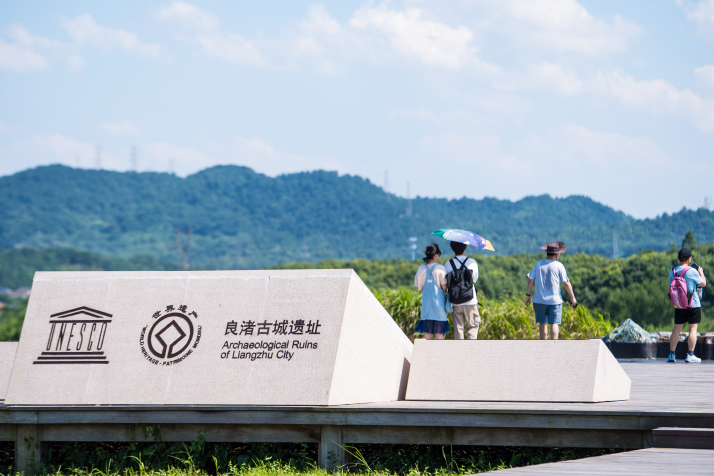 Visitors at the Mojiaoshan Palace Site at the Liangzhu Ancient City Ruins Park in Hangzhou, Zhejiang Province, on July 4, 2024 (XINHUA)
At the Liangzhu Ancient City Ruins Park in Hangzhou, Zhejiang Province, the visitors put on headsets and then stepped into a city that no longer exists. Palaces rose again and canals filled with jostling watercraft stretched out in all directions. "Standing there, it didn't feel like looking at ruins," Hedi Hariz, assistant editor in chief of the Social Affairs Department at Tunis Afrique Presse, told Beijing Review. "It felt like looking at the beginning of something that's still continuing. You can see the city layout and the water system. It made me realize that what we call 'modern civilization' didn't just appear suddenly. It has very deep roots here." Hariz was part of a group of international visitors who toured Hangzhou from April 15 to 20 as part of a program organized by the Hangzhou Municipal Bureau of Culture, Radio, Television and Tourism. More than a simple city tour, the route aimed to address the question of how a city can show both the depth of Chinese civilization and the practical workings of modern life. A city rooted in civilization Hangzhou is often introduced through its scenery: West Lake, the Longjing tea gardens, silk production areas, misty hills and the refined charm of the lower reaches of the Yangtze River. But its history is as expansive as its landscape. The city is also home to southern terminus of the Grand Canal and the Archaeological Ruins of Liangzhu City, both UNESCO World Heritage listed historical sites. While West Lake shows the city's long tradition of landscape aesthetics and cultural life, the Grand Canal, the world's longest artificial waterway, connecting Beijing and Hangzhou, provides insights into ancient systems of transport, trade and governance. The oldest parts of the canal date back to the fifth century B.C., although the various sections were finally combined into one during the Sui Dynasty (581-618). Liangzhu reaches even further back, to the early roots of Chinese civilization. The Liangzhu ruins site, located in Yuhang District, dates back more than 5,300 years and has helped shape understanding of China's prehistoric past. It left an impression on Creighton Ward, an American media professional and editor of Friends of Socialist China. She said the visit showed her a prehistoric civilization concerned not only with ritual and settlement, but also with food security, water control and survival. "We visited on a mild spring day, which made it easy to appreciate the natural beauty of the rice fields and environmental features that supported a prehistoric civilization," Ward told Beijing Review. The site has introduced new ways to immerse visitors in the ancient world. A pilot program launched in July 2025 allows visitors to take a 35-minute interactive journey through the historical city by wearing virtual reality (VR) headsets. For Ahmed Moustafa, an Egyptian economist and Director of the Asia Center for Studies and Translation, the tour route, through the Liangzhu ruins site, the Hangzhou section of the Grand Canal and West Lake, seemed deliberately designed to place different historical eras side by side. When ancient waterways stood alongside technology campuses and digital services, they showed Hangzhou's unique fusion of tradition and innovation, he said. 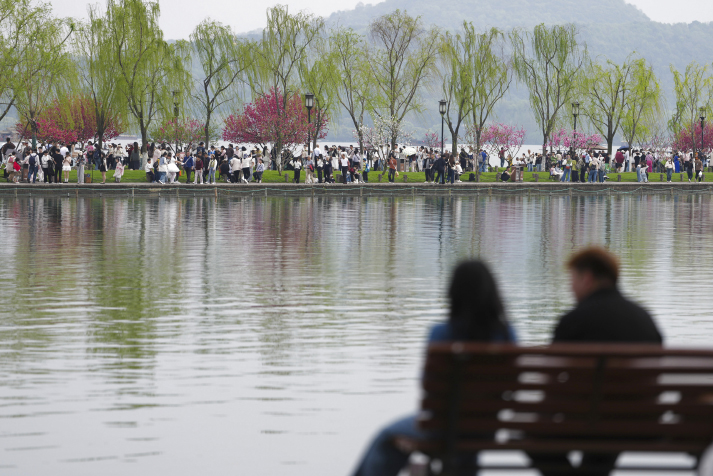 The West Lake scenic area in Hangzhou, Zhejiang Province, on April 2 (XINHUA)
Technology for daily life Apart from its culture and history, to many outsiders, Hangzhou is a tech hub. It began building its digital economic ecosystem in the early 2000s, when Internet companies such as Alibaba expanded rapidly. Today, the city is known not only for its e-commerce and financial technology (fintech) prowess, but also for a group of fast-rising hi-tech startups often referred to as the Six Little Dragons. These include AI developer DeepSeek, robotics companies Unitree and DeepRobotics, brain-computer interface company BrainCo, video game studio Game Science and AI-powered spatial intelligence company Manycore Technology. At Ant Group, a spin-off from e-commerce giant Alibaba and now a leading provider of financial services technology in China, the international visitors saw how digital finance has become part of daily commerce. They also toured robotics and AR-related companies, including Rokid, a Hangzhou-based company focused on augmented reality (AR) smart glasses, spatial computing and human-computer interaction. "We visited the headquarters ecosystem of Ant Group and Alipay (the payments branch of Ant Group), witnessing firsthand how digital finance has reshaped daily commerce and global fintech standards," Moustafa said. Michael Dunford, an emeritus professor at the School of Global Studies at the University of Sussex in the United Kingdom, linked Hangzhou's technology development to a broader question: What technology is used for. "If you produce things that are useful, if you invest, if you create the capabilities to produce things that are useful and improve the quality of people's lives, you're moving in a progressive direction," Dunford told Beijing Review. He added that Hangzhou offers a clear example of this approach. "You see extraordinary technological progress, the application of technology to useful things, to the care of the elderly, to healthcare," he said. Making travel easier For international visitors, a satisfying trip is shaped not only by museum tours and corporate visits, but also by practical, everyday considerations: Can I pay conveniently? Is the hotel easy to reach? Can I get assistance in my native language? Hangzhou has been trying to answer those questions as part of its development of inbound tourism. According to the Hangzhou Municipal Bureau of Culture, Radio, Television and Tourism, the city has continued to improve inbound tourism products and services in recent years. The numbers show the sheer scale of the effort. According to surveys conducted by the bureau, Hangzhou's accommodation facilities are expected to have received 1.4 million overnight inbound visitors in 2025, up 26.5 percent year on year, with main sources including the United States, Malaysia and the Republic of Korea. Hangzhou is enhancing convenience across all fronts for inbound tourists. For example, at Hangzhou Xiaoshan International Airport, an international service center provides integrated assistance in finance, telecom, transport, tourism and information. Visitors can also access SIM card services offline and eSIM services online. On August 29, 2025, the city piloted what it described as China's first one-click tax refund service for international tourists at a store of Wensli, a Hangzhou-based silk brand, cutting processing time from about 20 minutes earlier in the year to within two minutes. It has also distributed maps of tax refund stores to hundreds of locations in China and abroad. Hangzhou has also launched an English version of a tourism AI agent known as Hang Xiaoyi. It integrates DeepSeek's AI model to answer questions, recommend routes and handle travel inquiries. Its knowledge base now covers 383 scenic areas and cultural venues, 318 hotels and homestays, and 3,548 performances and exhibitions. Hariz said the human experience of Hangzhou was present "in every detail of daily life." Ward also recalled a small canal-side moment. "As we walked around, another member of the tour asked a vendor for a cup of water, and she gave one to him for free," she said. (Print Edition Title: Continuity and Change) (Reporting from Hangzhou, Zhejiang Province) Copyedited by G.P. Wilson Comments to liwenhan@cicgamericas.com |
|
||
|
||||||||||||||||||||||||||||
|