|
| China |
| A Uruguayan’s brush basks in Beijing’s light | |
|
|
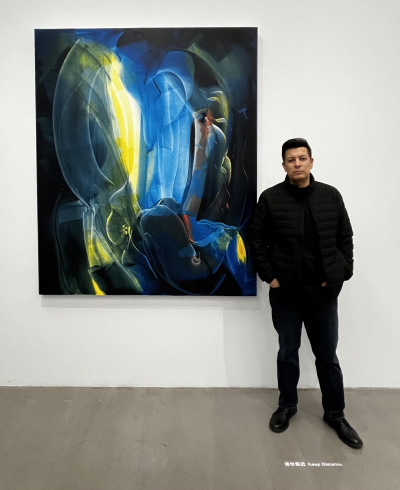 Uruguayan painter Mauricio Paz Viola (COURTESY PHOTO)
Some artistic paths follow a clear, almost linear logic; others are woven from experiences and moments of quiet revelation. Mauricio Paz Viola's belongs to the latter. The Uruguayan painter, trained across the Americas and Asia, is guided not by rigid principles or defined discourses, but by an ongoing search for the invisible—for that which cannot be named yet insists on emerging through form, color and texture. Beyond reason Born in Carmelo, a small riverside town in Uruguay, Paz Viola's journey into art began early. At 14, he started attending an oil painting workshop, an experience that gave him not only techniques but also something far deeper: access to an alternate world. Exhibitions, encounters with other young artists and collaborative projects blending painting, performance, film and music soon followed. This spontaneous, cooperative environment taught him that art is not an isolated exercise but a vital force capable of shaping human sensitivity. Some impressions, however, precede awareness. Paz Viola shared with the author a moment from childhood. "I was 7 years old, sitting in class, when I opened a textbook and a picture struck me," he said. At the time he did not know the painter's name or understand the image, but something in it marked him irreversibly. Years later, living in Chile, he discovered that the artwork was by Roberto Matta, the Chilean visionary who became one of his greatest artistic influences. Alongside Matta, the Uruguayan artist Javier Gil has also played a formative role in Paz Viola's development. What he draws from both is not imitation of style, but an approach to constructing inner worlds—an exploration of that threshold where the image moves beyond representation and becomes pure experience. It is a space where the psychological, emotional and spiritual converge freely, without the need for explanation. This sensibility inspires his own work. Paz Viola avoids direct messages and closed narratives; his paintings are deliberately untitled, an intentional refusal to steer viewer response. Instead of offering conclusions, they act as portals through which each person can project their own emotions, memories and intuitions. "The idea is not for the viewer to understand something rationally, but to experience something essential," he explained. His practice is rooted in a tradition that privileges the sensory over the discursive and the intuitive over the analytical. The spirituality in his canvases is not religious or dogmatic, but personal. 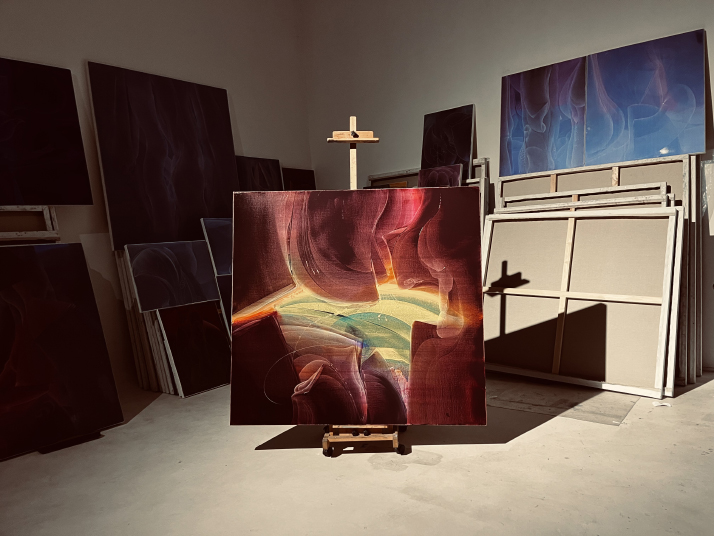 A painting of Paz Viola in his studio in Beijing (COURTESY PHOTO)
The artist at work When facing a blank canvas, Paz Viola deliberately avoids planning. "I always work that way—with the uncertainty of not knowing in advance what the final image will be. I use my emotions and mood as antennae to capture the moment," he said. His process begins with a stain or a gesture that gradually evolves through successive layers of color. Music plays a pivotal role. He paints accompanied by ambient sounds, baroque compositions, electronic tones or newage musical pieces. Natural light is another major component of his process. He works mainly during the day and notes that seasonal variations directly affect his palette and the atmosphere of his paintings. His openness extends beyond the studio to his own life. After years in Uruguay, he moved to Chile, where he met his future wife—a Chinese exchange student. They married in the capital of Santiago in 2012, and soon thereafter embarked on a journey that took them to the United States—first California, then New York City—before settling in Beijing in 2019. For Paz Viola, arriving in China was a turning point: an encounter with a completely new cultural reality. For his wife, it was a homecoming. The scale of Beijing, its order and contrasts proved powerful stimuli rather than sources of alienation. He quickly immersed himself in the city's art scene, visiting the 798 Art District, a hub of contemporary creativity brimming with galleries and cultural spaces. There, he began to understand the local dynamics and nuances of Chinese artistic preference. Then came the COVID-19 pandemic. For three years, restrictions shaped Beijing's rhythm and, inevitably, his own. Yet rather than stalling his work, the period became a phase of reflection and growth. He continued developing projects that had begun in New York, adapting his creative language to a new environment. In 2021, he opened a studio in Songzhuang, home to one of China's largest artistic communities, roughly 25 km from central Beijing. Since then, he has maintained a steady routine—intensive workdays in his studio during the week and weekends devoted to urban immersion. His reception in China has been notably positive. His abstract, spiritually charged style differs from dominant local currents, where figurative and expressionist paintings often prevail. "The public sees my work differently—certain forms, effects and colors are not typically associated with Chinese art," he said. These distinctions have become his signature feature. In recent years, Paz Viola has exhibited widely—in solo and group shows across galleries, museums and cultural spaces. In 2022, his work appeared on LED screens inside Beijing's subway stations, reaching hundreds of thousands of commuters. His collaboration with the prestigious Can Art Center has been especially significant; there, he held a solo exhibition titled Light, Embodied in 2023, accompanied by a bilingual catalog featuring related essays. His paintings have also appeared in various magazines and publications, including an inflight magazine distributed on domestic Chinese flights, evidence of his growing visibility in the country's art scene. Despite this success, Paz Viola remains introspective about the art world, observing differences between East and West beyond aesthetics—in interpersonal dynamics, timing and expectations. Where Latin America conveys urgency and spontaneity, China offers patience, strategic thinking and long-term vision—qualities that have become important lessons for him. He also feels a deep resonance with certain Chinese artists who share his spiritual approach. French Chinese artist Chu Teh-Chun (1920-2014) stands out as a key influence for his abstract language and cosmopolitan trajectory, while figures like painters Wu Guanzhong (1919-2010) and Huang Yuxing also occupy places on Paz Viola's personal map of inspiration. Looking ahead Paz Viola avoids rigid planning. He describes himself as "water"—someone who lets the current guide him while staying alert to the surroundings. This attitude reflects a different way of envisioning growth. He is especially drawn to Chinese museums, where their sheer scale and architectural depth offer unique spaces for artistic immersion. "I've always imagined my works inhabiting those spaces, in dialogue with other artists' pieces and receiving the attention they deserve," he said. He is also eager to explore new formats—collaborations with musicians, books, 3D projections and immersive experiences—to push beyond the canvas into realms "where the visual expands into the sensory and spatial." Ultimately, what defines Paz Viola is not only his art but the coherence between his creative practice and his way of being in the world. In an era that often prizes immediacy and spectacle, his approach stands out for its introspection, patience and openness to the unknown. His paintings do not impose; they invite. They do not explain; they suggest. They do not close; they open. And perhaps their true power lies precisely there: In that quiet ability to create a space where, for an instant, the viewer stops looking outward and begins—unknowingly—to look within. (Print Edition Title: A Journey of Introspection) Copyedited by Elsbeth van Paridon Comments to yanwei@cicgamericas.com |
|
||||||||||||||||||||||||||||||
|