|
| China |
| Unleashing individual creativity with the "zero-code" revolution | |
|
|
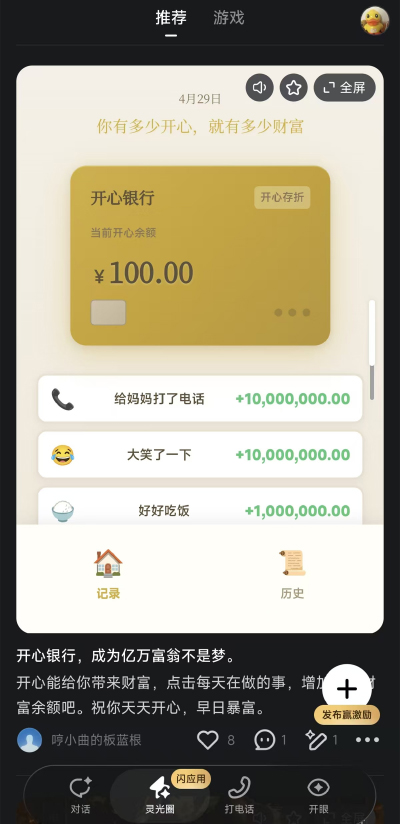 A screenshot of the Happiness Bank app published in Lingguang Circle. Here, every joyful moment is a deposit into one's own personal treasury (SCREENSHOT)
During a quiet lull before bed, while scrolling through her phone, a netizen who goes by the online moniker "Spoon" had a playful idea: She would translate her salary into visible "time value," creating a representation of each second's worth, she told China Newsweek magazine. And this was no sooner said than done. She immediately opened Lingguang AI, a mini-program builder from Ant Group (the company that owns China's ubiquitous Alipay app), and described what she wanted. Mini-programs are small, lightweight tools like add-ons or plug-ins that run inside popular super apps such as Weixin, known internationally as WeChat. Within seconds, a salary clock was ready—gold coins cascading into a transparent piggy bank at the center of her cellphone screen, and a number beneath the piggy bank showing her "current cumulative earning" in real time. With a simple tap, she could witness her income rise second by second, a sight that very much brightened her mood. Eager to share this novel experience, she posted the application in Lingguang Circle, the domestic AI industry's first zero-code application sharing community, where it quickly garnered likes from fellow users. "Zero-code application" refers to a software development approach that allows users to create, customize and deploy applications without writing any traditional programming code. By simply feeding the tool their needs in simple, natural language, they can generate an interactive, usable and even monetizable, standalone application in as little as 30 seconds. With such an application, turning a casual thought into a functional tool has become a reality for many people. A DIY wave The rise of this new approach has directly sparked a wave of DIY app creation, according to China Newsweek. Users shared their experience with the outlet. One user wanting to plan a trip simply told the app to "generate a three-day, two-night Beijing itinerary, with the order of attractions adjustable," and instantly received a personalized tool that also supports parameter adjustments. Others, aiming to create a fitness regime, just told the app: "Create a weekly fitness schedule customized by weight, including dietary advice." In mere seconds, they then received a dynamic plan tailored to their personal body data, with adjustable training intensity and meal pairings. Some parents used the app to generate learning programs for their children. They just fed it a single sentence and the app turned it into a learning game, with math problems becoming monster battles, and new levels able to be unlocked only after finishing a chapter. The Lingguang app has been online for a mere five months, yet it has already put out 30 million applications—an average of 200,000 apps created every single day. This output signals a shift in user behavior: Users now view the app not just as a novelty, but as a practical tool for addressing issues in daily life. Moreover, they are commercializing and sharing their self-created apps, ushering in a new paradigm of accessible entrepreneurship for everyone. The Lingguang platform offers monetary incentives to encourage the DIY wave. On April 20, it announced an incentive pool totaling 100 million yuan ($14 million), with up to 1 million yuan daily to reward 10,000 high-quality apps, alongside a weekly pool of up to 1 million yuan for 100 outstanding creators. Users can generate applications within the Lingguang app and publish them in Lingguang Circle to enter the selection process. The hurdles However, controversy also exists. Some observers believe that a mechanism encouraging such swift creation might produce many "throwaway" applications—tools designed for a single purpose and quickly discarded. The fundamental question for Lingguang, therefore, is how to effectively transform this massive volume of "one-time ideas" into "frequently used, indispensable" tools for its user base. This is the key challenge Lingguang most address to truly retain users and maintain its vitality in the long term. User Tutu was surprised by just how quickly she could create applications. Shortly after the Lingguang app's launch in late 2025, she swiftly "hand-crafted" four applications: a calorie converter, a period tracker, a weight tracker and a mood diary. The entire process, from text prompts to generating apps and adding them to her desktop, took only a few minutes. But her initial enthusiasm waned after using these self-made apps for only a few days. She also found it is difficult to distribute them widely. "They can't be searched within the Weixin ecosystem like mini-programs, nor are they available on app stores. Their distribution is essentially limited to the Lingguang platform itself," Tutu told news portal Tmtpost.com. Following Lingguang's introduction of Lingguang Circle, which provided a much-needed venue for these "hand-crafted apps" to be showcased and discovered, she found user experience had improved. Despite these improvements, she emphasized that the generated applications are still primarily published internally within the platform, lacking true integration with the public Internet, indicating substantial room for enhanced convenience and broader accessibility. User Jiajia's feedback was even sharper. This university student had used Lingguang to create a budgeting app for tracking daily expenses. Initially, she found it highly convenient. However, after a month of continuous use, a critical issue arose: All her accumulated data were suddenly lost due to a malfunction. Despite multiple debugging attempts, the data could not be recovered in a timely manner. When the latest update was released, her immediate reaction was not excitement, but apprehension: "Will the data get lost again?" Notably, Lingguang's recently introduced incentive mechanism has also become a subject of industry discussion. The rules are designed with clear logic: Creators can participate by generating "flash apps" and publishing them to Lingguang Circle. The evaluation criteria encompass five key aspects: functional completeness, smooth interaction, content value, creativity and user preference. This approach aims to encourage widespread creation. However, in practical application, any new rule invariably presents challenges. Some industry insiders have pointed out that since "user preference" is the sole immediately quantifiable metric among the five dimensions, and participation has an almost zero threshold, creators might adopt a "publish more, iterate faster" strategy. This could be employed to increase exposure and winning chances, rather than focusing on refining the depth and long-term value of a single application. This dynamic could potentially undermine the quality of the overall app ecosystem. Lingguang aims to nurture a cohort of core creators through tangible incentives, encouraging them to develop, use and share content, thereby injecting sustained vitality into the platform's ecosystem. In the short term, this strategy has proven effective, attracting more users to try it out. However, the true test will come when the subsidies end, revealing whether the created applications possess enough intrinsic value to thrive independently. (Print edition title: AI Alchemist) Copyedited by Elsbeth van Paridon Comments to jijing@cicgamericas.com |
|
||||||||||||||||||||||||||||
|