|
| China |
| Translate and transform | |
|
|
|
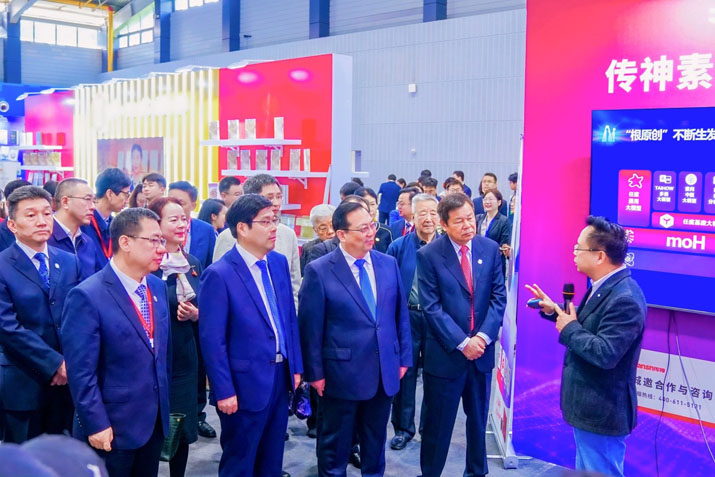
Participants visit booths of translation institutions at the Translators Association of China (TAC) annual conference on April 25 in Wuhan, Hubei Province (COURTESY PHOTO) A subtitle stays on screen for only a few seconds. If viewers have to pause to figure out who a historical figure is or what a cultural reference means, the video will have already moved on and the message will be missed. That is the challenge that Wang Lu, Director of the Film and Video Translation and Production Center of China Media Group and Executive Vice President of the Translators Association of China (TAC), has been grappling with. At the TAC's 2026 annual conference held in Wuhan, Hubei Province, on April 25-26, she described her team's solution as "telegram-style translation"—a minimalist approach that conveys maximum meaning with the fewest possible words, much like in the old days when we paid for telegrams by the (Chinese) character. "The audience has only one chance to catch it," Wang explained. "If your subtitle is too dense or too slow, they lose the visual experience. If it's too fast, they can't keep up. You have to find that sweet spot —clear, concise and compelling enough to hold their attention from beginning to end." This unforgiving reality of audiovisual translation has always been true. But in an era when Chinese web novels, online dramas, and video games are reaching overseas audiences by the millions, and when AI can generate subtitles in seconds, how should a translator adapt to the situation? How the translation industry is being reshaped by AI and what that means for telling China's story abroad are topics discussed at the TAC's 2026 annual conference, which gathered more than 900 representatives from government agencies, universities and language service companies. Translators should embrace digital technology to upgrade the industry while ensuring that translation retains its ideological depth and human touch amid the wave of technological change, said Chang Bo, head of China International Communications Group (CICG), at the opening ceremony of the annual TAC conference. He highlighted the role of translators and interpreters in promoting cultural exchange. "The 15th Five-year Plan (2026-30) for social and economic development has made major strategic plans to build a more effective international communication system and deepen inter-civilization exchanges and mutual learning," he said. "In the complex and turbulent international arena of public opinion, translators must maintain strategic focus and a clear sense of direction," he said, adding that they should accurately respond to the international community's attention to China.
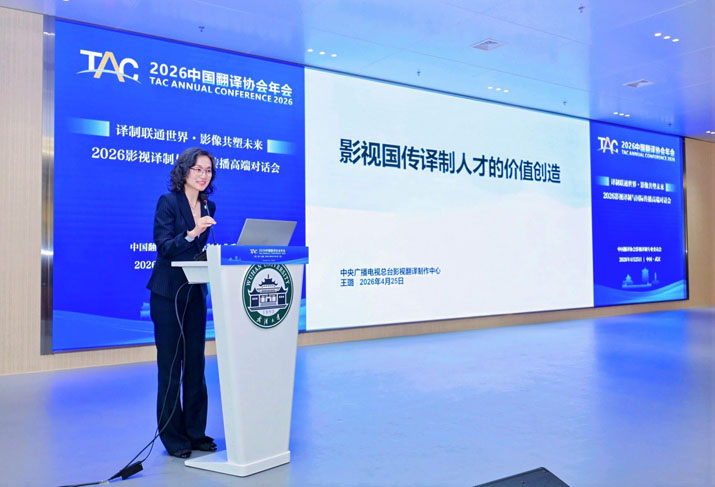
Wang Lu, Director of the Film and Video Translation and Production Center of China Media Group and Executive Vice President of the TAC, delievers a speech at a sub forum at the TAC annual conference on April 25 in Wuhan, Hubei Province (COURTESY PHOTO) Strengthened capacity Another central topic at this year's conference was the progress of the "Four Translation Projects," an initiative launched by TAC in 2025, covering talent development, cultural outreach, research and training. According to Du Zhanyuan, President of the TAC, the "Four Translation Projects" have bolstered China's multi-tiered translation talent pool. Focusing on brand building, the initiative has launched five major directions and selected a range of high-quality translation works from books to documentaries to enhance the global reach of Chinese civilization. To strengthen high-end think tanks' international communication capability, the TAC has partnered with provincial translation associations in Jilin, Shanxi, Guangdong provinces and Guangxi Zhuang Autonomous Region to conduct applied research. Key outputs include the 2026 China Translation Industry Development Report and 2026 Global Translation Industry Development Report, and the standards for the Japanese transliteration of Chinese cultural heritage terms. Additionally, specialized training programs, including MTI (Master's in Translation and Interpretation) degree courses, foreign affairs translation workshops and translation technology sessions, have been organized through partner institutions, effectively empowering highly-skilled translators. "With the talent pool now covering 53 disciplines, we are building a truly multi-dimensional workforce," Du said. "But capacity building is not just about numbers. We have issued group standards and published case study collection on translation practice to promote synergy across industry, academia and research." Ren Wen, Dean of the Graduate School of Translation and Interpretation at Beijing Foreign Studies University (BFSU), told the conference that her institution is already collaborating with CICG to develop joint doctoral programs in translation and co-design advanced courses. "To meet evolving demands, we prioritize developing all-rounded talents," Ren said. "In 2021, we pioneered a joint initiative with BFSU's School of International Journalism and Communication to train translators specializing in global communication." She explained that the program extends beyond core translation training. "Students engage with interdisciplinary coursework including new media studies, international news editing, media management, communication policies and journalistic ethics." This year, BFSU launched an AI-aided translation track covering generative AI fundamentals and applications, programming for translators, and AI ethics, Ren added. According to the indices on the global country-specific translation capacity, released by BFSU at the conference, China's national translation service ability ranks second globally—only behind the United States. "The next step is to make progress in translation legislation and planning," Ren said. Broadened horizons Translators and industry leaders also focused on how AI-powered translation is accelerating the global reach of Chinese digital cultural products. Web novels, online dramas and video games, dubbed the "new trio" of cultural exports, as compared to the three more conventional icons of jiaozi dumplings, taijiquan and the Chinese language, are reaching overseas audiences faster than ever before. A report on AI translation and the global reach of the "new trio" was released at the conference. "AI translation has shifted from an option to a necessity, becoming a foundational force supporting cultural exports," Wang said at the conference. She noted that in web literature, major overseas platforms using AI translation systems have reduced costs, achieving daily output of tens of millions of Chinese characters while enabling multilingual updates simultaneously. For online dramas, technologies such as AI-generated subtitles, voice cloning and lip-sync matching have shortened the time needed for multilingual adaptation, Wang added. The short drama sector is particularly benefiting from AI-powered language models, leading to a notable expansion in overseas markets. Gao Anming, Editor-in-Chief of CICG and Executive Vice President and Secretary General of TAC, highlighted at a panel discussion that film and television translation faces unique pressures. "Any boring segment, difficult terminology or indistinct dialogue can cause viewer to switch channels. Completion rate is the most important metric," he said. Gao called for improvements in content supply. "We need to expand our thinking from translation to communication," he said. "That means aligning narrative methods with the comprehension habits and aesthetic expectations of international audiences." From the perspective of documentary creation and global communication, Liang Bibo, a renowned documentary director and professor at the Beijing Film Academy, suggests that effective international communication relies on themes with universal human appeal and culturally recognizable Chinese elements. He also stresses that collaborative stories between China and other countries, major historical themes, and visually impressive cultural content carry strong potential for cross-cultural resonance. "Stories centered on ordinary people, shared emotions, and reallife experiences easily transcend borders, while distinctive Chinese symbols, natural landscapes, and modern development narratives provide accessible entry points for global audiences. These themes can echo without borders and bolster the impact of international communication," Liang said. Copyedited by Elsbeth van Paridon Comments to zhangyage@cicgamericas.com |
|
||||||||||||||||||||||||||||||
|