
|
| China |
| Growing numbers of young people are 're-raising their parents' | |
|
|
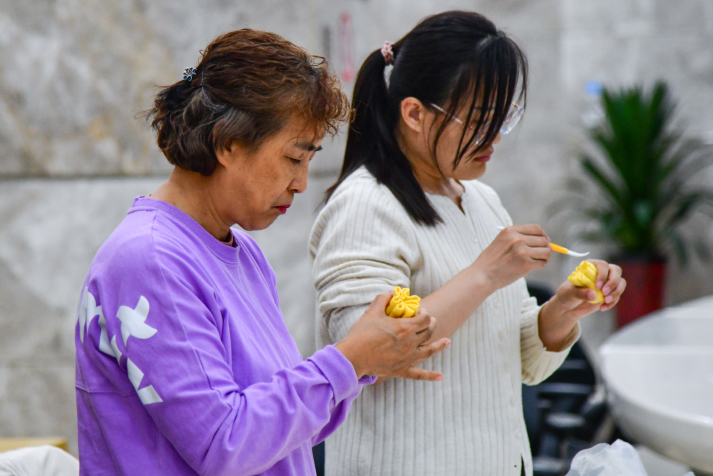 A retiree learns baking at a night school class in Jinan, Shandong Province, in April 2024 (XINHUA)
Instead of hitting up a trendy café like she usually does on weekends, Su Su, a 32-year-old professional working in Qingdao, Shandong Province, recently made a special trip to her parents' home. Her mission: teach her 61-year-old mother how to use a beauty camera app.
"Mom, smile—relax. Yeah, that's the angle," Su told her mother. Watching herself on screen—wrinkles smoothed away, skin brightened—her mom broke into a shy smile. "She was the one who taught me how to tie my shoes and write my name, step by step. Now it's my turn to hold her hand and help her find her way around this new world," Su told Beijing Review. This tender scene is playing out in countless Chinese households. Lately, a new trend known as "re-raising your parents" has emerged among young people, especially Gen Z. It doesn't mean literally raising your parents like children. Instead, it's a conscious effort to reshape the parent-child relationship by teaching parents the latest skills and ways of the modern world. In practice, this often starts with small, everyday acts: teaching parents how to use a beauty camera app, explaining Internet slang, or helping them navigate digital payments. But on a deeper level, it's about emotional re-parenting—offering the kind of patience, validation and gentle guidance that parents once gave their children, but now in reverse. "Re-raising your parents" was even listed as one of the social trends of 2026 in a report released by Just So Soul, the research institute of Chinese social networking platform Soul App, in partnership with Shanghai-based Fudan University in late 2025. "For young people, 're-raising their parents' isn't simply a matter of swapping roles. It's a conscious effort to reshape family dynamics once they reach adulthood—a sign of just how proactive and creative the younger generation can be when it comes to reimagining what family looks like," Xiao Xue, chief psychiatrist at Beijing Tsinghua Changgung Hospital told newspaper People's Daily. 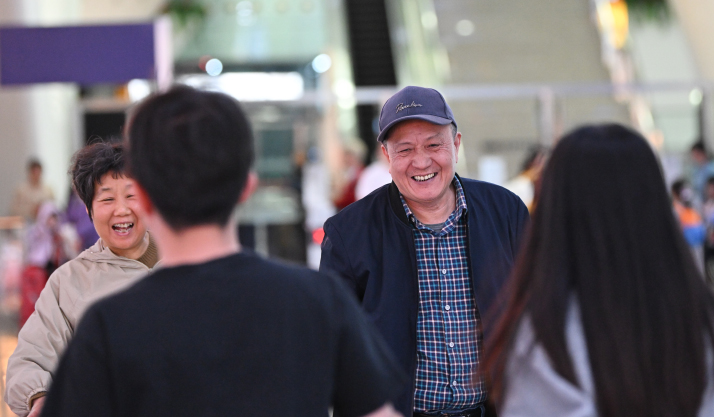 Parents pick up their son and daughter-in-law at a train station in Guangzhou, Guangdong Province, on February 7 (XINHUA)
Basic courses
For Su, the beauty camera tutorial was just the beginning. Over the following weeks, she offered more "lessons" to her mother. A new lesson started when her mother received a suspicious text message. "It said my bank account was frozen. I almost clicked the link," her mother confessed one evening. Su grabbed the phone and looked at the message—a suspicious sender number, urgent language, a misspelled website address. She sat down with her mother and went through the telltale signs of a scam, point by point. Su cautioned her mother to ask her first when in doubt. The next lesson was teaching her mother how to order food in a restaurant by scanning a QR code. One day when they dined at a restaurant, Su's mother stared at the QR code on the table, flustered because she had never used it. "I just want to talk to a real person and order my food," she whispered. Su had to explain that these days many restaurants no longer have paper menus or waiters who take orders. She walked her mother through the steps—scanning the code, navigating the digital menu and adding dishes to the cart. By the end of the meal, her mother had mastered it, though she still insisted it was "unnecessarily complicated." "These moments are not just about fixing problems. They are about being there—patiently, constantly—as my mother navigates a digital world that was never designed with her generation in mind," Su said. "But she is coping with it more quickly than I had expected." More people shared their experience in teaching their parents online. A netizen in his 20s posted about teaching his father how to use a ride-hailing app. He walked his father through setting up his pickup location, confirming the trip and tracking the driver's arrival. The first time his father successfully hailed a car on his own, he called him immediately. "The driver responded to me quickly," he announced proudly. "I'm inside it now." Another young woman recounted helping her mother understand why her phone storage was always full. The culprit turned out to be hundreds of screenshots—receipts, news headlines, recipes and random pictures her mother had saved "just in case." Together, they spent an afternoon deleting duplicates and organizing photos into albums. Beyond providing digital skills, the lessons have expanded into entirely new territory. Young adults are introducing their parents to skincare routines—explaining the difference between a cleanser and a serum, and why sunscreen is non-negotiable year-round. Some have been taking their parents to events their parents would never attend on their own: rock concerts with roaring guitars, electronic music festivals with booming bass, or hip-hop shows where the crowd chants every word. At first, the parents stand at the back, watching cautiously, unsure what to do with their hands. But soon enough, moms in sunglasses are documenting everything on their phones, while dads in bucket hats find themselves swaying to the headliner's rhythms with temporary tattoos on their arms. A healing process "Re-raising your parents" is closely linked to "family of origin issues," a topic that has been widely discussed online. In simple terms, family of origin issues are the emotional wounds and unhealthy patterns people carry from their childhood homes, whether it's feeling unheard, growing up with overly critical parents or learning to walk on eggshells around a volatile temper. For years, online communities have been spaces where young adults name these wounds, share their stories and try to heal. But "re-raising parents" takes a new path. Instead of just looking back at what went wrong, it asks a new question: What if we could give our parents the gentle care we wish we had received as children? "My parents are 'traditional'—my mother is overly naggy and my father isn't good at sharing his feelings. For a long time, I saw these as flaws I had to put up with," Su said. "But lately, I've started doing something different. Instead of waiting for them to change, I'm learning to meet them halfway—teaching my mom that silence can be comforting, and showing my dad that it's safe to say what's on his mind." "This is what re-raising them has taught me emotionally," she added. "I'm starting to relate to them more and understand them better through the very act of teaching them." "When more young people start to understand the underlying motivations behind their parents' actions and make a conscious effort to change how they respond, the dynamic between generations can move from confrontation toward genuine dialogue," Xiao said. However, not everyone gets the balance right. Yao Yuhong, a professor of psychology at Tongji University, has observed a subtle but telling phenomenon: Some young people who fiercely resist their parents' interference in their love lives and career choices end up doing the same thing in reverse—micromanaging every aspect of their parents' lives. They get upset when their parents scroll too much on short-video apps. They get angry when their parents are reluctant to spend money on themselves. Some even force their parents to change decades-old daily habits. She said some young people have fallen into a trap of control disguised as love, precisely the kind of behavior they resented most when they were on the receiving end as children. "The core of nurturing—whether it's raising a child or caring for an aging parent—is understanding, support and acceptance, not control, discipline or judgment," Yao emphasized in an interview with newspaper Wenhui Daily. (Print Edition Title: Swapping roles) Copyedited by G.P. Wilson Comments to luyan@cicgamericas.com |
|
||||||||||||||||||||||||||||||
|