|
| China |
| Minnan on the move | |
|
|
|
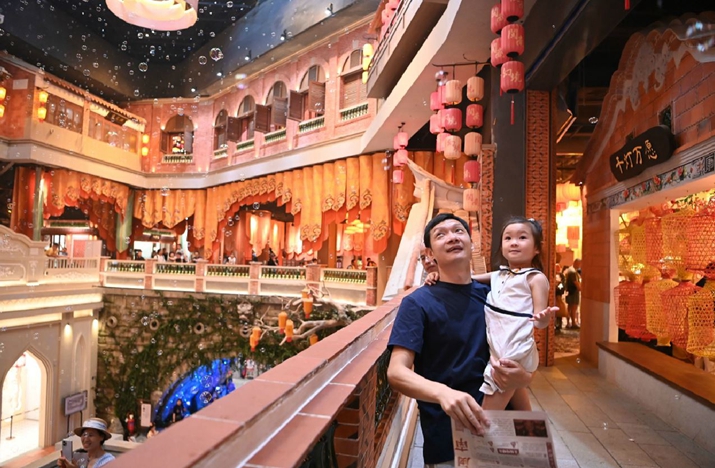
Time Meets Island: A Timeless Fantasy of Minnan, a Minnan culture-themed park located in the Xiamen International Cruise Homeport area in Xiamen, Fujian Province, on August 22, 2025 ( Stepping out of the Dongdu Passenger Terminal in Xiamen, a coastal city in Fujian Province, a 10-minute walk leads to a gateway where a millennium of history unfolds before the eyes. This is Time Meets Island: A Timeless Fantasy of Minnan, China’s first immersive theme park dedicated to Minnan culture, or Hokkien culture, originating in the southern part of Fujian. “We have truly encapsulated a millennium of Minnan culture into this space,” Huang Tao, the project’s Deputy General Manager, said. He spoke with the quiet conviction of a craftsman while pouring tea at a te-dau-ah, the Minnan term for a traditional open-air tea stall, in the park’s Hange Lane. Opened on May 17, 2025, the park is a masterpiece of urban renewal. Developed by Xiamen Port Holding Group, it has transformed the aging Xiamen International Cruise Center into a sprawling cultural odyssey. The site is divided into five chapters: Ancient Seas, Minnan Mirage, Gulangyu (Kulangsu) Echoes, Coastal Radiance and Cruise Era. The first phase, Minnan Mirage, spans 57,000 square meters and recreates the spirit of the region from the Song Dynasty (960-1279) to the modern era of Nanyang (Southeast Asian) migration. For Huang, the project’s significance lies not in its scale, but in its emotional and cultural value. He recalled an artisan in his late 60s perched on scaffolding, painstakingly turning two-dimensional sketches into three-dimensional reality. “At that moment, I realized that urban renewal is not just the reconstruction of space, but a relay race of memory and craftsmanship,” Huang told Beijing Review. This relay involved over 3,000 co-creators--directors, artists and 1,800 construction workers. Together, they selected 83 intangible cultural heritage items from the vast Minnan repertoire, weaving them into 116 buildings and over 100 interactive shows. Here, culture is no longer a static exhibit. It is a living ecosystem to be touched, tasted and lived. A gateway To understand this timeless fantasy, one must first know what Minnan is. Minnan, which literally means “south Fujian,” refers to both a region and a people. Centered around the cities of Xiamen, Quanzhou and Zhangzhou on China's southeastern coast, the area has long been a gateway for trade, migration and cultural exchange. Historically, Quanzhou was the starting point of the Maritime Silk Road and, during the Song and Yuan dynasties (960-1368), one of the world’s busiest ports. The Minnan people developed their own distinct language, which is still spoken by millions across the Chinese mainland, Taiwan and Southeast Asian Chinese communities. Wherever you find a Chinatown, from Manila to Jakarta to Singapore, you will likely hear the Minnan dialect. The Minnan culture’s essence lies in the fusion of two seemingly contrasting, yet complementary, elements: the adventurous spirit of seafaring merchants and a deep, poetic attachment to one’s roots. Huang has been in Xiamen for 20 years now, finding his calling as the space-time guide of this cultural window. “People ask why Xiamen birthed such a landmark,” he said. “My answer is ‘slow work.’ You must be willing to invest time to honor culture.” During the Song and Yuan dynasties, nearby Quanzhou stood as the world’s premier port. From these very waters, Minnan’s silk, porcelain and tea traveled to Southeast Asia, across the Indian Ocean and all the way to the East African coast. For Huang, Xiamen’s modern identity as a special economic zone (SEZ) is a continuation of this millennial genetic code of openness. An SEZ is a designated area in China where pilot policies and flexible measures are implemented to attract foreign investment, encourage exports and experiment with market-oriented reforms. Xiamen became such a zone on October 7, 1980--among the country’s first four SEZs established simultaneously that same year. “The spirit of those who ventured out centuries ago is the same spirit we see in today’s entrepreneurs here,” he said. “The Maritime Silk Road connected China to the world; Time Meets Island connects our past to our present.”
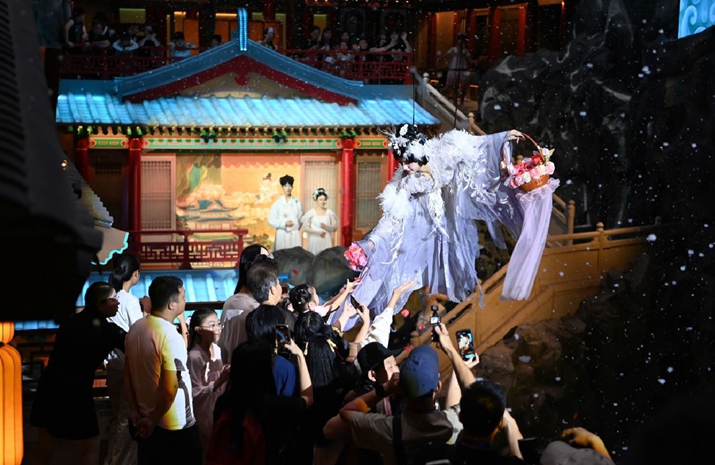
An actress portraying the Egret Goddess, a legendary figure that serves as a symbol of Xiamen, interacts with visitors at Time Meets Island: A Timeless Fantasy of Minnan on August 22, 2025 (XINHUA) The thread of heritage Inside the park, Yin Lili serves as a lishijun--a History and culture guide. Dressed in hanfu, the traditional attire of the Han Chinese, she regularly leads visitors through the Qiandeng (“Thousand Lanterns”) Lane. The architecture here is quintessentially Minnan: red-brick ancient houses with swallowtail ridges--curved rooflines that resemble the wings of a swallow, a symbol of the yearning to return home. A highlight of this heritage is chunzaihua (“spring flowers”), a 400-year-old craft of winding silk thread into intricate floral shapes. Historically, these symbolic flowers were worn by women during festivals and weddings to represent prosperity. Fu Mengtao, a practitioner of the craft, explained to Beijing Review that every flower shows a specific hope or blessing for the person who wears it: pomegranates for many children, chrysanthemums for longevity. “It took me three years to truly master the skill,” Fu said, her fingers flying as she transformed a simple silk strand into a blooming petal. Near the craft stalls lies the Qiaopi zone, a collection of old letters sent home by Chinese migrants living abroad. These documents were once the lifeline of separated families, combining personal messages with money orders sent back home. Yin pointed to a letter from a son to his mother: “I am safe abroad... sending money for the family.” “Why does the heart feel closer to home the farther one travels?” Yin asked. “Because the sea connects us. Whether you are in Singapore or London, the United Kingdom, if you hear the Minnan dialect or see a red-brick wall, home is right there.” This is the core of the park’s mission: To let those who left return home, if only through shared cultural memory. Across the Straits The story of Minnan is incomplete without Taiwan, where the same language, customs and flavors thrive. In the park’s Taiwan-themed section, neon signs hum with life. Here, Lin Muchen is busy slicing beef. Lin moved from Taiwan to Xiamen in 2019. “The environment and language here are almost identical to those of Taiwan,” he told Beijing Review. “Supportive policies for Taiwan compatriots made it the perfect place to build a life.” When he heard about Time Meets Island, Lin saw a chance to showcase the culinary link between the two sides across the Taiwan Straits. “Working among the glove puppetry and folk song performances I grew up with is wonderful,” he said. His recipes, family secrets passed down through generations in Taipei City, have found a new home in Xiamen. Lin has brought his whole family over; his two daughters attend local schools. “Moving across the Taiwan Straits was the most important decision of my life,” he reflected. For Lin, the sea is no longer a barrier, but a site for reunion. When asked what he would say to visitors from his hometown, he replied, “Whenever you visit from Taiwan, you are always welcome here. Consider this your home away from home for a bit.” Copyedited by Elsbeth van Paridon Comments to taozihui@cicgamericas.com |
|
||||||||||||||||||||||||||||
|