
|
| China |
| Why women are turning their gaze to menswear | |
|
|
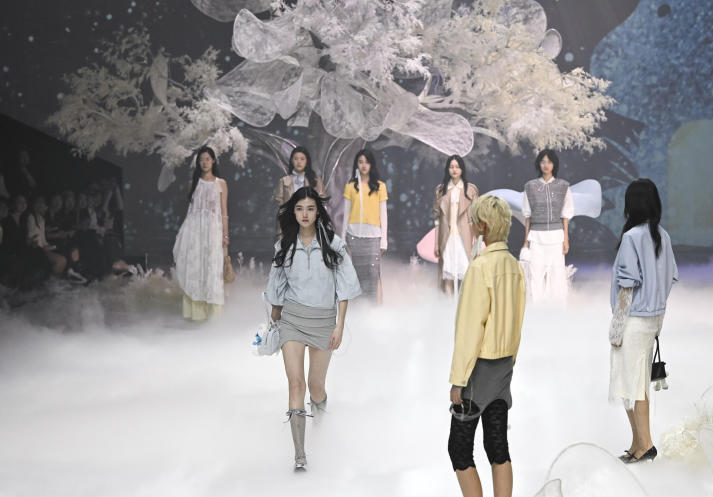 A show at the Fall/Winter 2026 Shanghai Fashion Week in Shanghai on March 25 (XINHUA)
It started with a simple annoyance during a hectic workday. Lin Zihan, a 28-year-old professional in Dalian, Liaoning Province, was juggling an iced coffee, her phone and a work pass, fumbling through an overstuffed tote bag for her car keys. Her "functional" women's trousers had pockets so shallow they could barely hold a credit card. That frustration led her to a section of the department store she had previously ignored. Today, Lin's wardrobe is about 60 percent menswear. She wears men's jackets, men's T-shirts and men's cargo shorts. "I was in a hurry once and just grabbed my husband's clothes to run some errands. That's when I discovered a whole new world," she told Beijing Review. Lin is not an outlier. In recent years, a trend of women wearing men's clothing has emerged in China. On social media platforms, more and more female consumers are voicing their frustration: "Why is it so hard to find a basic women's item with a normal fit and solid fabric?" Is this a bold expression of the new generation's individual style, or a reluctant escape forced by the declining quality of women's clothing? 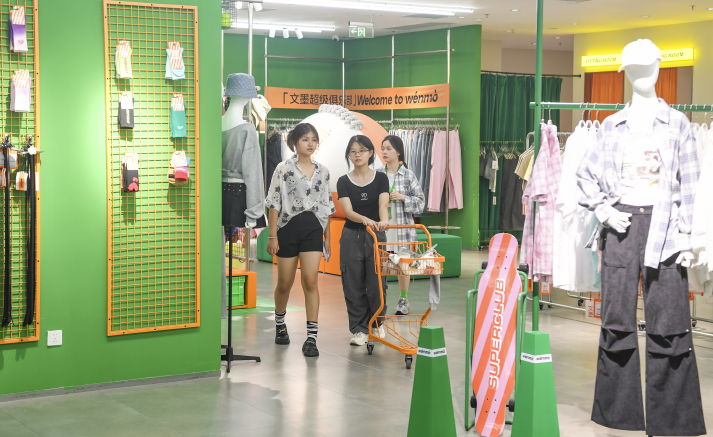 Customers select clothes at a shopping mall in Chongqing in August 2024 (XINHUA)
The shallow pocket trap "The sizing of women's clothing is just ridiculous," Lin complained. She finds herself constantly bouncing between Size M and Size XL. "I once tried on a pair of jeans from a fast-fashion brand—Size M was too tight to get into, but Size L had a waist three fingers too loose," she said. In pursuit of the so-called "perfect shoulder line," sleeves on women's clothing are getting narrower. And to create that "waif-thin" look, fabrics are becoming so thin they're practically see-through. Chen Mi, an office worker, once did a comparison at a clothing store. She held a women's Size S top next to an oversize piece from the kids' section and found that the adult top's bust was actually two sizes smaller. Even more absurd was what happened to Zhao Yan, another office worker in Beijing. In the fitting room, she discovered that a size L shirt was so tight that its straps left red marks on her shoulders, while the hem of an XL still couldn't cover her stomach. "Some clothes do look great on extremely thin celebrities, but I'm just an ordinary person," Lin said. "I just want clothes that are comfortable and look nice—not to sacrifice comfort just to look good." In contrast, menswear seems to have stayed true to its practical roots. The sizing is more consistent, the cuts are roomier, and the fabrics—while not always premium—are at least substantial enough to not fall apart after three washes. It's no wonder that more and more women are heading straight to the men's section when shopping for basics like T-shirts, hoodies or even blazers. "I've given up on women's white shirts," Lin said. "The men's small size fits me perfectly, and I don't have to worry about it being see-through or skin-tight." Women's versions often use flimsy, semi-transparent fabrics, while men's shirts come with a thickness that spares you that kind of awkwardness. Take jeans as another example. Women's pockets are often little more than decoration, whereas men's pockets can actually hold phones, keys and other daily essentials. The inner seams on women's clothes are often uneven, rubbing directly against the skin and causing irritation. By contrast, the inner seams on men's clothing are typically tighter and neater. Women's clothing may feature more decorative elements like ripped details and embroidery, but the inner seams are often relatively loose and the thread ends are finished more roughly. More importantly, at the same price, men's clothing tends to offer better quality and more thoughtful design than what's available in the women's section. Same price, different quality Why is there such a noticeable gap in quality between men's and women's clothing at the same price? The size of an order plays a big role in determining quality. Chen Bai, who works in the clothing industry, explained that men's clothing tends to feature classic styles that change slowly, so brands often place large orders for each design. Women's clothing, on the other hand, is driven by trends and moves much faster. A single style may only be on the market for one season, with orders as small as a few hundred pieces. "A single men's trousers order might start at 5,000 pairs," Chen told China Comment magazine. "Factories are willing to invest in better equipment and craftsmanship for that kind of volume. But for a small order of a few hundred pairs of women's trousers, the factory's investment is much lower." Under the fast-fashion business model, women's clothing relies on constant style updates to drive consumer demand. At the same time, trends set by luxury brands are often copied by fast-fashion retailers. Even as quality declines, the market still accepts it. Over time, this has created a production culture where women's clothing is held to lower standards than men's. On the design side, the fashion industry operates on two completely different sets of standards for men's and women's clothing. Womenswear designer Ling Zi explained that for womenswear, the number one rule is "looks good." The second rule is "looks slim." Everything else comes after. Designers are judged on their aesthetic sense and their understanding of the female body. To make clothes more appealing, they create an endless variety of styles and colors. And the old saying—"a woman's wardrobe is never complete"—has quietly fueled the shopping habits of generations of female consumers, turning womenswear into a fast-moving commodity. Menswear, by contrast, is still treated as a durable good. The focus is on functionality and comfort. Most men's patterns are simple, everyday designs that don't allow for much novelty, so they don't require a lot of creative flair. Ling recalled that when she graduated from fashion school, she chose womenswear over menswear precisely because she found menswear design "too boring." Most of a menswear designer's time, she said, is spent refining tiny details and figuring out how to make a garment more comfortable to wear. Getting things right For many women, buying men's clothing is often a choice made out of necessity rather than preference. "Finding men's clothes that actually fit well also takes luck," Lin admitted. The physical differences between male and female body types are real, and simply borrowing men's patterns isn't a one-size-fits-all solution for every woman. What the fashion industry really needs is to make adjustments on the supply side. Aware of the shifting attitudes among female consumers, the fashion industry has also seen the rise of genderless clothing in recent years. The genderless trend doesn't just mean androgynous style, nor does it simply refer to men wearing women's clothes or women wearing men's clothes. Instead, it's about embracing an inclusive philosophy that removes the boundaries between men's and women's clothing, allowing a single garment to serve a wider range of people. Some international fast-fashion brands were among the first to jump on this trend. However, brands interpreted the idea of breaking down gender barriers as simply making the most basic, mass-market essentials—think white, black and gray T-shirts, sweatshirts and jeans. "Whether it's women's clothing, men's clothing or genderless clothing, what we increasingly care about is the essence of the garment itself—a more comfortable and better value-for-money wearing experience, rather than marketing slogans that refresh endlessly," Lin said. Copyedited by G.P. Wilson Comments to luyan@cicgamericas.com |
|
||||||||||||||||||||||||||||||
|