
|
| China |
| The rise of experience-driven spending in China | |
|
|
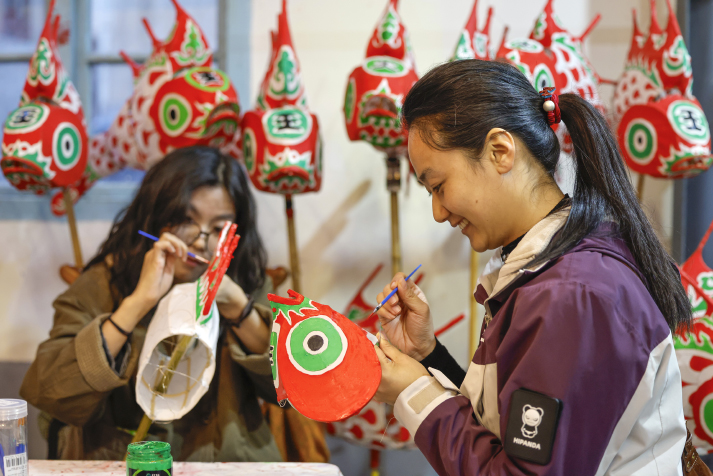 Visitors try their hand at making fish lanterns in Shexian County, Anhui Province, on March 1 (XINHUA)
To dine at Shuyanfu Restaurant in Chengdu, capital of Sichuan Province, is to steep in history. The experience transcends the typical culinary outing; it is an ancient banquet—a multi-sensory descent into the splendors of China's imperial past. The journey begins long before the first course is served. Guests typically arrive two hours early to be transformed; the restaurant offers a wardrobe of over 400 traditional hanfu sets, complemented by professional styling and makeup. After a session in the on-site photography studio, diners enter a hall where Sichuan cuisine is served, accompanied by traditional Chinese instruments. From the decor to the waitstaff, every detail is meticulously curated to offer an authentic "ancient" flavor. Lu Jun, the restaurant's marketing director, told the Chengdu Business Daily that this immersive program has proven exceptionally popular. Despite a premium price of 1,100 yuan ($150) per person, Shuyanfu remains fully booked across its three daily seatings. Ancient-style restaurants are proliferating across China's large cities. While these venues command some of the highest price tags in the market, they are rarely empty. 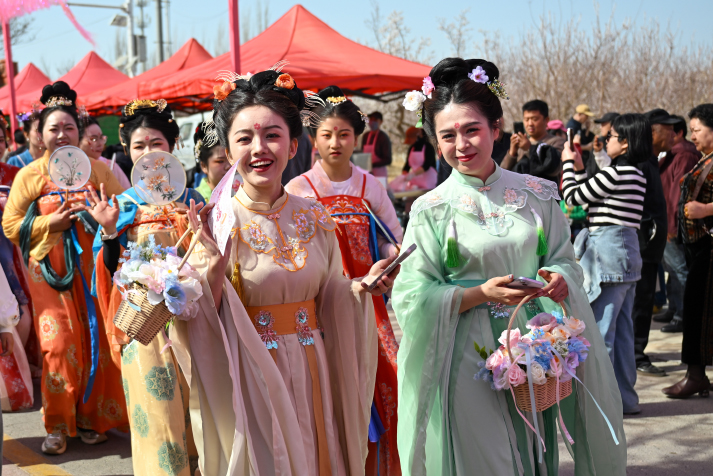 Tourists and local residents take part in a garden tour event in Tulufan (Turpan) City, Xinjiang Uygur Autonomous Region, on March 20 (XINHUA)
The macro shift The boom of these restaurants is part of a larger shift in consumption pattern in China: from buying goods to buying experiences. This "experience economy" is no longer a niche trend; it is a structural evolution driven by a growing demand for personalized, emotionally resonant consumption. While hands-on activities like tea picking and calligraphy workshops have long been staples of Chinese leisure, today's offerings are fundamentally different. Spurred by advances in augmented reality and virtual reality, the modern experience is more technologically sophisticated and interactive than ever before. "As per-capita GDP goes above the $10,000 threshold, basic material needs are largely satisfied," Zhang Yi, CEO of iiMedia Research, told Xinhua News Agency. "At this stage, consumption inevitably shifts toward emotional and psychological fulfillment." China has already crossed that threshold, with per-capita GDP climbing from $10,000 in 2021 to over $13,000 in 2025. The financial implications of this shift are staggering. According to a 2025 year-end report, China's experience market reached 18.4 trillion yuan ($2.68 trillion)—a 22.6-percent year-on-year increase that outpaced the global average by over 7 percentage points. Furthermore, iiMedia Research predicted that the market value of the emotional economy will exceed 4.5 trillion yuan ($618 billion) by 2029, nearly doubling its 2024 value. Experience economy, by satisfying emotional needs, is closely related to emotional economy. Policymakers are moving just as fast as the markets. In January, the General Office of the State Council released a strategic plan specifically targeting "emotion-driven and experience-based services" as new growth engines. Regions like Hubei and Jiangxi provinces have taken the unusual step of codifying terms like "emotional value" into their official government work reports, signaling a state-level commitment to this new frontier. This transformation is reshaping landscapes far beyond the dining table. From urban centers to rural resorts, the focus is now on the "spectacle." A prime example is Along the Yellow River, a large-scale immersive epic performance in a resort in Dezhou, Shandong Province. The 70-minute production has emerged as a cornerstone of regional tourism. "Beyond our cast of 200 professional actors, we've deployed over 140 retractable holographic screens and 30 mechanical lift stages to create a fluid, dynamic performance space," Liu Yan, a resort employee, told Xinhua. The investment has paid off: Since its May 2025 premiere, Along the Yellow River has drawn nearly 200,000 visitors and significantly lifted the occupancy rates of themed hotels in the vicinity. The experience economy is also reclaiming the "everyday" spaces of the city. On April 4, the Soloists' Ensemble of the Moscow State Tchaikovsky Conservatory performed an unconventional concert atop the roofs of a historic neighborhood in Shanghai's Hongkou District. Beautifully restored traditional alleyway houses served as a gritty, authentic backdrop for world-class strings. The performance drew a dense crowd of residents and tourists, standing several rows deep in the narrow alleys. As an adapted arrangement of the classic anthem The Bund echoed against the brickwork, it stirred a wave of collective nostalgia, prompting many in the audience to hum along. Industrial immersion The experience economy is even transforming factories. In Haikou, Hainan Province, the Coconut Palm Group factory has undergone a radical transformation from a functional manufacturing hub into a vibrant social media landmark. Since the 2026 Spring Festival holiday, industrial experience tours have seen a surge in popularity, with crowds of residents and tourists flocking to the production lines to witness the rhythmic choreography of bottling and packaging firsthand. Across China, industrial tourism is turning heritage sites into high-end leisure destinations. In Qingdao, Shandong, the historic Tsingtao Brewery has long set the pace, integrating century-old cellars with immersive tasting rooms and digital museums. "Modern consumers are no longer just a buyer; they are a witness," notes a recent industry report from Xinhua on industrial revitalization. By inviting the public to go "behind the curtain," traditional industries are securing new revenue streams and, more importantly, building brand trust through transparency. 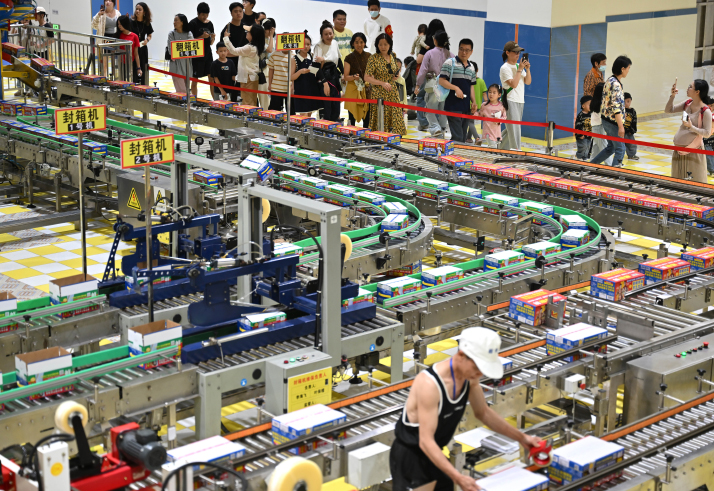 Tourists visit the factory of Hainan Coconut Palm Group in Haikou, Hainan Province, on February 27 (XINHUA)
Tactile tranquility Beyond the grand scale of immersive tourism, the experience economy is carving out a quieter, more intimate space through hands-on crafts. A handicraft involving the meticulous arrangement of small plastic fuse beads into intricate patterns has increased in popularity over the last year. This once-niche hobby has evolved into a meditative sanctuary for young urbanites. Wang Luyi, a 24-year-old resident of Shenyang, Liaoning Province, has become a regular at a local DIY studio. "It helps me forget everything else," Wang told Xinhua. "When I'm focused on the beads, the pressure of deadlines simply disappears." The surge in demand has triggered a rapid transformation in the retail landscape. Data from the digital sphere have confirmed this grassroots momentum. On the e-commerce giant Taobao, sales of pixel bead art supplies surpassed 100 million yuan ($14.5 million) in 2025. Meanwhile, a trend report from the lifestyle platform RedNote (Xiaohongshu) ranked bead art, alongside crochet and handmade jewelry, as one of the top 10 "unexpected" hobbies of the year, with related social media discussions surpassing 23 million. This cultural shift is reflected in the corporate registry as well. According to Qichacha, a leading business data platform, 6,955 new handicraft-related companies were registered in 2025—a 31-percent year-on-year increase. The combination of intangible cultural heritage and handmade crafts has also become a driver of the experience economy. In Shexian County, Anhui Province, the traditional fish lantern, once a "rustic craft" practiced during the Spring Festival, has evolved into a sophisticated, experience-driven ecosystem. No longer just part of the Spring Festival parade, the fish lantern is now the anchor for a network of boutique homestays, themed dining and curated study tours. By integrating ancient folklore with modern hospitality, Shexian has proved that heritage can be a vibrant, sustainable engine for local growth. Yet, for many in the younger generation, the true value of heritage lies not in the spectacle, but in the silence. In Chengdu, a senior university student named Xiao Zhong represents a more personal side of this economic shift. Xiao invested over 5,000 yuan ($730) in a 16-lesson course to master the art of making lacquer beads, a form of intangible cultural heritage. The process is an exercise in extreme patience: Natural sap is applied in dozens of layers onto a wooden core, which is then meticulously carved and polished to reveal swirling, iridescent patterns. As youth study tours fill the studio around him on weekends, Xiao remains focused on the tactile rhythm of his work. In a fast-paced digital world, he has found the ultimate luxury: the ability to slow down. "Here, in the fusion of raw lacquer, sand and water," Xiao told Chengdu Business Daily, "I listen to the sound of time." Copyedited by G.P. Wilson Comments to yuanyuan@cicgamericas.com |
|
||||||||||||||||||||||||||||||
|