|
| China |
| A 1,400-year-old craft is being reshaped in the hands of a new generation | |
|
|
|
In today's Xiamen, a city in southeast China's Fujian Province, defined by busy ports, bustling streets and constant flow of visitors, traces of a much slower rhythm can still be found. Tucked away along an unassuming street, a small workshop continues a craft that has endured for more than 1,400 years. Inside, artisans are quietly shaping fine threads by hand—line by line, as generations before them once did. The craft is lacquer thread sculpture, or qixiandiao. "Lacquer thread sculpture begins with twisting the thread. Raw lacquer, tung oil (a drying oil) and brick powder aged over many years are hammered together into a dense, malleable paste. Worked patiently by hand, the material is rolled into lacquer threads that are soft yet resilient, varying in thickness. The finest of them are as delicate as a strand of hair," Cai Chaorong told Beijing Review. He is the 13th-generation inheritor of this craft. "At the heart of the craft lies panxian—the coiling of the thread. Without interruption, the lacquer threads are wound, layered and stacked, one line following another in a continuous flow. Through this meticulous process, intricate patterns slowly emerge, rich in depth and rhythm, built entirely from the quiet accumulation of countless lines," he continued. The origin of the craft can be traced back to the Tang Dynasty (618-907), when Buddhism spread widely across south Fujian. As devotion deepened, so did expectations for the appearance of Buddhist statues. Artisans began developing a specialized decorative technique known as zhuangfo, or "adorning the Buddha." Using lacquer threads, gold and intricate detailing, they transformed wooden figures into objects that reflected both craftsmanship and belief. Lacquer thread sculpture has undergone centuries of evolution. It embodies the elegance of Jingdezhen porcelain, the spiritual subtlety of Fuzhou bodiless lacquerware and the brilliance of Beijing cloisonné—the qualities of the "three treasures" of traditional Chinese craftsmanship. At the same time, it draws from the folk techniques of south Fujian artisans, blending carving and embroidery-like methods. Incorporating elements from folk traditions, religious art and imperial ritual objects—such as ceremonial vessels, sacrificial ware and tribute offerings—the art is further enriched with gilded and silver details. The result is a style that is resplendent, dignified and highly prized for both its visual impact and its collectible value.
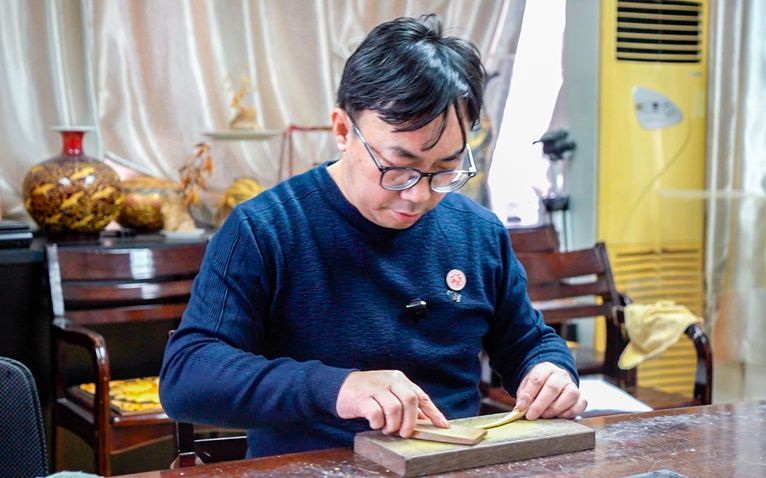
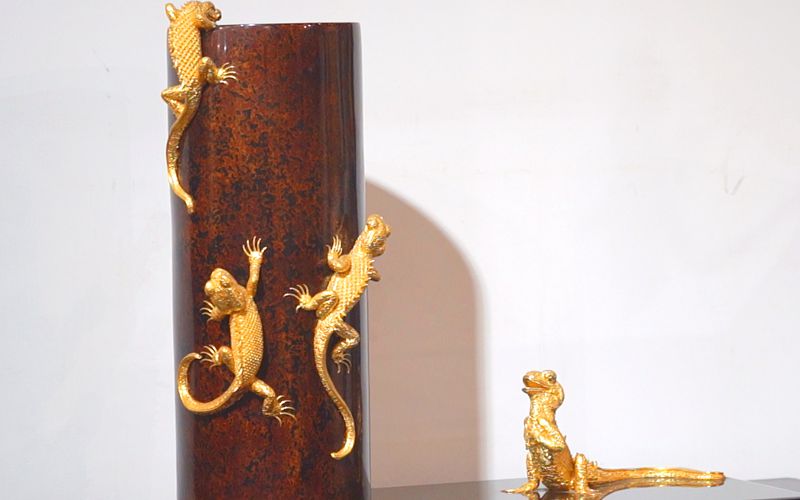
Cai Chaorong twists a lacquer thread at his studio in Xiamen, Fujian Province, on January 22 (YINKANG) The family line Among those who have carried this legacy into the present is the Cai family of Xiamen, custodians of the craft for 13 generations. Their story is one of dedication and revival, of craft lost and found again, reshaped and reimagined with each successor. Cai Shuikuang, a 12th-generation master, spent 10 years in seclusion, seeking harmony between tradition and the modern world. He gave this evolved art its modern form. Under his guidance, lacquer thread sculpture spread from the sanctity of Buddhist statues to porcelain plates, vases and even the delicate surface of eggshells. The 13th-generation torchbearer, Cai Chaorong, now stands at the forefront of this living tradition. Recognized as a provincial-level representative inheritor of Xiamen lacquer thread sculpture and selected as a national-level inheritor of intangible cultural heritage in 2025, Cai Chaorong represents the delicate balance between preservation and innovation. Cai Chaorong's artistry is based on the traditional approaches. The four core processes of lacquer thread sculpture, namely, sculpture, base coating, line decoration and gilding, remain at the heart of his practice. Yet he supplements these with modern tools: 3D modeling enables him to design intricate forms with precision, and contemporary subject matter infuses the art with new vitality. Reimagining tradition Unlike the solemn figures and gilded deities that once defined lacquer line sculpture, the piece Five Sons Achieving Success holds a special place in Cai Chaorong's heart. It presents a scene that is far more intimate: At the base of a brush holder, a lizard pauses, while above it, five tiny lizards climb upward, their bodies pressed against the smooth surface as they inch toward the rim. The setting itself carries layered meaning. "In ancient China, the brush holder was no ordinary object. It belonged to the scholar's desk and symbolized learning," Cai Chaorong explained. "Only households devoted to study would have one. It represented knowledge, ambition and a cultivated life." Placing the lizards within this context turns a simple moment into a quiet metaphor for growth and the pursuit of knowledge. What makes the work distinctive, however, is not only its narrative but also its form. Traditionally, lacquer line sculpture appears in relief, serving as surface decoration. Here, the technique is developed into full-round sculpture. The lacquer lines do not simply embellish; they build structure, volume and movement. As the viewer moves around the piece, light shifts across its gilded curves, revealing new details from every angle. Also transformative is the choice of subject. For centuries, lacquer line sculpture has been associated with solemnity—religious icons, mythic guardians, grand symbols of authority and ritual. The craft carried a dignified weight. Lizards—nimble, familiar creatures of everyday life—become the protagonists, introducing a sense of playfulness. In doing so, the piece offers a different way of understanding the craft, grounding a long-standing tradition in scenes drawn from ordinary life.
Details of Five Sons Achieving Success, a lacquer thread sculpture created by the art’s inheritor Cai Chaorong (YINKANG) Among his celebrated works, Tiger Crouches, Dragon Coils stands out. This synthesis of traditional craftsmanship and modern vision was recognized with the 12th Shanhua Award of Chinese Folk Literature and Art, an honor that acknowledges master artisans, folk performers and scholars who work to keep traditions alive. He has also contributed to national ceremonial artistry, including the design of Shenwu Dayuanshuai, an award-winning Chinese lacquer thread sculpture that was a state gift for the BRICS leaders' summit in Xiamen. BRICS is a 10-member group of emerging economies originally consisting of Brazil, Russia, India, China and South Africa. Yet recognition alone does not define him; like generations before him, Cai Chaorong is committed to passing the craft forward. He teaches, mentors and brings qixiandiao into classrooms, ensuring that this delicate heritage is not merely preserved in glass cases, but lives and breathes in the hands of new practitioners. While the technique itself is highly refined, he noted that the craft's core competitiveness remains insufficient. Most existing works are designed primarily for display, with limited interactivity. Therefore, he has also attempted to combine this technique with popular IPs, to meet public demand for intangible cultural heritage products that are not only to be admired, but also handled and experienced. He used lacquer thread sculpture to decorate dolls and daily items, so that this craft could reach a wider audience. In the hands of the Cai family, qixiandiao became a heritage that is not frozen—it is a living thread, delicate yet enduring, capable of carrying the weight of history while inspiring the visions of tomorrow. (Print Edition Title: Threads of Time) Copyedited by Elsbeth van Paridon Comments to kangcaiqi@cicgamericas.com |
|
||||||||||||||||||||||||||||
|