
|
| China |
| Stories from a tech forum on the human side of innovation | |
|
|
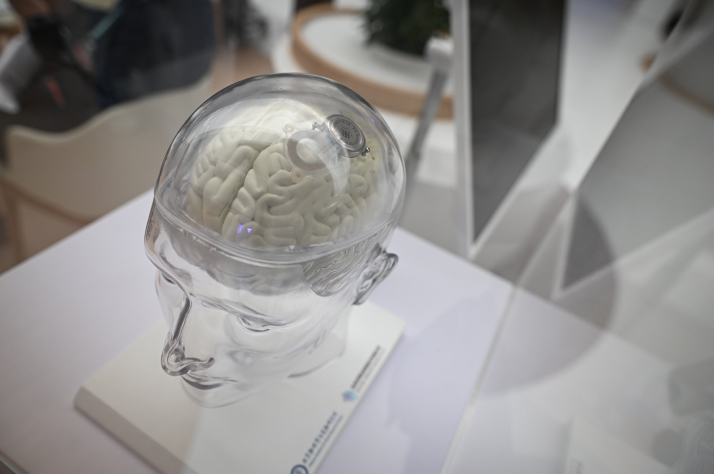 The Beinao-1 brain-computer interface on display at the Zhongguancun International Innovation Center in Beijing on March 26, 2025 (XINHUA)
With robots that leap, back flip and breakdance, tech forums are meant to dazzle participants. Yet you might leave such events wondering how much of these spectacles will ever matter in everyday life. At this year's Zhongguancun Forum Annual Conference, held in Beijing's Zhongguancun—often described as China's Silicon Valley, on March 25-29, the answer, at least in one respect, was reassuringly clear. Launched in 2007 and themed Innovation and Development, the forum is a high-level platform for sci-tech innovation exchange and cooperation. More eye-catching displays aside, the forum also presented a less visible class of innovation. Among them: brain implants designed to restore movement and communication; digital services that help people with reduced mobility travel more independently; and voice-repair systems that give people with speech impairments new ways to be heard. These are very different stories, yet all share the same core: How science and technology are beginning to change not just what people with disabilities can do, but how fully they can participate in the world around them. From thought to motion "Pick up the cup," Xiaorui (pseudonym) thought. A robotic arm fixed to the table slowly lifted a cup of water to his lips. While taking a sip, he could not hold back his tears. It was the first time in years that he had been able to drink water on his own. In 2022, a car accident left him with a spinal-cord injury, paralyzing him from the neck down. After all other options had been exhausted, he became the first patient, in February 2025, to receive an implant in the clinical trial of Beinao-1, a semi-invasive brain-computer interface (BCI) developed by the Chinese Institute for Brain Research (CIBR) in Beijing. A year later, he was able to use his own hand to eat strawberries, which was hailed as a major step from machine-assisted movement toward partial self-recovery. According to Luo Minmin, Director of CIBR and the chief scientist behind the trial, BCI development has long been shaped by a trade-off between precision and safety. Invasive systems capture clearer signals by placing electrodes beneath the dura mater, the membrane surrounding the brain, but require riskier surgery. Non-invasive ones rely on wearable external devices and are therefore safer, though less precise. Beinao-1 takes a middle path: Through minimally invasive surgery, flexible electrodes about one 15th the width of a human hair are placed outside the dura mater, without penetrating the brain itself. "Its transmission rate still lags somewhat behind invasive products, but it is highly stable," Luo said at an event during the forum. So far, Beinao-1 implants have helped improve mobility and speech in seven patients living with conditions including spinal-cord injury, post-stroke hemiplegia and amyotrophic lateral sclerosis (ALS). For Luo's team, speech posed a particular challenge. "This is the world's first case of standard spoken Chinese decoding, which is vastly different from decoding English syllables," Yuan Yaning, a CIBR staff member, told Beijing Review. This breakthrough in speech decoding is just one example of how China, despite a relatively late start, is moving quickly in the field. The Chinese Government has designated BCI as one of the six industries of the future to be prioritized during the 15th Five-Year Plan (2026-30) period. On March 13, China became the first country in the world to approve an invasive BCI medical device for commercial use, a major step for a technology that has long been stuck in clinical trials worldwide. Amid this broader push, Luo's team plans to implant Beinao-1 chips in another 50 to 100 patients by the end of this year. Beinao-2, a newer invasive model currently undergoing animal testing, is also expected to enter clinical validation later this year. For China's estimated 3.74 million people with spinal-cord injuries, nearly 15 million stroke survivors and tens of thousands living with ALS, these numbers are tiny. Yet they represent a hopeful, if still narrow, opening. 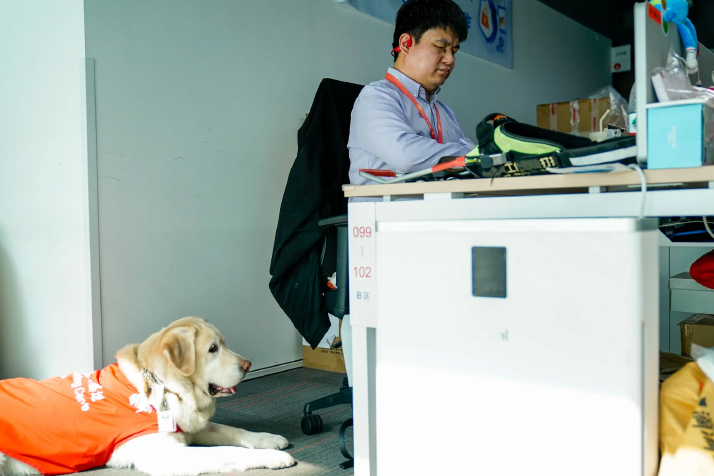 Wang Zhihua, his trusted guide dog Mango by his side, at work in his office at DiDi, China’s largest online ride-hailing platform, in Beijing (COURTESY PHOTO)
Rewiring the ride At one assistive technology-themed event at the forum, amid discussions of hard science, Mango, a guide dog on the stage, drew particular attention. Its owner is Wang Zhihua, head of the accessible travel service program at DiDi, China's largest online ride-hailing platform. For China's 17 million people with visual impairment, hailing a cab was once a daunting task. As Wang recalled, he had to rely on the sound of the engine to judge whether a car was approaching. Yet it was hard to distinguish between taxis and private cars just by listening. On one occasion, he even flagged down a police car. So when the DiDi app launched in 2012, Wang was among its first users. "The changes wrought by digital technology are often quiet; but set against a longer timeline, their impact is unmistakable," he told Beijing Review, reflecting on how routines that once required painstaking guesswork—feeling his way along supermarket shelves or trying to piece together information through conversation—have gradually given way to the ease of apps that use voice commands to order groceries online and deliver news. Yet technology alone does not solve every problem. After Mango joined him in 2016, hailing a cab became unexpectedly difficult. With fewer than 100 trained guide dogs in China at the time, Wang often encountered drivers who mistook Mango for a pet. After countless rejections, Wang began reporting the problem to DiDi. And out of the blue, one day in 2019, the company contacted him with a job offer, and he became a member of its accessible travel service team. Since then, he has participated in several rounds of program upgrades. One persistent difficulty was helping visually impaired passengers locate their ride. After multiple revisions, the app now sends drivers a voice prompt asking them to contact the passenger in advance and help guide them into the vehicle. Those who serve passengers traveling with guide dogs also receive an additional bonus of 10 yuan ($1.5) per trip. To make the project work better in practice, DiDi has also brought in people with disabilities as accessibility testers to evaluate its functions. "Decisions about accessibility should not be made without the participation of those they are meant to serve," Wang observed. Progress, however, relies not only on the involvement of people with disabilities but also on driver support. To that end, DiDi has introduced a certification mechanism under which drivers are trained to better assist people with disabilities. As of this February, 3.48 million drivers had completed the certification. As Wang puts it, accessible travel is not only about cutting-edge technology, but also about the people who make it work. "People talk about 'tech for good,' but goodness is a human quality," he said. "The role of technology is to bring people closer together, so that everyone can be involved." Access & awareness That idea that science is, at its core, a human endeavor, was reflected in the story of another forum attendee: Wang Sujing, widely known as the "Chinese Stephen Hawking." Born with cerebral palsy, Wang Sujing spent much of his childhood in rehabilitation centers. Yet despite all the hardships, he developed a passion for computer science. After teaching himself the equivalent of an undergraduate education in the subject, he was granted exceptional admission to Jilin University in the northeastern province of Jilin. He is now an associate research fellow at the Institute of Psychology at the Chinese Academy of Sciences, where he studies the use of micro-expression recognition for mental-state monitoring, an area with enormous potential to deepen understanding of mental disorders. Beyond academia, Wang Sujing has also applied his computing skills to building the world's largest database of recorded Chinese (standard and Cantonese) speech samples from people who have difficulty speaking, including those with conditions like ALS, post-stroke aphasia or other speech disorders. "Researchers with disabilities have a unique role to play in creating a more accessible world, given we understand both the technology and the needs," the research fellow told Beijing Review. And he's not alone. Nationwide, people with disabilities are playing an increasingly active part in driving technological progress. Zhou Fugui, a visually impaired programmer, developed an app that describes a user's surroundings in real time. Li Linqing, who, like Wang Sujing, was born with cerebral palsy, created an AI-powered map for people with limited mobility that can identify accessible facilities and plan routes accordingly. Yet for all the rapid advances in assistive technology, Wang Sujing himself has noticed, with some frustration, that public awareness of disability remains quite limited. "Technology tends to focus on helping us overcome physical barriers, but it is just as important to address our psychological needs," he said. "That is where disability awareness comes in: It helps build a more inclusive society for all." That awareness, though still incomplete, has been slowly improving, Wang Zhihua has found. "The inconveniences Mango once caused were never really about the dog itself, but about people's lack of understanding," he said. In recent years, however, he has found himself turned away less often—whether when hailing a ride or entering public places. Deep down he believes that one day, when public awareness is strong enough, voice alerts like the ones he helped to refine will no longer be needed. That future may still be some way off. But it no longer feels entirely out of sight. (Print edition title: Codes of Care) Copyedited by Elsbeth van Paridon Comments to pengjiawei@cicgamericas.com |
|
||||||||||||||||||||||||||||
|