
|
| China |
| Why China's parks belong to the grandmas and grandpas, and why that's a beautiful thing | |
|
|
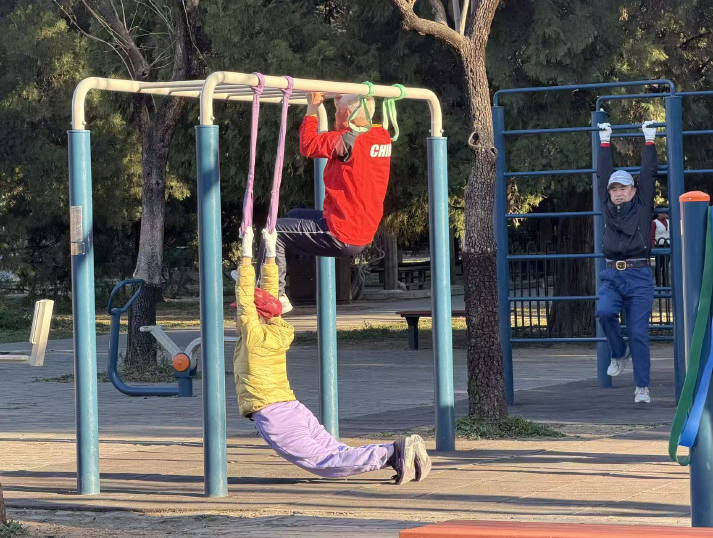 Seniors exercise at Beijing’s Temple of Heaven Park on April 1 (YUAN YUAN)
Spending the morning at the Temple of Heaven Park in Beijing will make many young people rethink what it means to be "old." Shortly after the gates open at dawn, a wave of silver-haired regulars streams in, scattering across the park. One corner, however, draws the biggest crowd—a cluster of parallel bars, horizontal bars and other outdoor fitness equipment. These seniors know each other well. They greet one another, trade small talk, ease into their warm-ups and then launch into their signature moves. Some elderly men swing their legs onto the parallel bars and then hold a handstand. Others pump out pull-ups on the horizontal bar. A group gathers on the sit-up benches, performing advanced crunches—hovering in the air as they curl their torsos upward, all while chatting and laughing as if it were nothing. For many people half their age, these moves would pose a serious challenge. These "morning exercise grandpas" have long been a viral sensation on Chinese social media. You'll find them in parks nationwide, their jaw-dropping skills and effortless mastery leaving younger generations in awe. Consider the gray-haired man who spins a full circle on the horizontal bar, without even bending his knees. Park veterans On March 17, Team China table tennis player Qian Tianyi took to social media to share a video from Wudingmen Park in Nanjing, Jiangsu Province. She joked in the caption: "Young people should go to parks less often—it can easily hurt your self-esteem." In the footage, she encountered uncles and aunties doing advanced stretches, making homemade chalk for better grip, and playing table tennis with impressive skill. She even joined a match with a left-handed "uncle" who mimicked table tennis star player Fan Zhendong's signature moves. "Even as a professional athlete, I felt challenged by these grassroots veterans," she wrote. In Chinese culture, "uncle" and "auntie" are terms of respect and familiarity used to address older adults who are not necessarily relatives. This wasn't the first time a star was awed by seniors at a neighborhood court. Back in 2021, former table tennis champion Zhang Jike was outplayed by an 80-year-old man who switched hands fluently; the senior then teamed up with his wife for mixed doubles and used steady tactics to put the former Grand Slam winner under heavy pressure. Popular actor Tu Songyan also shared a video on Douyin (the Chinese version of TikTok) on March 11, capturing a morning visit to the Temple of Heaven Park. "You can feel the vitality," he said. "Every major park is full of hidden masters." He chatted with an 81-year-old man who told him the oldest regular there was 96. For some people there in their 70s, navigating the full length of the monkey bars—a horizontal ladder—is considered standard. Tu decided to give the monkey bars a try. He took one swing and let go, finding it more challenging than it looked. "My hands hurt," he admitted. An old-timer next to him explained it takes two or three years of practice to build up to it, and showed Tu the calluses on his hands—honed from years of gripping the bars. "Morning workouts in Beijing's parks are no joke," Tu said. "There's just no competing with these grandpas and grandmas." Not every senior in the park pursues such "hard stunts." Among those who don't is 68-year-old Zhang Yu, who leads a small troupe specializing in a remarkable four-ring acrobatic catch—a skill he has honed over 22 years of daily practice. In 2004, as he neared retirement, Zhang discovered the activity during a workout at the Temple of Heaven Park. "It was so much fun," he told newspaper Beijing Daily. The game was invented by an elder surnamed Song, who also taught everyone how to handcraft the rings. Each ring has a soft rubber inner layer wrapped in red and yellow fabric, measuring about 30 centimeters in diameter and weighing roughly 150 grams. The setup is simple but demanding: One thrower stands 10 to 15 meters away and simultaneously tosses four rings, while four "targets" stand in a row, catching the rings with their heads or necks. The goal is to land all four rings in one go. Zhang is currently the only one who can consistently execute the four-ring toss successfully—a skill that took him some five years to master. Beginners typically need about a month or so just to get the hang of it. For Zhang and his companions, ring tossing is about far more than physical fitness. "It's a full-body exercise—it works the neck, shoulders and strengthens the core," he explained. "But more importantly, it's helped me find like-minded friends who share my passion for staying active as we age." Health and passion Young netizens have two main theories for why seniors seem so energetic and healthy: They no longer have to work, and they have a stable pension. A 72-year-old Beijing resident surnamed Wu, who regularly practices taijiquan (also known as tai chi) at Ditan Park in Beijing, admits that retirement has given him more time to engage in outdoor activities. "When I was working, I sat in an office all day, like a plant," he told Beijing Review. "Since retiring, I finally have more time to stretch my body. Many younger people today have jobs that require long hours of sitting, which definitely affects their health." Wu, like Zhang, has found a steady group of exercise partners at the park. "Many people have experienced real health gains—fewer aches and pains that come with aging, better blood sugar levels and lower blood pressure. Witnessing these benefits is what keeps so many committed to their daily practice," he said. For 68-year-old Wang Yali, however, the motivation goes beyond health. A deep love for an activity and the need for social connection have kept her going for years. Twenty years ago, she suffered a stroke that left her partially paralyzed. She had to rely on a wheelchair for over a year. After recovering, she was out taking a walk at Beijing's Beihai Park when she noticed a group performing a colorful ribbon dance. A dozen people were waving ribbons over 8 meters long, creating a vibrant, flowing spectacle. "This is a great exercise—it gets the whole body moving," she told Beijing Daily. After mastering the dance herself, more of Wang's friends joined in. By 2020, the ribbon dance team she led had grown to a considerable size. In the past two years, the team has expanded to over 100 members, moving their practice venue from Beihai Park to the Bell and Drum Towers Square. "Since Beijing's Central Axis was added to the World Heritage list, there have been many more tourists in the square," Wang said. "I hope our dancing figures can become a beautiful sight here." The Central Axis is a 7.8-km north-south line running through the heart of Beijing, comprising a sequence of gates, buildings and streets that served as the architectural and ceremonial spine of the Chinese capital from the Yuan Dynasty (1271-1368) onward. It was inscribed as a UNESCO World Heritage Site in 2024. Beyond parks and squares, Wang's ribbon dance dragon team also performs at community centers, theaters and schools. Through their daily practice, Wang said, the women in her group have forged deep bonds. "For us, ribbon dancing is about health, happiness and, above all, friendship." Copyedited by Elsbeth van Paridon Comments to yuanyuan@cicgamericas.com |
|
||||||||||||||||||||||||||||
|