|
| China |
| Tianjin world championships showcase the growing global appeal of Chinese martial arts | |
|
|
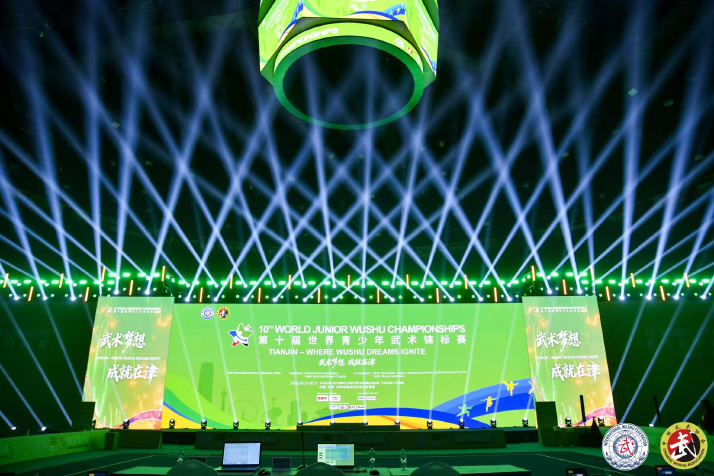 The center arena of the 10th World Junior Wushu Championships in Tianjin on March 25 (COURTESY PHOTO)
In a training area inside the Tianjin Olympic Center Gymnasium in Tianjin Municipality, Mariela Brayton, a teenage U.S. athlete, demonstrated the opening of a taijiquan (tai chi) routine. She bent her knees, raised her arms as if holding a ball, and explained that the movement begins by settling the body and finding balance. "It's like channeling your energy, your center of balance," she told Beijing Review. Brayton was one of hundreds of young participants at the 10th World Junior Wushu Championships, held in Tianjin from March 25 to 30. The event drew 1,179 participants from 78 countries and regions, including 666 athletes. The biennial event is the largest and highest-level youth wushu competition in the world, and this year's edition was the first time it was staged in China's mainland. The tournament includes three age groups—children, juniors and youth—and awards 83 gold medals across 66 taolu (choreographed routines) and 17 sanda (full-contact combat) events. A sport, a language Many people outside China are unfamiliar with the word "wushu." It is a collection of Chinese martial arts that is also sometimes called kungfu and, internationally, both names generally refer to the Chinese martial arts. The International Wushu Federation (IWUF) was founded in 1990 to govern the many distinct types of martial arts under the wushu banner, the practices themselves have a history dating back to the Qin Dynasty (221-206 B.C.). Currently, there are two main disciplines of wushu, the abovementioned taolu and sanda. Taolu is further split into categories based on different stances, movements, routines and weapons—including the bare-handed taijiquan and also taijijian, which is tai chi with a Chinese straight sword. Sanda features combat using wushu techniques, and is split into weight categories similar to other Asian martial arts such as judo and taekwondo. Tianjin is often described in Chinese reporting as one of the birthplaces of modern sport in China and a place with deep wushu roots, including multiple local martial arts lineages. The opening ceremony of this year's championships carried the theme Wushu Connects the World, Youth in Harmony. "We are very much looking forward to the event. As I mentioned earlier, this is the largest World Junior Wushu Championships in history, in terms of both participants and participating countries and regions. That in itself reflects the vigorous growth of wushu around the world," Zhang Yuping, IWUF Secretary General, told Beijing Review in the lead-up to the event. "Young people are the future, and more and more of them are getting to know wushu, loving wushu, practicing wushu and stepping onto the competition stage," she said. Additional significance has been attached to this year's championships, as the IWUF has described the event as an important stop before the Dakar 2026 Youth Olympic Games, scheduled in the capital city of the African country Senegal from October 31 to November 13, where wushu will appear as an official sport for the first time. According to the federation, the Dakar program will include four events: men's and women's changquan (a fast and exciting style incorporating many breathtaking movements) combined, and men's and women's taijiquan combined. "In recent years, a great deal of work has been done to advance the internationalization and standardization of wushu. This includes the standardization of competitions, technical standards and organizational systems," Zhang said. "The overall levels of development are all steadily improving. The prospects are very promising," she noted. 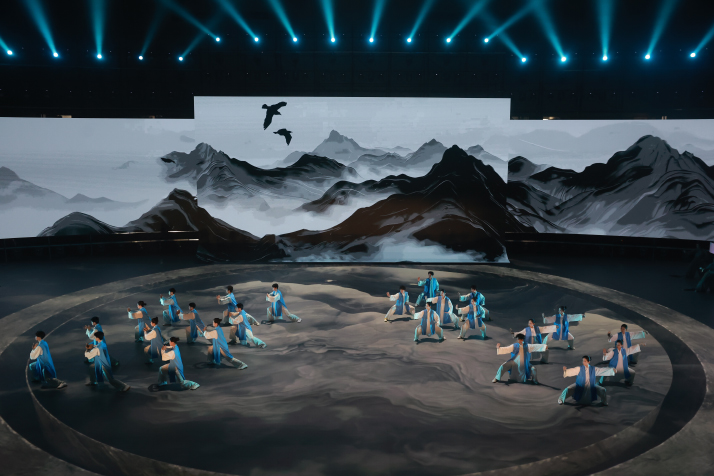 Martial artists perform during the opening ceremony of the 10th World Junior Wushu Championships in Tianjin on March 25 (COURTESY PHOTO)
Beyond fighting Wushu is now practiced all around the world. The IWUF has member federations in 162 countries and regions, and the sport has built a regular international competition system that includes world championships, junior championships and continental events. Taijiquan, originating in China nearly 400 years ago and the best-known branch of wushu worldwide, has spread even further. According to UNESCO, the discipline is now practiced in more than 180 countries and regions. In 2020, taijiquan was inscribed on UNESCO's Representative List of the Intangible Cultural Heritage of Humanity and in 2025, the 43rd Session of the UNESCO's General Conference designated March 21 (the Spring Equinox in the Northern Hemisphere) as International Taijiquan Day. The choice of the date not only aligns with the natural rhythm of the spring equinox, characterized by "balanced day and night, moderated cold and heat," but also resonates with taijiquan's philosophical concept of "harmony between humanity and nature," the IWUF said on its website. That global reach is one of the reasons taijiquan is often the first form of Chinese martial arts people encounter. Its movements often have poetic names that are not immediately clear to beginners, but for athletes who practice it, the explanation is usually practical before it is philosophical. Taijiquan, Brayton said, helps with posture, balance and motor control and is generally good for health. She said she began practicing other forms of wushu in 2011 and taijiquan in 2016 after her parents signed her up. Over time, it became part of her daily life. "The main thing that I like from wushu is learning balance," she said. "We learn a lot of discipline from the teachers. It teaches us how to work hard and consistently for many years." She also described the social side of the sport. Her school is in Portland, Oregon, but competitions bring her into contact with students from neighboring California, the U.S. East Coast and other countries, including Brazil and Singapore. "I've learned a lot about wushu and made a lot of friends throughout the world because of wushu," she said. "I just can't stop. It's so fun." James Brayton, her father, described wushu's cultural dimension from the perspective of family life. His children began their training at the U.S. Wushu Center in Portland. Their mother is Chinese American, and he said the sport has given the children a way to connect to that part of their background, while also learning discipline. "It has been a great source of connection to Chinese culture," he told Beijing Review. James Brayton said he has visited China many times, first for business in 1996 and later for his children's competitions. What stands out for him is beyond the competition itself. It is the contact it creates among people from different countries. "It's very eye-opening, very mind-opening, to get out of one's country and to interact with people of similar interests," he said. "It's really just been a great cultural and sporting experience for the family." (Print Edition Title: The Worldwide Wave of Wushu) Copyedited by G.P. Wilson Comments to liwenhan@cicgamericas.com |
|
||
|
||||||||||||||||||||||||||||
|