
|
| China |
| Leaders at Boao will search for a roadmap to stability and shared growth | |
|
|
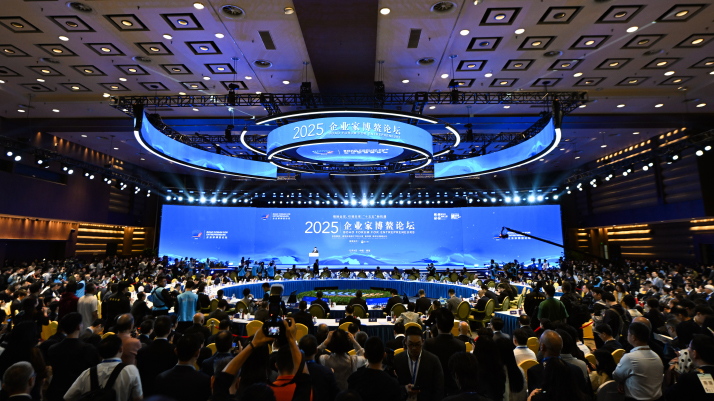 The main forum of the 2025 Boao Forum for Entrepreneurs in Boao, Hainan Province, on December 4, 2025 (XINHUA)
When global leaders, corporate executives and academics descend in late March on the tropical beach enclave of Boao, Hainan Province, they will find a literal and metaphorical landscape that has been meticulously reshaped. The white sands of Hainan Island have been groomed; the pruned palm trees sway in gentle breeze. But the delegates arriving for the Boao Forum for Asia (BFA) Annual Conference 2026, scheduled for March 24-27, are hoping for more than just respite from the northern hemisphere's lingering winter. They are coming in search of a blueprint. In a world order characterized by fragmentation, the official theme of this year's gathering—Shaping a Shared Future: New Dynamics, New Opportunities, New Cooperation—reads like a defiance to the old frameworks that are failing and an assertion of hope. "The world today is undergoing profound changes, and the global economic and trade landscape is in a period of significant adjustment," Zhang Jun, the forum's Secretary General and a seasoned Chinese diplomat, said at the BFA New Year Outlook event in January. His statement voiced the international community's concern over the uncertainty of the world and a need for action. 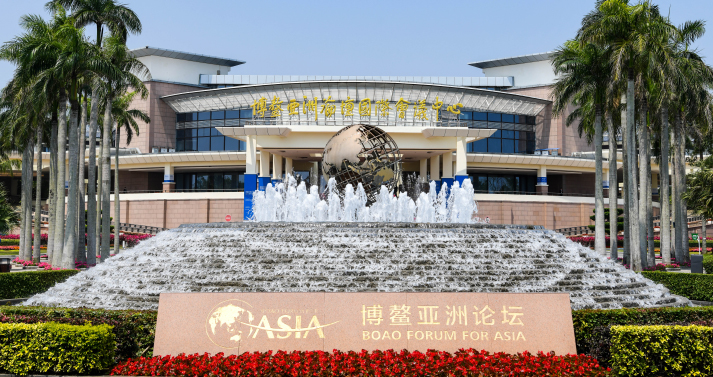 The Boao Forum for Asia International Conference Center in Boao, Hainan Province, on March 25, 2025(XINHUA)
A platform for cooperation Headquartered in China, the BFA is an international organization launched in 2001 by 29 member states, as a response to the region's realization that its voice carried too little weight in Western-dominated global governance. At the time, China was still a year away from joining the World Trade Organization, and the idea of a distinctly Asian voice in global affairs was nascent. Now, 25 years on, the forum has evolved from a modest platform for discussing trade integration into Asia's premier gathering for political and economic dialogue. Its founding mission—to promote economic integration across the region—remains intact. The forum now speaks of "pooling positive energy for the development of Asia and the world," a phrase on its official website that captures both its diplomatic sensibility and its aspirations. As Mu Hong, China's Chief Representative to the BFA and Vice Chairman of the BFA, noted at the event in January that the forum's enduring goal is to "contribute the Boao wisdom to promote economic globalization and regional integration." The logic underpinning the BFA is straightforward: With the progress of economic globalization and regional integration, Asian countries have been faced with great opportunities as well as severe challenges. This requires them to strengthen cooperation with other parts of the world and enhance mutual exchange and cooperation. In fact, it is now a common task for them to find a way to cope with the challenges brought about by globalization, to maintain the healthy economic growth of Asia, and to strengthen their coordination and cooperation. The urgency of this task was underscored by Ban Ki-moon, former UN Secretary General, who now serves as chairman of the BFA. In a video address at the event in January, Ban painted a stark picture of the current moment. "Twenty twenty-five has been a bumpy year," he said, citing the multiple challenges of unilateralism, protectionism, geopolitics and climate crisis. He added the global order, the multilateral system and the international rule of law have suffered severe shocks. Humanity once again stands at a historical crossroads. The world is becoming more divided, more dangerous and more unpredictable. Yet Ban also pointed to reasons for hope. Crisis breeds opportunity; pressure can be transformed into momentum, he said. He noted that most countries still believe multilateralism and international cooperation represent the right direction, pointing to UN climate conferences, G20 summits and APEC meetings, where enthusiasm and expectations for collective action remain undiminished. "In today's complex environment, Asia, as one of the key engines of global economic growth, has an important role to play in charting the way forward and promoting the healthy development of world economy," Zhang said. "Against this backdrop, the BFA stands ready to make a greater contribution to strengthening regional cooperation." Zhang noted that the 2026 BFA annual conference will be "committed to promoting dialogue and exchange, and enhancing mutual understanding and trust." To that end, the agenda has been meticulously designed: plenary sessions for broad pronouncements, high-level dialogues for candid exchange, round-tables for technical depth, panel discussions for competing perspectives, country-specific sessions for targeted outreach and press events for message sharing. The goal, Zhang suggested, is an "open and inclusive platform" where every participant can find topics of interest, and opportunities to take part in meaningful discussions. From diagnosis to prescription The topics for the plenary sessions and high-level dialogues of this year's BFA annual conference will include navigating the shifts in the global trade landscape in response to tariff wars and safeguarding shared economic security. A session dedicated to bringing greater certainty to an uncertain world will sit alongside discussions on the role of Global South in improving global economic governance—a direct challenge to the post-war architecture dominated by the United States and Europe. The annual conference will be dedicated to deepening regional cooperation and unlocking growth vitality. Discussions will explore how to unleash the potential of the Regional Comprehensive Economic Partnership, the world's largest free trade deal to date. Other sessions will address revitalizing APEC toward the Vision of the Asia-Pacific Community, promote new energy cooperation across Asia, develop diversified cross-border payment systems, safeguard financial security and stability, and strengthen cooperation among regional institutions. Panels will explore industrial upgrading empowered through digital and intelligent technology, the advancement and breakthroughs in humanoid robotics and the implementation of the UN Sustainable Development Goals. The green transition, global climate governance, AI-enabled healthcare, the blue economy, smart cities and long-term value-oriented investment all feature prominently. The through-line is clear: Asia's future prosperity will depend not just on trade deals and payment systems, but on mastering the technologies that will define the next industrial revolution. By engaging with these frontier trends, the forum's organizers hope to do more than merely discuss the future—they aim to identify opportunities for cooperation and map pathways for concrete action. The objective is to strengthen the drivers of economic growth and enhance economic resilience. Mu framed China's role in distinctly forward-looking terms. "Economic globalization is an irreversible historical trend," he said. "Fairness, justice, openness, inclusiveness and win-win cooperation represent the right path and can inject certainty and stability into a turbulent world." As China prepares to implement its 15th Five-Year Plan (2026-30), he added, "China's door will open wider and wider," sharing development opportunities with Asia and the world. Copyedited by G.P. Wilson Comments to luyan@cicgamericas.com |
|
||||||||||||||||||||||||||||||
|