|
| China |
| The blueprint for modernization | |
|
|
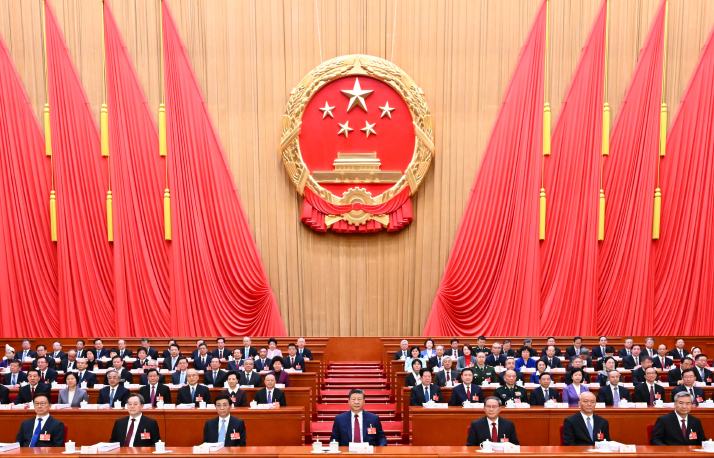 The opening meeting of the Fourth Session of the 14th National People’s Congress (NPC) at the Great Hall of the People in Beijing on March 5 (XINHUA)
With the 15th Five-Year Plan period (2026-30) kicking off in 2026, this year's Two Sessions—the annual meetings of the National People's Congress (NPC) and the National Committee of the Chinese People's Political Consultative Conference (CPPCC), held from March 4 to 12—have drawn significant attention for the policy signals sent. These crucial gatherings, making decisions and suggestions on everything from the five-year plan and legal system to social welfare and foreign policy, provided an open window through which to view China's policy direction for the year ahead and the next five years. This year, the NPC deliberated on the draft outline of the 15th Five-Year Plan for national economic and social development, while the CPPCC National Committee engaged in thorough consultations and offered suggestions regarding the draft, together formulating the nation's development vision. The 15th Five-Year Plan is a vital stage in the push toward largely achieving socialist modernization by 2035. Luo Zhiheng, Chief Economist at Yuekai Securities, underscored the direct link between economic performance during this period and reaching the 2035 goal of achieving the per-capita GDP of moderately developed nations, particularly as the international political and economic landscape undergoes the current profound changes. "The economic strategy should be centered on strengthening domestic demand, integrating technological innovation with industrial innovation, and prioritizing risk management to build internal certainty amid external unpredictability," he told Economic Information Daily newspaper. For multinational corporations, this launch of a new five-year plan is more than a standard policy cycle; it signals a new wave of structural opportunities, Jason Cao, Managing Partner at FINN Partners Greater China, a communications consultancy, told Beijing Review. He emphasized that the current policy signals a reinforced dedication to high-standard opening up and a more favorable environment for foreign investment. Cao highlighted that key initiatives emerging from this new development phase are aligned with the strategic imperatives and operational realities of multinationals deeply engaged in the Chinese market. These key initiatives include nurturing new quality productive forces, which emphasize innovation-driven, hi-tech growth, as well as driving the green transition, boosting consumer confidence, and enhancing the business environment through regulatory reforms. 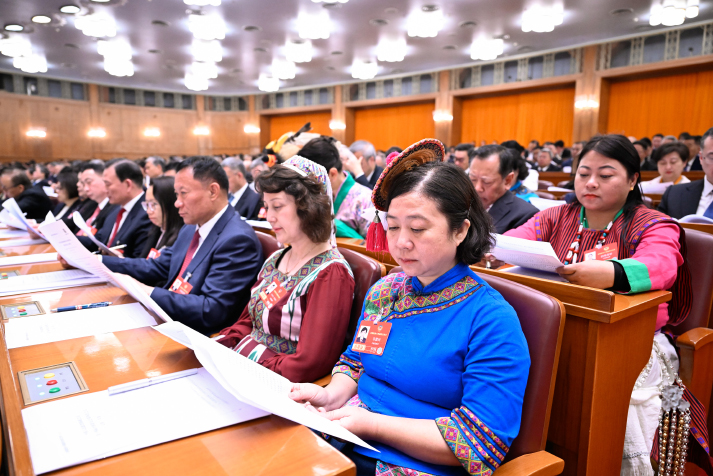 The opening meeting of the Fourth Session of the 14th Chinese People’s Political Consultative Conference National Committee at the Great Hall of the People in Beijing on March 4 (XINHUA)
Growth target China has set its economic growth target at 4.5 percent to 5 percent this year and will strive for better in practice, according to the government work report that was submitted to the country's top legislature for deliberation. Premier Li Qiang, who delivered the report at the opening meeting of the Fourth Session of the 14th NPC in Beijing on March 5, said that the growth target is well aligned with the country's long-range objectives through the year 2035 and is broadly in line with the long-term growth potential of China's economy, with favorable conditions in place for achieving this target. Government at local levels should, taking into account their own conditions, make solid efforts to deliver positive outcomes, Li said. He added that this year's targets, including the economic growth target, took into account the need to leave some room for structural adjustments, risk prevention and reform in what is the opening year of the 15th Five-Year Plan period, so as to lay a solid foundation for delivering better performance in the coming years. In consideration of evolving developments both at home and abroad and other relevant factors, it was proposed that the GDP target for the next five years should be set as an appropriate range, with annual growth rates to be determined in light of actual conditions, according to the government work report. "The shift to a target range rather than a single figure affords Beijing greater flexibility to balance growth with broader socioeconomic priorities. It reduces pressure on local governments to chase high headline numbers at the expense of quality, and creates space to pursue structural reforms, build a unified national market, and advance economic transformation," Yan Liang, Chair Professor of Economics at Willamette University in the U.S., told Beijing Review. "In short, moderating the growth target is not a concession to weakness—it is a deliberate pivot toward more sustainable, higher-quality development," she added. Economists also noted that while traditional engines such as the property sector and demographic factors fade, new drivers including the increased scale and quality of domestic consumption, innovation-driven productivity gains and the expansion of the services sector are emerging. Expanding consumption Like the 2025 government work report, this year's report placed the expansion of domestic demand at the forefront of the 2026 governmental tasks. Zhang Liqun, a researcher at the Department of Macroeconomic Research at the Development Research Center of the State Council, told China Newsweek that China currently possesses production and supply capabilities sufficient to support a higher rate of economic growth. The primary constraint, he argues, is insufficient domestic demand, which results in businesses lacking orders and being unable to fully utilize their production capacity. Su Jian, a professor of macroeconomics at the School of Economics of Peking University, told China Newsweek that macroeconomics cannot focus solely on the economic aggregate; the distribution between household income and government revenue, the structure of household income, and unemployment rates are more critical. These factors determine whether people have the capacity to consume, which is essential for expanding domestic demand. This year's government work report rolled out a series of practical measures to address these problems. "China will formulate and implement plans to boost incomes, rolling out a series of practical measures to boost earnings for low-income groups, increase residents' property income, and improve social security systems," according to the report. Dong Yu, Executive Vice Dean of the Institute of China Development Planning at Tsinghua University, told China Newsweek that the current emphasis on increasing income, as opposed to solely promoting consumption seen in recent years, signifies that the government is addressing the problem at its source. "In the past, Chinese residents' consumption was primarily focused on basic needs such as adequate food and clothing. However, current consumption demands are upgrading. This is not only reflected in the quality improvement of goods consumption but, more significantly, the scale expansion and structural optimization of service consumption," Liu Shangxi, a CPPCC National Committee member and a researcher with the Chinese Academy of Fiscal Sciences, told Beijing Review. "Under the market economy, the upgrading of the consumption demand structure will naturally drive the supply system to make corresponding adjustments. With the growth in demand for service consumption, the proportion of the service industry in the national economy will inevitably rise gradually. This is a natural outcome of a country's rising level of development and the improvement of its people's quality of life," Liu added. Improved living standards Issues relating to living standards have consistently remained a central focus of the Two Sessions. Employment serves as the direct path to increased income and is foundational to public wellbeing. China currently faces new challenges in stabilizing the job market, stemming from structural mismatches in labor supply and demand, compounded by the sweeping influence of AI-driven substitution. The government work report sets clear targets for the year: creating 12 million new urban jobs and keeping the urban unemployment rate at around 5.5 percent. The government work report stated that the nation will strengthen support for employment through multiple policies and foster an employment-friendly growth model. To achieve this, the government planned to strengthen employment support through a range of policies and foster an employment-friendly growth model. This included bolstering support for labor-intensive industries and companies to stabilize jobs, while simultaneously creating more new job opportunities in emerging industries and industries of the future. Furthermore, supportive employment policies will be released for college graduates and other young people, efforts will be made to stabilize jobs for migrant workers, and assistance will be provided to demobilized military personnel in resettling and finding jobs. For people facing difficulties finding jobs, the government will increase assistance, and for flexible workers and those in new forms of employment such as delivery personnel and ride-hailing drivers, more inclusive social security programs will be made available. Education remains fundamental to both individual wellbeing and national development. China will adjust the allocation of educational resources in response to structural changes occurring in school-age populations. It will upgrade basic education and make coordinated efforts to develop balanced, quality compulsory education and inclusive, quality preschool education. A key focus will be strengthening physical, aesthetic, labor skills, and mental health education, and improving the school-family-society collaboration mechanism to ensure that students are physically and mentally healthy and achieve well-rounded development. As China's elderly population surpasses 300 million and the aging trend deepens, senior care has become increasingly prominent. The strategic focus is shifting from merely ensuring the elderly are "cared for" to guaranteeing they enjoy a "high-quality life in their later years." Specific measures in the national strategy response to population aging include increasing the supply of not-for-profit elderly care services and improving elderly care services in rural areas, granting elderly care service vouchers to seniors affected by moderate or more severe functional impairments and refining supportive policies for products designed for seniors, pension finance, and seniors' seasonal relocation for wellness and care. The report also outlined measures to foster positive attitudes toward marriage and childbearing. The government will boost housing support for first-time married couples and those with their first child, and help families with children meet their needs for better housing. Furthermore, maternity insurance and parental leave systems will be refined, demonstrations and trials for subsidized childcare services will be expanded, and support will be provided for public-interest childcare services and integrated nursery and childcare services. 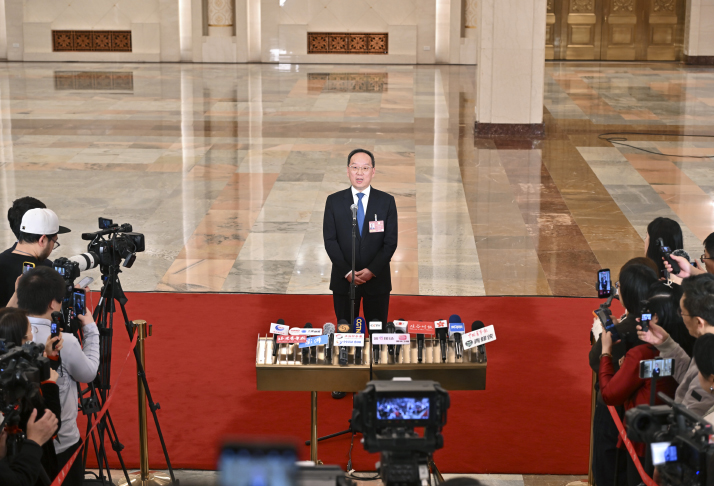 Chinese Minister of Industry and Information Technology Li Lecheng gives an interview after the opening meeting of the Fourth Session of the 14th NPC at the Great Hall of the People in Beijing on March 5 (XINHUA)
Legislative agenda The legislative agenda was a major focus during the Two Sessions. The Fourth Session of the 14th NPC deliberated several key pieces of legislation, including the draft environmental code, the draft law on promoting ethnic unity and progress, and the draft law on national development planning. Typically, Chinese draft laws become law following three readings by the NPC Standing Committee. However, legislation touching upon major public interests or fundamental national concerns requires review and approval by the full session of NPC deputies, rather than solely by the Standing Committee. Lou Qinjian, spokesperson for the Fourth Session of the 14th NPC, explained at a March 4 press conference that ecological civilization—a concept China promotes for balanced and sustainable development that features harmonious coexistence between humanity and nature—was incorporated into the country's constitution in 2018 and has become the will of the entire Chinese people. As China has entered a phase of high-quality development marked by an accelerated green and low-carbon transition, the adoption of the new environmental code during this year's Two Sessions establishes the most stringent systems and the most rigorous rule of law to protect the country's ecology and environment and promote green development. Concurrently, the law on promoting ethnic unity and progress aims to foster a stronger sense of community for the Chinese nation and ensure the lawful rights and interests of people from all ethnic groups are better safeguarded. The law on national development planning ensures that grand blueprints are carried forward consistently. 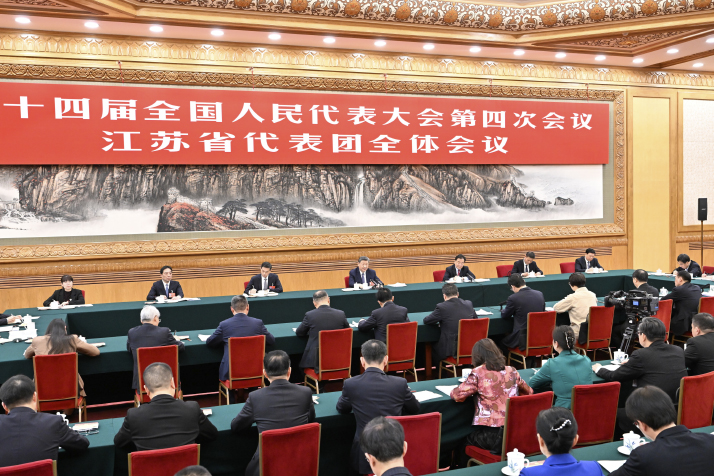 President Xi Jinping takes part in a deliberation with his fellow deputies from the delegation of Jiangsu Province at the Fourth Session of the 14th NPC in Beijing on March 5 (XINHUA)
Reform and opening up China's current economic development faces several bottlenecks, including excessive restrictions on consumption, counterproductive rat race competition, and difficulties in capital market financing and investment. Addressing these issues necessitates a further, comprehensive deepening of reform alongside the steady promotion of institutional opening up. The government work report explicitly stated that China "will address monopolies and unfair competition with greater intensity, enhance the binding force of fair competition review, and thoroughly address rat-race competition with a full range of approaches, including production regulation, standard-based guidance, pricing law enforcement, and quality supervision, so as to cultivate a sound market environment." Regarding international engagement, Liu Jieyi, spokesman for the Fourth Session of the 14th CPPCC National Committee, indicated that China will continue to press ahead with high-level opening up and use the Hainan Free Trade Port (FTP) as a new gateway for global trade and investment liberalization. He noted the progress achieved during the recent Spring Festival holiday (from February 15 to 23): Offshore duty-free sales in Hainan rose by 30.8 percent year on year, and the number of visa-free foreign arrivals increased by 75.6 percent. The figures, he added, demonstrate tangible progress in facilitating the flow of goods and people. Responding to a question on the global impact of the Hainan FTP's island-wide special customs operations, launched late last year, Liu called the move a landmark step underscoring China's commitment to high-standard opening up and an open world economy. He said the special customs operations had significantly enhanced trade liberalization and facilitation, improving links with international markets. According to Liu, the new customs arrangements represent a steady expansion of China's institutional opening up, covering rules, regulations, management and standards. The initiative reflects China's determination to carry out reform and opening up through to the end, he said. "China has always adhered to opening up as a fundamental national policy. The door will not close; it will only open wider," Liu said. BR (With reporting by Xu Bei, Tao Zihui and Li Fangfang) Copyedited by G.P. Wilson Comments to jijing@cicgamericas.com |
|
||||||||||||||||||||||||||||||
|