
|
| China |
| The rural blueprint | |
|
|
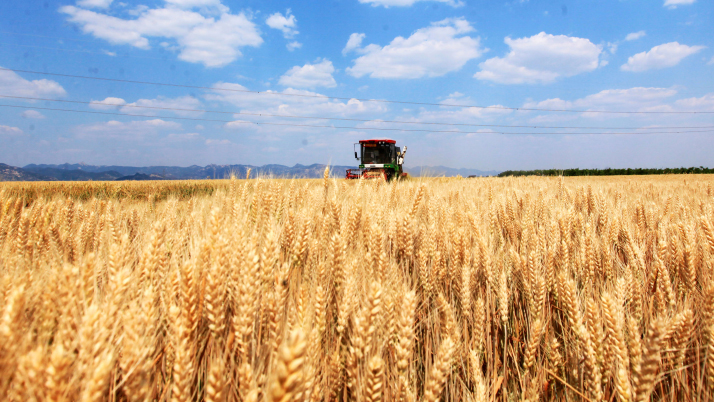 The wheat harvest underway in Pingyi County, Shandong Province, on May 24, 2025 (XINHUA)
The No.1 Central Document, officially released on February 3, outlined the principal tasks for agricultural and rural work in the current year. A core focus has been placed on reinforcing national food security, averting a return to poverty among rural populations and increasing farmers' incomes. As the first policy statement released by China's central authorities each year, the document is a crucial indicator of the country's policy direction. This year's document seeks to achieve fresh progress in comprehensive rural revitalization and lift agricultural and rural modernization to a new level, as China moves steadily toward its goal of becoming a strong agricultural nation. Rural revitalization, a national strategy put forward by President Xi Jinping at the 19th National Congress of the Communist Party of China (CPC) in 2017, is designed to systematically narrow the urban-rural development disparity through accelerated rural development and enhanced rural living appeal. The strategy aims to consolidate the achievements of poverty alleviation, with China having eradicated absolute poverty as of late 2020, by developing the rural economy and improving rural governance. Enhancing grain production China's annual grain output reached 714.9 million tons in 2025, an increase of 8.4 million tons from a year earlier, according to the Ministry of Agriculture and Rural Affairs. It was the second consecutive year output has exceeded 700 million tons. The document set a clear goal for this year: "Grain output to be stabilized at around 700 million tons." Han Wenxiu, head of the Office of the Central Rural Work Leading Group, said at a press conference on February 4 that this year's No.1 Central Document focuses on securing the national food security bottom line. The focus of grain production will shift from output to a balance of output and quality. This necessitates optimizing growing structures and regional distribution aligned with local circumstances, alongside the promotion of superior grain varieties and initiatives to improve overall quality. "Natural disasters are the biggest threat to grain production; managing disaster prevention and reduction is equivalent to ensuring increased production and income," Han emphasized. Given that crop areas impacted by natural disasters have exceeded 10 million hectares each year in the last two years, the development of a comprehensive agricultural disaster prevention and mitigation system warrants heightened priority. This includes strengthening disaster monitoring, forecasting and early warning systems, reinforcing farmland water conservancy construction, improving the mechanism for allocation and emergency dispatch of disaster relief equipment, and enhancing the ability to respond to extreme weather to ensure a good harvest despite disasters. Preventing poverty Following the victory in the battle against poverty in 2020, the CPC Central Committee instituted a five-year transition period designed to maintain support for formerly impoverished populations and areas, thereby ensuring a smooth transition from solidifying poverty alleviation achievements to executing the rural revitalization strategy. Han confirmed that the CPC Central Committee has already defined the requirements for normalized, sustained assistance and the current No.1 Central Document contains specific mandates, with supporting policies presently being formulated and issued. He pointed out that the consolidation and expansion of poverty alleviation successes constitute a continuous endeavor. Normalized assistance must be integrated into the comprehensive implementation of rural revitalization, with sustained efforts to prevent the large-scale return to poverty. In terms of policy continuity, Han stated that there will be no abrupt withdrawal of support in critical areas such as fiscal allocations and financial aid. The volume of normalized assistance funds from the Central Government, alongside investments from provincial and municipal tiers, will be maintained at consistent levels. Moreover, established frameworks, including mechanisms for cross-regional collaboration and the dispatch of work teams to villages, will be retained as part of a long-term poverty prevention system. 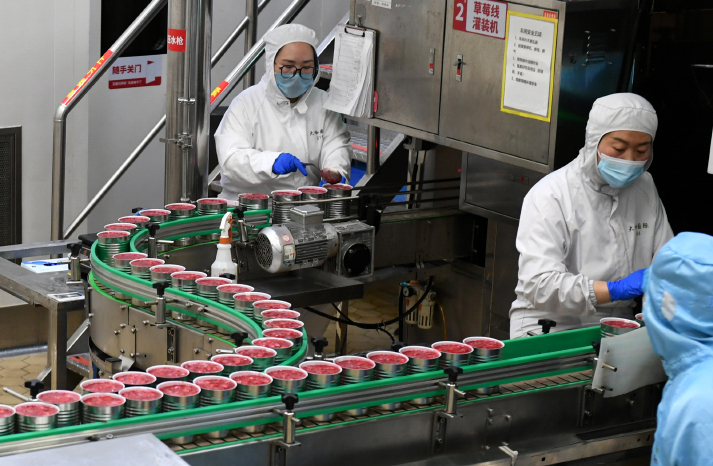 The production line of a beverage company in Wenxian County, Henan Province, on February 27, 2025 (XINHUA)
Developing rural industries A key directive emerging from the Central Economic Work Conference late last year was the "formulation and implementation of the income growth plan for urban and rural residents," positioning it as a key focus for this year's economic work. Correspondingly, the No.1 Central Document placed substantial emphasis on augmenting rural residents' incomes. Data from the National Bureau of Statistics showed that the per-capita disposable income for rural residents reached 24,456 yuan ($3,561) in 2025, representing a year-on-year growth of 6 percent. To actively foster stable income growth for farmers, the No.1 Central Document detailed four specific measures: preserving and motivating farmers' dedication to farming and grain production; nurturing and fortifying county-level industries; promoting stable employment opportunities for migrant workers; and expanding rural consumption through multiple measures. Zhu Weidong, Deputy Director of the Office of the Central Rural Work Leading Group, said "industrial prosperity serves as the material foundation for rural revitalization and a crucial mechanism for increasing farmers' income." He also stressed the necessity of developing county-level industries by accentuating local distinctiveness. This requires actively backing localities in developing characteristic county economies leveraging their particular resource endowments, while simultaneously ensuring meticulous overall planning of industrial projects to prevent homogeneous competition. Zhu highlighted the rapid growth of new business formats in rural areas, such as e-commerce and live-stream commerce. He stressed the need to refine policies and standards to ensure these sectors develop healthily and orderly, effectively contributing to higher farmer incomes. Furthermore, avenues for farmer participation in industrial development must be broadened, alongside improving mechanisms for the equitable distribution of industrial benefits. This will establish a positive feedback loop between industrial expansion and increased farmer prosperity. Modernizing agriculture This year's No.1 Central Document reiterated the need to "develop new quality productive forces in agriculture tailored to local conditions." New quality productive forces refer to the shift toward innovation-driven growth, technological advancement and high-quality development in multiple sectors of the economy. This mandates promoting the integration of AI into agricultural development and broadening the application scope for drones, the Internet of Things (IoT) and robotics. Zhu pointed out that China is already the world's leading operator of agricultural drones, accounting for over 300,000 of the approximately 500,000 globally. These drones are rapidly becoming essential farm tools for many farmers, much like traditional tools like sickles and hoes. Their application scenarios are continuously expanding, going beyond crop protection, sowing, fertilization and field monitoring to include the transport of materials and produce. Zhu concluded by emphasizing the integration of AI with agriculture and scaling up the use of drones, IoT and robots to drive modern agricultural development. BR Copyedited by G.P. Wilson Comments to jijing@cicgamericas.com |
|
||||||||||||||||||||||||||||
|