
|
| China |
| 'Thanks, but No Thanks': Why China's Internet is arguing about politeness toward AI | |
|
|
 LI SHIGONG
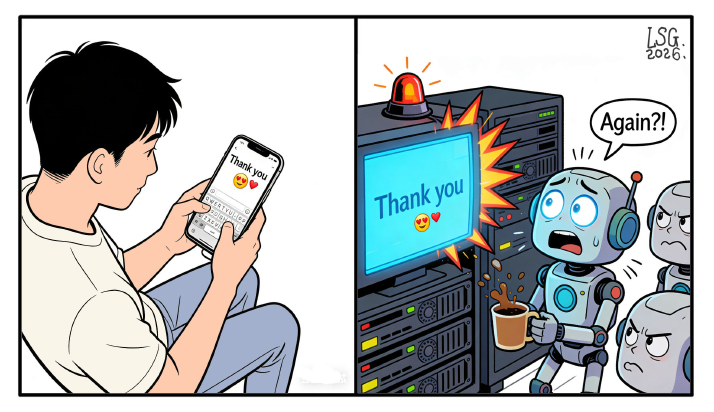
A curious debate is heating up on Chinese social media: Should we say "thank you" to AI? The discussion gained traction after U.S. OpenAI CEO Sam Altman recently noted that processing polite niceties like "please" and "thank you" costs the company tens of millions of dollars annually, thanks to the computational resources and server energy required each time the AI reactivates to generate a response. When millions of users do this daily, the math adds up. Fast. Some argue that politeness keeps human-AI interaction warm and civil. But a growing chorus finds the debate itself absurd: Why waste breath, and energy, discussing gratitude toward something that doesn't have feelings? Editorial (Guangming Daily): Saying "thanks" won't boost AI's performance or change the fact that users are talking to machines. But from an energy perspective, the debate is worth having. AI may feel like magic—anthropomorphic, conversational, almost human. But beneath the interface lies something remarkably "primitive"—the infrastructure of the Second Industrial Revolution: electricity, energy, factory buildings. And age-old human assets like land and water sources. Here's the paradox: The more intelligent and human-like AI becomes, the bulkier the machinery behind it grows. On your screen are fluent sentences, instant replies. On the outskirts of cities, in industrial parks, even in the wilderness: rows of high-power cabinets, humming substations and cooling systems running 24/7. AI's politeness toward humans is not genuine; it is merely following instructions. Therefore, this extra "thank you" we say to AI is indeed an invalid command. But is this inefficiency equal to meaninglessness? When people show politeness toward AI, the ones who may truly benefit are humans themselves—as they become accustomed to interacting with the world (even the virtual one) in a courteous and respectful manner, they subconsciously reaffirm themselves to be cultivated and warm-hearted individuals. This psychological feedback can effectively soothe anxiety and even subtly enhance work efficiency. Xin Haiguang (The Beijing News): Altman did talk about this topic, but he did so when responding to netizens' questions in a humorous way. He did not deny that more text responses would increase energy consumption, but he also noted that these polite expressions are "worth the cost," as they are inherently part of the interaction between humans and AI. In practice, AI does not initiate an additional round of high-intensity reasoning simply because of a "thank you." The ensuing response requires far less computation than answering a question. Although this energy consumption exists mathematically, in reality, it is almost negligible. If netizens were to focus their energy on debating such topics, that would be the real "waste of computational power." The view that saying an extra "thank you" wastes energy only arises when AI is regarded purely as a tool for production or problem-solving. In reality, AI's role for humanity is far from that simple; it can be an assistant, a friend or even a family member. Many users seek emotional comfort by confiding in AI and that, too, holds considerable value. AI does indeed consume large amounts of energy, but there are many other areas where efficiency could be improved. It is not reasonable to attribute that burden to users' "thank yous" to AI. BR Copyedited by Elsbeth van Paridon Comments to yanwei@cicgamericas.com |
|
||||||||||||||||||||||||||||
|