
|
| China |
| Inside the Spring Festival spending spree | |
|
|
 Tourists admire lanterns at a lantern fair in Dunhuang, Gansu Province, on February 22 (YIN KANG)
This year's Spring Festival Gala on China Central Television did more than entertain—it ignited a shopping spree for robots. Data from China's leading online shopping platform JD.com showed that within two hours of the gala's broadcast on the Chinese New Year eve on February 16, searches for robots increased by over 300 percent month on month, customer service inquiries grew by 460 percent, and new orders rushed in from more than 100 cities across the country. The catalyst for this craze was the gala stage itself. Four robotics companies—Unitree, Noetix, MagicLab and Galbot—made high-profile appearances, showcasing their humanoid robots in martial arts routines, sketch comedy, song-and-dance performances and even short films. The displays brought humanoid robotics technology into the public spotlight like never before. Compared with last year's gala, the robots demonstrated remarkable progress in agility, fine-motor precision and human interaction. 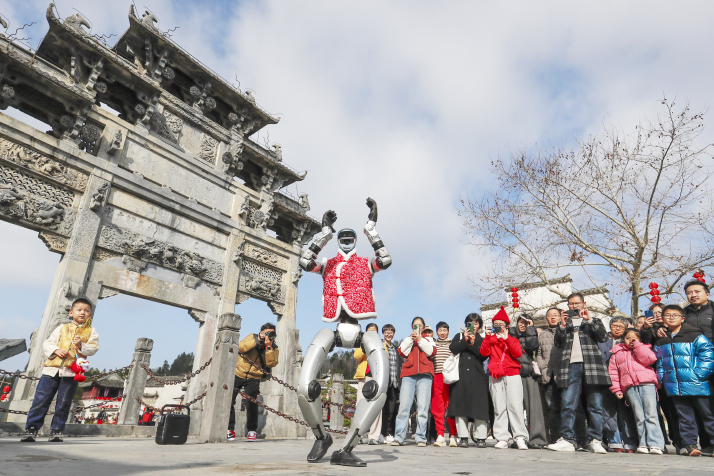 Visitors watch a robot performance in Yixian County, Anhui Province, on February 18 (YIN KANG)
Robots as a common scene This technological showcase quickly translated into real sales. A JD.com platform representative told The Beijing News that on February 16, the Galbot G1 industrial robot, priced at nearly 630,000 yuan ($92,126), sold out within minutes of being listed. Consumer-grade products from Unitree, Noetix and Magiclab, were also snapped up. Data from another major online shopping platform Tmall showed that on the day after the gala, gross merchandise volume for AI-powered robots surged 108 percent year on year. Searches for terms like "Unitree robot" and "gala-featured robot" jumped over 1,200 percent from the same period of the previous year. The online frenzy soon spilled into the physical world. At a Spring Festival shopping event in Hangzhou's Wushan Square, crowds gathered so tightly around an exoskeleton robot booth that it was nearly impossible to get through. Residents lined up to try on the device, with some making on-the-spot purchases. Meanwhile, at a Chinese New Year goods fair in Beijing, smart exoskeleton walking aids and AI-enabled mattresses capable of displaying real-time heart rate and breathing data emerged as surprise bestsellers, drawing waves of curious customers eager to experience and buy. During the record long nine-day Spring Festival holiday (February 15-23), China saw robust consumer activity across all sectors, with demand for a variety of products and services surging at an especially rapid pace. Data from the Ministry of Commerce showed the country's key retail and dining enterprises recorded an 8.6-percent year-on-year increase in average daily sales during the first four days of the Spring Festival holiday. Among these, using AI to place food orders, book flights and hotels and buy movie tickets has become a new holiday ritual. According to data from Qwen, an AI-powered large-language model, users placed nearly 200 million orders on the platform during the Spring Festival. On average, one in every 10 people in China made a purchase through Qwen. This effortless, hands-off consumer experience aligned perfectly with the public's desire to save time and energy during the holidays. 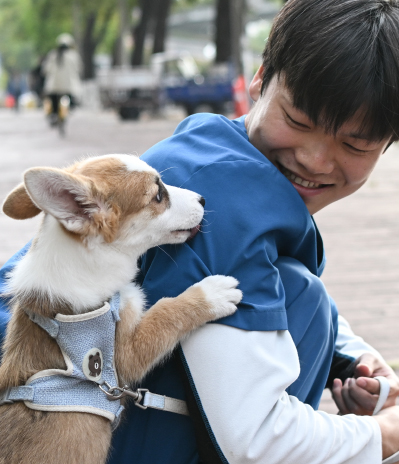 A staff member plays with a pet dog at a pet hospital in Liwan District, Guangzhou, Guangdong Province, on February 5 (XINHUA)
"Using AI to find restaurants and hotels is incredibly convenient," Han Xueying, a 27-year-old Beijing resident, told Beijing Review. "There's no need to switch between different apps to gather information or plan a trip. It's extremely user-friendly, and even my parents can use it without any trouble." Han and her parents divided their nine-day holiday into two parts. They spent the first three days in Beijing, then drove to Yixian County in Anhui Province to admire the traditional fish lanterns and sample local Huizhou cuisine. "We were mentally prepared for crowds, but we didn't expect it to be this packed. If we hadn't booked our hotel in advance, we probably wouldn't have found a place to stay." The fish lantern tradition in Yixian is recognized as a form of intangible cultural heritage. Every Spring Festival, the county hosts lantern fairs and parades, and visitors can also learn the craft of making fish lanterns themselves. "There were even robot performances on site. The fusion of robotics and intangible cultural heritage felt surprisingly natural—not jarring at all." The growing appeal of intangible cultural heritage experiences has become a standout trend during the Spring Festival holiday. In late January, the Ministry of Culture and Tourism launched a nationwide initiative running through early March, featuring around 30,000 cultural and tourism events and distributing over 360 million yuan ($53 million) in consumption vouchers and subsidies—offering the public a wider array of choices for holiday celebrations. According to 2026 Spring Festival consumption data released by short-video platform Douyin, the Chinese version of TikTok, group purchase ticket sales for services that blend cultural heritage with local markets surged by 764 percent year on year, reflecting strong consumer interest in traditional experiences during the holiday. Performances featuring cultural displays also saw remarkable growth, with group purchase sales for lantern parades and drum performances skyrocketing by approximately 1,500 percent.  Visitors feed red-billed gulls in Kunming, Yunnan Province, on February 16 (XINHUA)
Beyond the reunion dinner Many people chose to split the Spring Festival holiday into two parts this year. A growing trend among young people was to spend the first two or three days with their families and then embark on solo trips. Zhang Zining, who has worked in the tourism industry for over a decade, told China News Service that the biggest change she noticed this year's Spring Festival holiday season was the increase in solo travelers. "In previous years, Spring Festival trips were usually taken by families or groups of friends, almost always as package tours. But this year, inquiries for solo travel accounted for about 30 to 40 percent of the total," she said. On social media platforms, even more people shared their experiences of traveling alone instead of going home. Chen Zhenzhen, a 29-year-old working in Beijing, spent the Spring Festival vacation traveling alone for the second consecutive year rather than returning to her hometown in Shandong Province. "After working for a year, I just want to relax. Staying home and dealing with different relatives every day is actually more tiring. Unlike many of my relatives, I'm not married and don't plan to be in the near future, so I'm always bombarded with questions." Last year, she traveled to Liuzhou in Guangxi Zhuang Autonomous Region. This year, she chose Shunde in Guangdong Province. "During my days in Shunde, I didn't have to think about anything. I just slept, wandered and ate," she said. "The New Year atmosphere there is incredibly vibrant. You don't even need to research restaurants—if you see a place with a decent number of diners, the food is almost guaranteed to be delicious." Before leaving Beijing, she placed her dog in a pet boarding facility. "I really wanted to bring him along, but I don't drive, and flying with him would be too complicated. So boarding seemed like the more practical option for me." As the number of pet owners grows, the market for pet boarding and related services continued to heat up during this Spring Festival holiday. Ranging from traditional kennels to in-home feeding services, this diverse and specialized range of options is increasingly meeting the holiday needs of pet-owning families. Many stores offering pet boarding services are fully booked well in advance. Wang Xin, who runs a home-based pet boarding service, rented a three-story villa in Hangzhou with her husband, using the entire space for pet boarding during the Spring Festival. "This year, we planned to take in only 20 pets for the holiday," she told newspaper Guangming Daily. "The spots were quickly filled, yet we still receive numerous inquiries from potential customers every day. Spring Festival is the peak season for pet boarding." Copyedited by G.P. Wilson Comments to yuanyuan@cicgamericas.com |
|
||||||||||||||||||||||||||||||
|