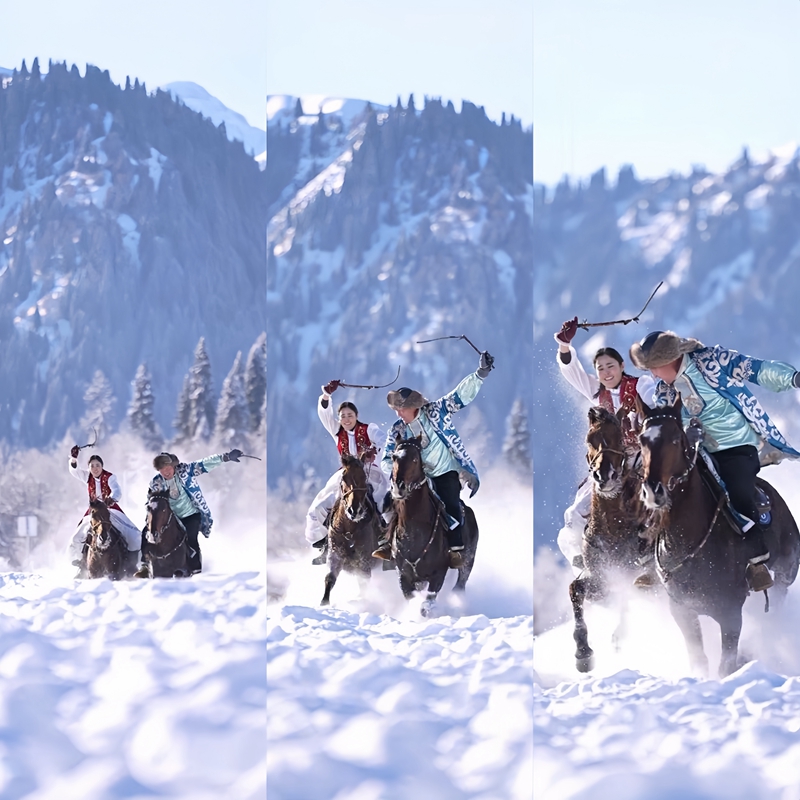
A screenshot from a video posted by Torekeldi Bikbori on his Douyin (the Chinese version of TikTok) account showing him and his companion riding in Kuerdening on December 24, 2025 (SCREENSHOT)
The Ili River Valley, located in the northwestern part of Xinjiang Uygur Autonomous Region, stretches westward, and in its final expanse before reaching the China-Kazakhstan border lies the scenic Kuerdening area, nestled in the foothills of the Tianshan Mountain range. This is a nature reserve for the Tianshan spruce. In winter, heavy snow seals the mountains, and the forest, a vast sea of white, isolates itself from the dust and din of the world beyond. Yet, it has never been devoid of human presence.
For millennia, Kazak ethnic herders have followed the ancient rhythm of seasonal migration here. Their horses were their companions on this perennial journey, the very lifeline of their survival. Many of their descendants continue the tradition, though with some difference.
Torekeldi Bikbori, known to all as Lao Tuo, is one of them. The 37-year-old Kazak guide for horseback journeys, a son of this land, seems like a character who’s stepped out of Robert Frost’s poem Stopping by Woods on a Snowy Evening, where the woods are described to be “lovely, dark and deep,” filling up with snow. Torekeldi’s life and home lie deep within the spruce forest.
A Kazak’s best friend
Following Torekeldi along a snow-covered track, a few log cabins came into view. This is his home, and also where he hosts travelers. By the cabins, a puppy wagged its tail joyfully and trotted over. Pushing the door open, warmth embraced us, mingled with the aroma of dairy. Torekeldi’s mother greeted the arrivals in Kazak, her eyes full of goodwill. The puppy circled the visitors’ feet.
Torekeldi’s wife filled porcelain bowls one by one with steaming milk tea and handed them to the guests. Sipping it sent warmth spreading from the throat, dispelling the mountain chill. She spoke only occasionally, refilling the cups with hot tea, a gentle smile on her face.
“Our own home, our own horses, our own guests,” Torekeldi told Beijing Review with pride. This homestead inside the nature reserve, currently a trending tourist destination on social media, hosts multiple groups of visitors from across the world each week in peak season. They follow him on horseback deep into the heart of Kuerdening to see the trees in the snow and return to the cabins in the evening, sitting together and sharing stories.
His youngest daughter, 10-year-old Reyana was home from school on her winter break. Asked whether horses or friends are more important, she thought for a moment and stated firmly, “Horses are more important.”
It is a Kazak tradition that every child born owns a horse. “We Kazak people grow up on horseback!” Torekeldi said. The family has more than 20 horses; they are their livelihood, companions and heritage.
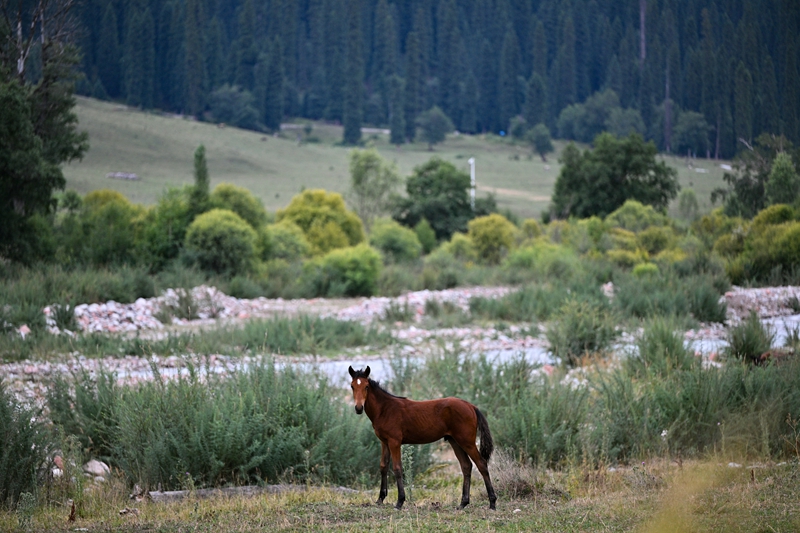
A horse wanders through the lush meadows of Kuerdening on August 2, 2025 (XINHUA)
Home is best
When Torekeldi was in his 20s, he traveled far to a large equestrian center in Shandong Province in east China and worked there for four years. It was a crucial learning experience. There, he learned modern stable management and hospitality. After returning to Kuerdening in 2018, he used this acquired knowledge to start his own horseback travel venture.
Then, in the winter of 2023, he visited Xi’an in Shaanxi Province, Guangzhou in Guangdong Province and Beijing, studying the management and pricing strategies of equestrian facilities in these cities. Later, he made a special trip to Shanghai for further study and obtained his equestrian coach certification.
“We must keep learning,” he said. “More and more guests are coming. We need to be more professional.”
Torekeldi’s family is large and flourishing. His eldest daughter and son study in the town, excelling academically. He has two elder brothers, two younger brothers and a sister. His second brother is a doctor; the eldest runs a business in Kazakhstan.
With such an extensive family, reunions aren’t easy. “We manage to gather about once every three months,” Torekeldi said. “My brothers come back too.” He glanced at his mother and smiled. “We must come to see mom.”
Torekeldi’s phone has many photos and videos, documenting his work and family moments. Last year, he took his mother to Almaty, Kazakhstan, for his nephew’s wedding. “But my mom still thinks home is best,” he said with a laugh.
His nephew, his eldest brother’s son, speaks seven languages. This has opened new vistas for Torekeldi and given him inspiration. It has also prompted his own travels to Kazakhstan. “But after circling around abroad, no place is more beautiful than Kuerdening,” he said.
This year, he plans to lead a small group of four on their first trip to Astana, Kazakhstan. The tourists will fly to Yining, a city in Ili Kazak Autonomous Prefecture in Xinjiang, where Torekeldi will meet them before crossing the border via the Houerguosi Port.
Xinjiang, an important hub on the ancient Silk Road trade routes linking China with Central Asia, Europe and beyond, remains a crossroads connecting different civilizations. Borders converge here, and opportunities intersect as well.
Torekeldi travels afar to learn, so that his hometown’s beauty can be presented more professionally. He expands cross-border tourism, so that his home can become a stop on global itineraries. He blends traditional pastoral life with modern tourism, hosting guests from around the world in his log cabin.
Here, in this nature reserve in China’s northwestern frontier, Torekeldi and his family guard a fluid sense of hometown—one deeply rooted in the Kazak traditions of the saddle and mountain-forest culture, yet simultaneously open to the world. BR