
|
| China |
| Technology, policy and a supportive ecosystem are turning research results into real-world products in Hangzhou | |
|
|
 Qianjiang New Town in Hangzhou, Zhejiang Province, on June 27, 2025 (XINHUA)
Normally, machines see the world much as human eyes do—relying on light and working best in the daytime. That is changing now. Machines are learning to see clearly even in total darkness. Much of this revolution begins with a component no bigger than a fingernail. It is a short-wavelength infrared (SWIR) sensor, a device that detects light beyond the range of human vision. It captures reflected infrared light, allowing cameras to see through fog and smoke, and in some cases to reveal details beneath surfaces, such as veins beneath skin. For years, these expensive sensors were used mainly in aerospace and specialized scientific research. Encouragingly, a startup in Hangzhou, Zhejiang Province, is working to bring them into everyday products—from automobiles to agricultural and industrial equipment—at a fraction of their former cost. Hanhui Xinchen Infrared Technology is one of many young firms in Hangzhou working to turn laboratory breakthroughs into commercial products. General Manager Liu Yu said commercialization cannot succeed without market-driven innovation and supportive policies and institutions. The team behind the company is relatively young, with an average age of about 35. Many of its researchers and engineers, trained at leading universities and institutes, work in fields such as chip design and process optimization. Some are natives of Zhejiang, who have returned after studying or working elsewhere, drawn by the region's expanding innovation environment. Making the invisible visible Until recently, cost was the main barrier to SWIR sensor adoption. A domestically produced sensor could cost tens of thousands of yuan (roughly thousands of U.S. dollars), while imported ones were far pricier. "The problem was not demand; it was that people simply could not afford to use them," Liu told Beijing Review. The ability of infrared cameras to operate in darkness or haze makes them invaluable in fields such as industrial inspection, night-time security and search and rescue operations, he explained. But when one sensor alone cost tens of thousands of yuan (thousands of U.S. dollars), there was no economic viability, Liu added.  An infrared camera, which is capable of capturing images in total darkness, on display at the headquarters of Hanhui Xinchen Infrared Technology in Hangzhou, Zhejiang Province, on February 5 (LI WENHAN)
The difficulty lay in manufacturing. Traditional SWIR sensors require extremely precise alignment between a light-sensitive layer and a complementary metal-oxide semiconductor (CMOS) circuit—the same type of circuitry used in ordinary digital cameras. Even a microscopic deviation can reduce performance, and the equipment needed to align the components is costly and complex. Rather than trying to catch up step by step with existing manufacturing processes—a path that could take years—the Hangzhou team chose a different approach. They turned to quantum dots, a class of nanometer-scale semiconductor materials. These particles can be dispersed into an ink-like liquid and evenly applied to the surface of a chip, forming a light-sensitive layer without the need for complex alignment. The results have been striking. Sensors produced with this method may cost only a few thousand yuan (roughly $100), with prices expected to fall further as production scales up, while performance remains comparable to that of traditionally manufactured devices, Liu said. Lower costs could open the door to wider use in vehicles, robotics and consumer electronics. From laboratory to market In addition to good engineering, turning a promising technology into a product also requires reliable supply chains, adequate financing and customers willing to try new ideas. For startups, these steps are often the hardest. The company's decision to base its headquarters in Hangzhou was partly driven by the city's effective ecosystem for tackling those challenges. Stable expectations—confidence that policies will remain consistent and that supportive programs will be implemented as promised—are cited by Liu as a decisive factor when choosing where to locate. Over the past decade, the city has built multiple platforms to help translate research results into compelling products. One key organization is the Hangzhou Technology Transfer and Transformation Center, which links research institutes, businesses and investors. Rather than acting only as an intermediary, it provides services such as project evaluation and financing coordination, helping startups navigate the early stages of commercialization. So far, the center has helped commercialize more than 1,500 scientific and technological achievements in Hangzhou. The center operates as an important platform under the Zhejiang Torch Center, a science and technology service institution founded in the early 1990s and widely regarded as one of the most influential of its kind in the province. The Torch Center hosts several national-level platforms for industrialization and technology transfer, with the Hangzhou Technology Transfer and Transformation Center serving as a key hub within this framework. After learning about the company's technology and development needs, the Torch Center introduced Liu's team to China (Hangzhou) Artificial Intelligence Town in Yuhang District, where the company later established its headquarters. The area is known for its concentration of firms across the AI industrial chain. Liu said the logic behind choosing the location was straightforward: Proximity shortens the distance between suppliers, partners and customers. In practice, this allows engineers to test components with nearby manufacturers, meet potential clients face to face and rapidly refine prototypes. What might take months in a more dispersed ecosystem can sometimes be accomplished in weeks. A city built on technology Hangzhou's transformation into a technology hub did not happen overnight. Long known for its scenic West Lake and tea and silk products, the city began cultivating its digital economy in the early 2000s, when Internet companies such as Alibaba expanded rapidly. Today, the city is home to a diverse array of tech champions, collectively known as the "Six Little Dragons." Among them, AI developer DeepSeek has drawn global attention for its large language models, while robotics companies such as Unitree and DeepRobotics are known for their humanoid and quadruped robots. 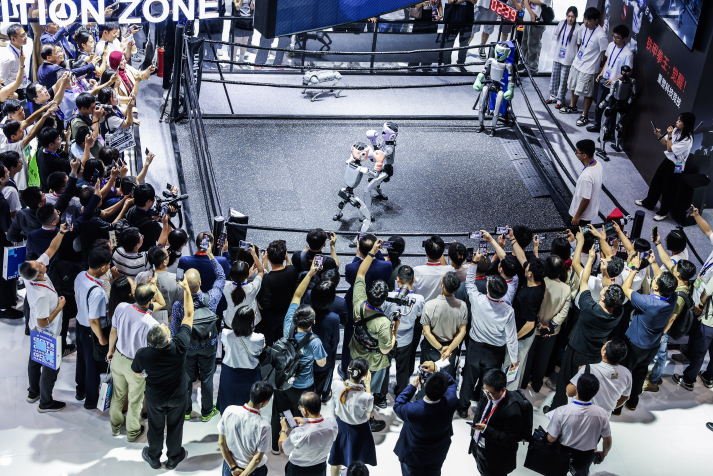 Visitors watch a humanoid robot boxing match at the Fourth Global Digital Trade Expo in Hangzhou, Zhejiang Province, on September 25, 2025 (XINHUA)
Brain-computer interface specialist BrainCo is exploring emerging fields at the intersection of hardware and software. Video game studio Game Science, whose blockbuster title Black Myth: Wukong gained international recognition, represents another strand of the city's innovation economy. Manycore Technology, which may seem niche relative to the other dragons, offers spatial intelligence solutions based on AI technology. For Liu, such stories of rapid growth are ultimately grounded in daily work. His team is conducting final tests on two products—one with a resolution of 640 X 512 pixels and the other, the first domestically developed 1K-resolution SWIR sensor. "This year is a window of opportunity," Liu said. In his view, what makes progress possible is not only technical breakthroughs, but also a market willing to adopt new technologies quickly—conditions China provides. "Only when a technology is used can it keep improving," he said. "And only when it is widely used can it truly mature." (Print Edition Title: From Lab to Life) (Reporting from Hangzhou, Zhejiang Province) Copyedited by G.P. Wilson Comments to liwenhan@cicgamericas.com |
|
||||||||||||||||||||||||||||
|