|
| China |
| Living in a 'Very Chinese Time' | |
|
|
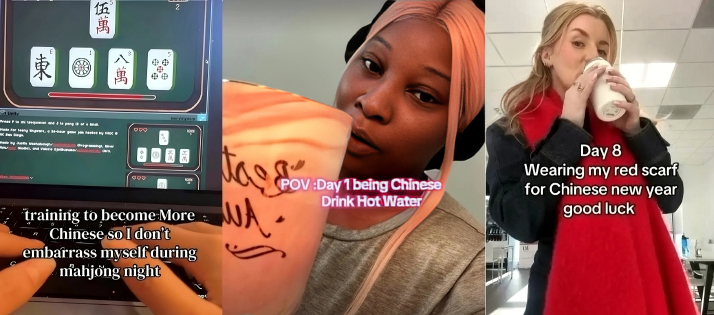 TikTok users share their #BecomingChinese moments on the app in late January (SCREENSHOT)
In the hushed light of dawn, before the city's relentless hum begins, a quiet symphony of care unfolds. It is heard in the gentle shuffle-shuffle of soft-soled cotton slippers on apartment floors, a sound as familiar as a heartbeat. It is seen in the slow, cloud-like arcs traced by taijiquan (tai chi) practitioners in misty parks—their movements a dialogue between body and breath. It is carried in the hands of commuters clutching stainless steel thermoses—not filled with iced coffee, but with warm water—and tasted in the steaming, simple comfort of a breakfast bowl of congee. These are the unremarkable threads of daily life for millions in China, practices woven so deeply into the fabric of wellbeing they often escape notice. Yet, on the lively, fragmented screens of social media platforms like TikTok, these routines are not mundane; they are a revelation. Under hashtags such as #BecomingChinese, what is ordinary in Shanghai or Chengdu is being curated into an aspirational lifestyle abroad—from Brooklyn to London to Berlin. This is a phenomenological one: a global, digital experiment in living according to the principles of yangsheng—the ancient Chinese art of (literally) "nourishing life." Chinese habits, global trend This cultural wave traces its origins to digital creators like Zhu Xirui (@sherryxiiruii) and Emma Peng, who serve as essential "cultural translators." Zhu, a Chinese-American creator, recently sparked the trend with a viral TikTok video listing distinctive Chinese lifestyle habits. The video amassed approximately 750,000 likes and inspired the trending hashtag #BecomingChinese. "Tomorrow, you are turning Chinese," she announced playfully in the clip. Peng, who was raised in China before moving to the United States, also explains and reframes traditional Chinese practices on her social media accounts, translating them into the modern language of wellness. Rather than explaining traditional concepts like qi (energy) or yin and yang, these creators frame long-standing Chinese customs through the contemporary language of Western wellness—using terms like "detox," "lower cortisol" and "heal your gut." "I just want to say that my culture can be your culture," Peng reflected in a recent video. "I'm so glad I met you at such a Chinese stage of your life." The content has resonated widely with global audiences. Comments under their videos often express curiosity and appreciation, with users from different countries sharing how they have incorporated these habits into their own wellness routines, like drinking warm water, using facial massage tools or prioritizing certain foods. Some shared: "I've been Chinese for a week and now I crave congee for breakfast." "I've never been so regular since finding out I'm Chinese." "I started drinking warm water and my acid reflux has improved amazingly, I feel hydrated throughout the day since ditching my ice cold water jug. This change is gold." The wellness logic What followers are adopting is not a random assortment of health hacks, but an interconnected ecosystem of preventive care. The logic is deeply rooted in millennia-old Chinese traditions. For example, the thermos of warm water stems from Traditional Chinese Medicine (TCM)'s emphasis on protecting the body's yangqi, which cold drinks are believed to disrupt. Swapping outdoor shoes for soft cotton slippers at the door is not just about cleanliness; it safeguards the home as a purified sanctuary and, from a health perspective, protects the feet—considered vulnerable gateways for cold air rising from the floor—thus maintaining the body's foundational equilibrium. A warm breakfast like congee is considered "gentle fuel" that stokes the digestive system upon waking, aligning with the body's natural rhythms. This logic extends to other adopted habits, such as eating stewed apples. In TCM, raw fruits are often seen as potentially creating "dampness" and taxing the spleen, especially in colder weather or for those with sensitive digestion. Cooking the apple—often adding a pinch of goji berries, also known as wolfberries, or cinnamon—is believed to transform the fruit's nature, making it warmer, easier to absorb and thus a tonic for the gut. Moreover, tai chi, long perceived in the West through a narrow lens as a gentle exercise for the elderly or a cinematic martial art, is being fundamentally recontextualized. Through the #BecomingChinese lens, its slow, flowing movements are now celebrated as a form of "moving meditation" and a sophisticated technology for stress management. While tai chi offers deep philosophical immersion, it is the simpler baduanjin that has become the true gateway practice. Baduanjin—which literally translates to "eight pieces of brocade"—is a set of eight precise, stretching exercises designed explicitly as medical qigong, a concept best described as "the skill of cultivating vital energy." Each movement targets specific energy meridians and organ systems according to TCM principles, performed with deliberate slowness and coordinated breath. Its appeal lies in its accessibility and immediate sense of release; practitioners often report feeling a wave of warmth and relaxation after just a few minutes, a direct physical feedback that validates the ancient practice for a modern, sensation-seeking audience. 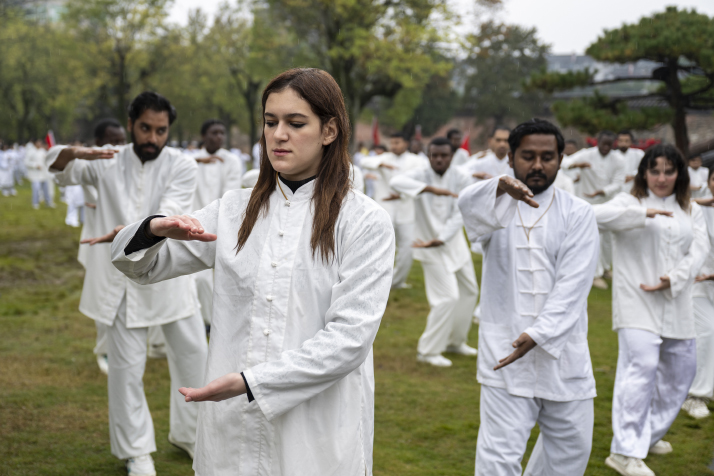 Tai Chi enthusiasts perform at the opening ceremony of the 2025 International Wudang Tai Chi Culture Festival in Shiyan, Hubei Province, on October 25, 2025 (XINHUA)
Closer connection In an article for newspaper The Beijing News, Zhang Taofu, a professor of journalism at Shanghai-based Fudan University, observed that the Becoming Chinese trend reflects a shared human desire for goodness, beauty and a better life. "The vibrant, authentic fabric of daily life in China has resonated with global audiences," he noted. "Many are not only expressing appreciation but are earnestly adopting Chinese habits and lifestyles, almost as a form of cultural 'role-play.'" Zhang added that this wave of genuine interest is helping to dissolve long-held stereotypes and negative perceptions, gradually replacing them with a more complete, truthful and multidimensional understanding of China. This cultural draw is also reflected in measurable ways. According to leading brand valuation and strategy consultancy Brand Finance's Global Soft Power Index 2025, China has risen to second place globally—its highest ranking to date. Meanwhile, language app Duolingo reported a 216-percent year-on-year increase in new Chinese language learners in the United States in early 2025. Many new users cite practical motivations such as wanting to "follow beauty tutorials on [Chinese lifestyle and e-commerce app] RedNote (Xiaohongshu)," "understand TCM" or "get the cultural references shared by Chinese content creators." To enhance cross-cultural exchange, China has pursued a high-level opening-up policy that makes it easier for international visitors to enter the country. A key example here is the relaxation of the visa-free transit policy in late 2024, which extended the permitted stay for eligible travelers from the original 72 or 144 hours to 240 hours and expanded the program to cover 55 countries. In the first year after the new policy took effect, China recorded more than 40 million foreign arrivals, up 27.2 percent year on year, and visa-free transit entries rose 60.8 percent compared with pre-adjustment levels, the Ministry of Public Security said on January 8. Travel facilitation has spurred a noticeable increase in foreign visitors and online creators sharing their real-time experiences in China, resulting in a wealth of organic and firsthand digital content. BR Copyedited by Elsbeth van Paridon Comments to luyan@cicgamericas.com |
|
||||||||||||||||||||||||||||
|