
|
| China |
| Short-term rentals drive market expansion of humanoid robots | |
|
|
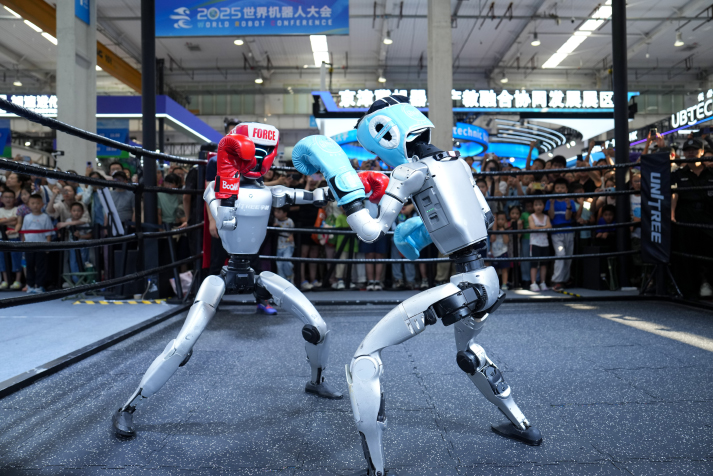 A robot boxing demonstration at the World Robot Conference exhibition center in Beijing on August 11, 2025 (XINHUA)
With the Chinese New Year approaching, humanoid robots are becoming an increasingly common sight at commercial events, corporate gatherings and cultural tourism venues. These sophisticated machines are taking on a variety of short-term "gigs," from greeting guests to performing on stage. The emergence of dedicated robot short-term rental platforms to meet this demand is a sign that the humanoid robot "gig economy" is moving beyond the exploratory phase and entering a stage of large-scale application. Industry analysts believe this rental model is crucial, as it costs less than buying, expands application scenarios and drives the development of task-oriented, specialized robots and services. A promising sector One of these rental platforms, BotShare, was jointly launched last December by embodied intelligence startups AgiBot and Flycode. The platform tiered its pricing to meet a variety of needs. The corporate annual general meeting package, including three humanoid robots and two robot dogs for reception, hosting and performances, is priced at 13,300 yuan ($1,912) per day. A smaller birthday celebration package featuring two robots and one robot dog for greeting, singing and dancing will cost you 2,500 yuan ($359) a day. BotShare also caters to other needs, including sales promotions in shopping malls, sports competitions and concerts. The platform is already operational in 50 cities, with plans to expand to over 200 cities by the end of 2026. Weeks after its launch, the platform has more than 200,000 users and 1,000 devices, processing over 200 daily rentals on average. Big surges are expected around the upcoming Chinese New Year holiday from February 15 to 23. Jiang Qingsong, Senior Vice President of AgiBot, revealed at the BotShare launch that the robot leasing market exceeded 1 billion yuan ($140 million) last year. With the advent of platform-based operations like BotShare, this market size is projected to reach at least 10 billion yuan ($1.4 billion) by the end of 2026. This trend aligns with broader industry forecasts. A recent report by International Data Corporation on China's embodied intelligent robot market said robot business models are shifting from simple hardware-centric sales to becoming more services-oriented. "Robot as a service" leasing and subscription models lower initial customer investment while fostering sustained revenue and customer loyalty through value-added services. This shift is pushing the industry beyond equipment manufacturing toward the development and provision of sophisticated services, injecting new momentum into market growth. A standardized rental model is rapidly solidifying in the market. This typically involves a "robot plus operating engineer" package, where each deployed robot is accompanied by a dedicated engineer providing full-time service. Technical support follows a hybrid model, combining online operational guidance with rapid, offline assistance. As the rental model matures, these service packages are increasingly integrating other services such as dance choreography and other creative inputs. To manage logistics efficiently across the country, BotShare collaborates with the online freight platform Huolala. Hui Jianzhong, General Manager of Shanghai Longxi Culture Co. Ltd., a company specializing in robot production and sales, told People's Daily newspaper that over 95 percent of current market demand is for short-term rentals, mainly for corporate events, commercial performances and cultural tourism. "Many clients do not need to own robots long term; they simply want to use them during critical moments and major events," he explained.  Robots perform alongside humans during a performance celebrating the upcoming Spring Festival, which falls on February 17 this year, in Wuhan, Hubei Province, on January 23 (XINHUA)
Lowering barriers Innovative business models are essential for bringing advanced technologies to a wider user base and finding new real-world applications. At this point in the commercial deployment of humanoid robots, short-term rental is playing that innovative role. It effectively transforms high-value, fixed assets into accessible services, lowering the threshold for usage, particularly for small and medium-sized enterprises. Zhang Lihua, Vice Dean of the College of Intelligent Robotics and Advanced Manufacturing at Shanghai-based Fudan University, told People's Daily that there is sustained demand for performing robots in concerts, film and television production, theme parks and commercial shows. Zhang also noted that renting robots for a single event is often more cost-effective than hiring professional dancers and technical crews long term, and also generates greater public buzz. The future Zhang said the rental model is fundamentally reshaping the structure of the robotics industry and creating new development trends: Rental demand is forcing manufacturers to redefine product goals. Instead of solely pursuing the development of general-purpose humanoid robots, companies are increasingly focusing on optimizing system capabilities around specific application needs—enhancing motion stability for performance roles, or strengthening dynamic control for competitive applications. This is accelerating the emergence of task-oriented, specialized robots. According to Zhang, given the hi-tech nature of robot technology, high upfront purchase costs and subsequent maintenance expenses, long-term leasing will likely become more common. In this model, professional leasing service providers purchase robots in bulk at wholesale rates and offer usage rights for a relatively low rental fee, bundled with technical support. Hui confirmed that while short-term rentals dominate their current business, demand for long-term robot usage is already appearing in the food and beverage industry, providing a realistic foundation for exploring long-term leasing. While commercial performance applications are thriving, experts agree that the truly promising market potential lies in solving the practical, everyday needs of ordinary people. Lin Hanchen, co-founder of a Beijing-based robot research and development company, told news portal Cnr.cn that robot applications are categorized into industrial, commercial service, special operations and household sectors. He noted that the household sector, while the most challenging to achieve, offers the greatest potential. Li Zhengxiang, Chairman of the Hubei Humanoid Robot Innovation Center, told Cnr.cn that there is high public interest in robots for elderly care and home services. However, he cited technological limitations and the challenge of scaling up production volume as current bottlenecks. Technology content creator Zhao Hongmin agreed that while most current applications are limited to performances, the future growth driver will be solving practical human needs. "I believe the major role of robots in the future should be performing specific practical functions, such as those that are too inconvenient or dangerous for humans to perform," Zhao concluded. Copyedited by G.P. Wilson Comments to jijing@cicgamericas.com |
|
||||||||||||||||||||||||||||
|