
|
| China |
| The role of social forces in creating a stronger safety net for people in need | |
|
|
|
On a rainy winter day in Changsha, Hunan Province, former patients, parents, doctors and volunteers gathered inside the auditorium of the Hunan Children's Hospital to celebrate a decade of steady, compassionate service.
The event, held on January 30, marked the 10th anniversary of the first Ronald McDonald House in the Chinese mainland, a facility in Changsha that has provided free lodging and comprehensive support to families of children who are undergoing medical treatment far from their hometowns.  A former patient (left) shares her experiences at the celebration of the 10th anniversary of the Ronald McDonald House in Changsha City, Hunan Province, on January 30 (COURTESY PHOTO)
After the ceremony, guests took the short walk from the hospital to the Ronald McDonald House. Just over 200 meters, not even a 5-minute walk, the distance seemed trivial. Yet for Chen Ting, a volunteer who has supported more than 1,000 children and their families, that walk holds some of the most unforgettable moments of her career as a volunteer. She remembered one night in 2019, a child named Xiaomin, who was recovering from a stem cell transplant, suddenly fell critically ill. Chen was tidying up a room in the Ronald McDonald House when she heard frantic cries coming from Xiaomin's room. She rushed in to find the child limp and barely conscious, the parents frozen in panic. Chen lifted the child onto her back and ran toward the hospital, calling out to keep the child awake and turning back to calm the sobbing parents. Only after the doctors in the hematology ward took over did she finally allow herself to breathe. "It was only a few minutes' walk, but that night every step felt purposeful and full of care," Chen recalled. "Today, Xiaomin has grown up. But she still remembers my shoulder and my voice. That's when I realized how small, everyday acts of care can leave an enduring sense of warmth in a child's life. That's the true power of public service." Home comfort Child health lies at the heart of family wellbeing. For families forced to travel long distances for specialized care—many with limited resources—the lack of external support can mean delayed treatment or a relapse into poverty driven by medical costs. It is exactly those families that the Ronald McDonald House intends to help. The program serves families of children undergoing intensive treatments, including leukemia-related stem cell transplants, cancer therapies, organ transplants and cerebral palsy rehabilitation. Facilities are intentionally located within walking distance of major hospitals, offering free lodging, kitchens, laundry rooms and communal spaces, alongside volunteer companionship and psychological support. The goal is not simply to provide shelter, but stability—a place where families can step out of hospital corridors and regain a sense of daily life. 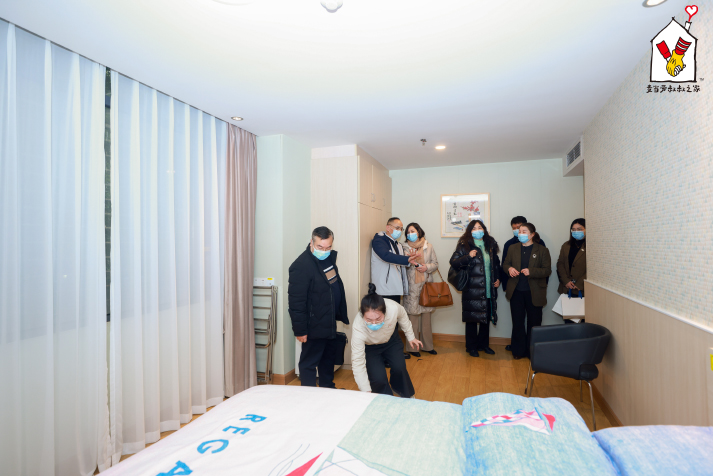 Inside the dormitory of the Ronald McDonald House in Changsha on January 30 (COURTESY PHOTO)
Behind this model is a long-term, professionalized charitable structure. In 2006, McDonald's China and the China Soong Ching Ling Foundation jointly established a dedicated charitable fund to support children's health initiatives nationwide. Over the years, Ronald McDonald Houses have opened in Changsha, Shanghai and Beijing. As of late 2025, the program had assisted 1,890 families. Such work is neither light nor short-term, requiring coordination with hospitals, sustained funding and trained staff. Over time, the houses have fostered a community-centered approach. Families living under the same roof share treatment experiences, care for one another's children and offer emotional reassurance in moments of despair. "The needs of families have evolved," said Gu Lei, Chief Impact Officer of McDonald's China. "What they seek now goes beyond accommodation; it includes emotional support and psychological resilience. Families are no longer just recipients of services; they have become participants in a mutual support network that complements medical care. In Hunan, this approach is being put into practice with the official opening of a new music room at the Ronald McDonald House, offering families of hospitalized children additional emotional companionship and therapeutic support." To sustain operations, the program relies on a diverse and steady stream of public donations. A primary source is the iconic collection boxes found in McDonald's restaurants, where customers can directly contribute. This is supplemented by McDonald's long-term commitment to donate proceeds from every Happy Meal sold. Additional funding is generated through employee volunteer initiatives and collaborative charity markets organized with corporate partners, ensuring a reliable and multifaceted flow of resources. Social backbone The work of the Ronald McDonald House exemplifies a broader trend in China, where social organizations complement government efforts to support those in need. While government agencies provide policy guidance, regulation and public services, social organizations help implement these frameworks on the ground, providing practical support that reaches families every day. "Social organizations are particularly effective where personalized, transitional support is needed. They do not replace state responsibility, but extend and humanize existing support structures," Ulrich Sollmann, a visiting professor of psychology at the Shanghai University of Political Science and Law, told Beijing Review. "Beyond direct services, social organizations connect families, hospitals, communities and administrative systems, translating everyday needs into practical support that informs the ongoing refinement of public services." However, social organizations also face serious obstacles and challenges. Some organizations struggle with transparency in the use of donations, undermining public trust. Others face shortages of skilled professionals, high rental costs, difficulties in securing suitable locations near hospitals or funding disruptions. These obstacles, intertwined and systemic, mean that many promising initiatives falter after early success, limiting their ability to deliver sustained social protection. Addressing these challenges requires coordinated action, Xu Jialiang, Dean of the Institute for Philanthropy Development at Shanghai Jiao Tong University, told Beijing Review. He emphasized the importance of cultivating a culture of public service that moves charitable giving beyond short-term emotional impulses toward sustained, rational engagement. Programs including volunteer initiatives, targeted donations and paired support between donors and families provide clear avenues for participation, creating a predictable framework that encourages long-term involvement. Xu also highlighted the role of government in supporting social organizations. Policies that refine regulations, offer tax incentives, increase funding and coordinate access to facilities help reduce operational costs and enable nonprofits to sustain their services. He added that professional training in project management, operations and digital skills—combined with nonprofit incubation and guidance—can strengthen the sector, build public trust, and create a sustainable social support system. Digital platforms have also become a defining feature of China's charitable landscape. Online donation portals operated by companies such as Tencent and Ant Group—two of China's largest technology and digital payment companies—have lowered participation barriers, integrating philanthropy into everyday digital life. Small donations and interactive campaigns have expanded the reach of charitable giving, making it easier for ordinary citizens to contribute regularly, Sollmann added. (Reporting from Changsha, Hunan Province) Copyedited by Elsbeth van Paridon Comments to wangruohan@cicgamericas.com |
|
||||||||||||||||||||||||||||||
|