|
| China |
| From facelifts to full checkups | |
|
|
|
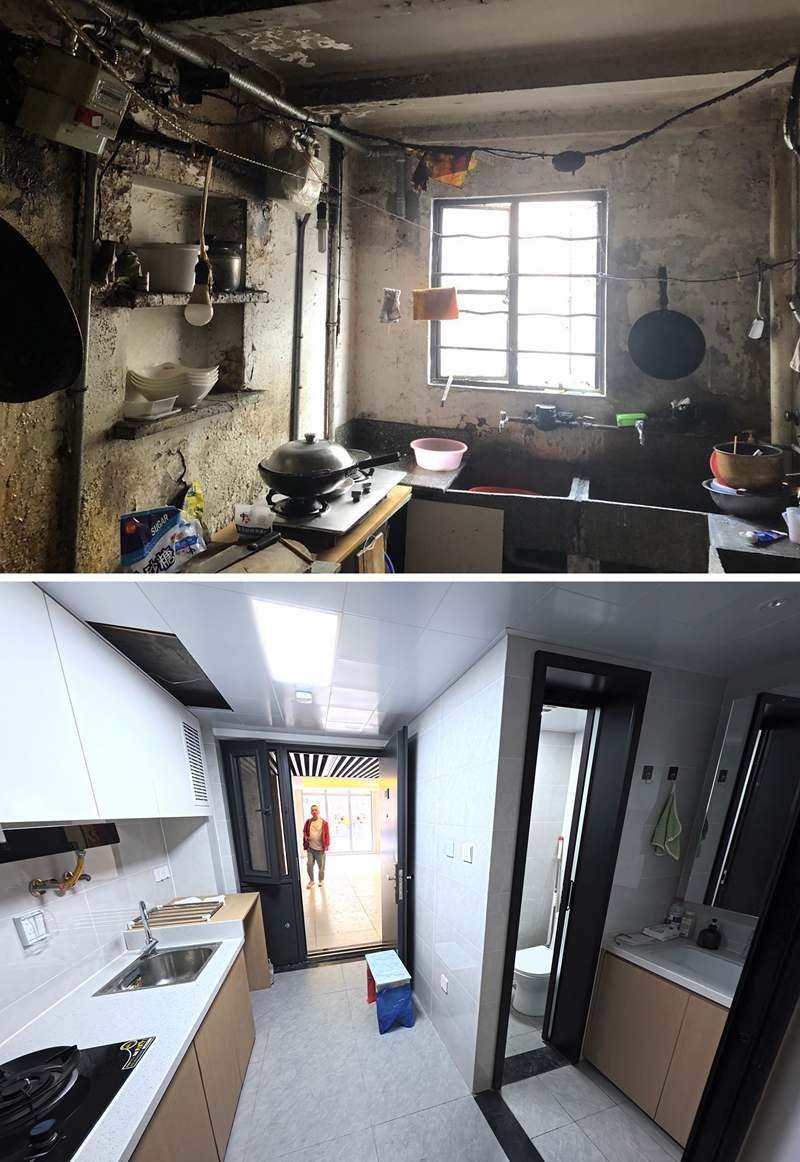
(Above) A communal kitchen shared by multiple households in a compound in Shanghai before its renovation (Below) A private, enclosed kitchen and bathroom inside an apartment after the same compound was refurbished, in October 2024 (XINHUA) In a quiet courtyard of Shijingshan District in Beijing, 42-year-old Zhang Hongsheng recently watched as workers put finishing touches on the freshly painted exterior of his apartment building. “It’s like watching an old friend get a new suit,” Zhang, also a real estate agent, told Beijing Review. His home, built in 1986, is in the final stages of a government-funded renovation. Zhang’s residential community is one of hundreds of thousands across China benefiting from a national campaign to renovate aging urban residential compounds. For decades, these neighborhoods—many constructed during China’s rapid urbanization in the 1980s and 1990s—have grappled with leaking pipes, peeling facades and outdated facilities. Now, they’re getting a second life. Just as residents have been celebrating their newly repaired and upgraded homes, a piece of news has generated further optimism. Recently, housing authorities in many cities unveiled plans on conducting regular structural “health checks” on older buildings, similar to preventive medical screenings for people. For residents, the promise of ongoing monitoring is a profound relief. “You always have a small worry at the back of your mind—is this building still strong? Is it safe?” Zhang said. “Knowing that experts will regularly check its ‘health’ lets us sleep more soundly. It shows the government’s care for us extends into the long-term future.” Safer homes As urbanization has advanced, China’s stock of aging housing has continued to grow. According to Yan Yuejin, Vice President of the E-House Research and Development Institute, a Shanghai-based real estate research agency, residential properties in need of upgrades and repairs can be broadly categorized into four groups based on their age. The first category covers century-old buildings that are dilapidated and structurally unsafe. Next are properties that have surpassed their 50-year designed service life. The third group includes buildings approaching the 50-year threshold, such as residential compounds constructed around 1975. Last are those built since the 1980s, which typically still have a remaining service life of more than 30 years. Data from the 2020 China Population Census Yearbook indicates that five years ago, the proportion of housing stock over 20 years old had already reached 35 percent, with buildings over 30 years old reaching 20.6 percent. “Aging buildings are facing structural deterioration and corroded pipes, among other issues. Mandatory safety inspections are a necessary measure to hold the bottom line of safety,” Li Yujia, Director of the Housing Policy Research Center at the Guangdong Urban and Rural Planning Institute, told China Economic Weekly magazine. On November 19, 2025, the Housing Security and Real Estate Administration Bureau in Zhengzhou, capital of Henan Province, detailed a clear, age-based framework for its new inspection regime. Under the rules, urban residential buildings under 30 years old are exempt from mandatory checks. For buildings aged 30 years or more but still within their original design lifespan, inspections are required once every decade. The requirements become more stringent for buildings that have reached or exceeded their design life but remain in use. In such cases, a structural assessment every five years is mandated. A pivotal aspect of Zhengzhou’s policy is that the municipal government will cover the full cost of the first inspection, a measure designed to ensure swift adoption and ease the financial burden on residents. Building on a mandatory inspection schedule similar to that of Zhengzhou, Changsha, capital of Hunan Province, issued technical guidelines in late October 2025, which place strong emphasis on routine inspections and dynamic monitoring. In Changsha, the responsibility for routine inspections lies with the designated party accountable for the building’s safe occupancy, which is the property owner according to the city’s housing safety regulation that went into force on January 1 this year. These inspections primarily focus on identifying irregularities such as unauthorized renovations, structural modifications and any obvious signs of deformation or damage to the building’s main structure. Dynamic monitoring encompasses both unscheduled inspections and a monitoring and early-warning system. This system employs technical means to conduct regular monitoring of critical indicators, including foundation settlement, building tilt and the development of cracks. When monitored data exceeds predefined safety thresholds, the system automatically triggers alerts. This enables precise risk management and facilitates rapid emergency response measures. According to data released by the Ministry of Housing and Urban-Rural Development last October, some two thirds of the country’s cities have launched urban physical examination initiatives similar to those in Zhengzhou and Changsha. Major cities across China, including Tianjin Municipality, Shenyang in Liaoning Province and Nantong in Jiangsu Province, have all released their own management measures and technical guidelines for building safety evaluations. While the specific focus of these local policies may vary, their fundamental objective is the same: to ensure the structural safety of aging housing. In its recommendations for the formulation of the 15th Five-Year Plan (2026-30), released in October 2025, the Communist Party of China Central Committee highlighted the need to promote high-quality development in the real estate sector, emphasizing that “we should build more houses that are safe, comfortable, eco-friendly and smart, and carry out projects to improve housing quality and initiatives to improve property services. A full life-cycle safety management system should be introduced for housing.” China’s annual Central Urban Work Conferences identify priorities and coordinate actions on the development of urban areas. Last year’s conference, which took place in Beijing in July, made it clear that urban development is transitioning from a phase of large-scale expansion to one focused on improving the quality and efficiency of existing housing stock and urban infrastructure. The conference outlined key priorities, including “building safe and resilient cities,” “advancing the safety of urban infrastructure projects and accelerating the renovation and upgrading of aging pipes” and “comprehensively elevating housing safety standards.” Who pays the bill? To advance the building inspection system, local authorities are exploring diversified funding models to address the crucial question of who pays the bill. Current practices vary by region, with distinct features. Zhengzhou draws inspection fees for urban residential buildings from municipal public accounts. The city of Dongguan in Guangdong Province has implemented a funding model to finance its mandatory building safety inspections, under which the primary financial responsibility lies with individual property owners. The local government acts as the final backstop, providing guarantees to ensure that essential inspections and repairs are completed even when other funding sources fall short. To facilitate implementation, the policy explicitly permits the use of communal property management funds—accumulated from resident fees for maintenance—to cover the costs of inspections. “Those of us who’ve lived here for years and will probably continue doing so, we get it—dealing with these regular inspections is a hassle. But at the end of the day, it’s a small price to pay for knowing our homes are safe,” Zhang said. “The real challenge is getting everyone on the same page about footing the bill, not only for the checkup, but also for whatever fixes might come after it. That’s going to take a system that’s smart about how it works and crystal clear in how it’s run.” BR Copyedited by G.P. Wilson Comments to luyan@cicgamericas.com |
|
||||||||||||||||||||||||||||
|