|
| China |
| Resilience through reform | |
|
|
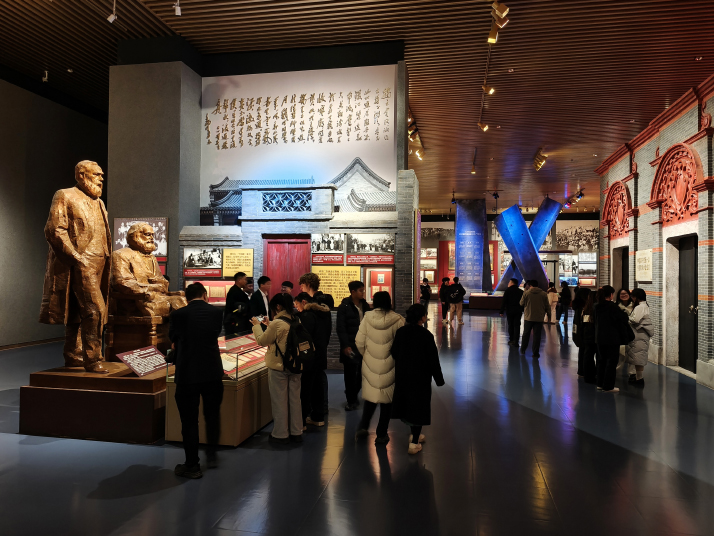 The Museum of the Communist Party of China in Beijing in December 2025 (VCG)
The rise and fall of dynasties has been the norm throughout China's history and in order to secure lasting and stable governance, the Communist Party of China (CPC) must transcend these historical cycles. Even before the founding of the People's Republic of China in 1949, Chairman Mao Zedong contemplated the question of how the Party could do so. His answer was through scrutiny by the people. In 2021, the centenary of the CPC's founding, President Xi Jinping, also General Secretary of the CPC Central Committee, gave a second answer: self-reform. To gain insights into how the Party governs itself, Beijing Review spoke to Zheng Huan, a professor of Party development at the Party School of the CPC Central Committee in Beijing. The school is the top Party school tasked with training officials in Marxist theory and Party ethics. Edited excerpts of the interview follow: Beijing Review: Could you please share with us some major differences between the internal governance of the CPC and that of political parties in the West? Zheng Huan: Parties are products of political modernization. Since countries follow different paths to modernization, diverse political parties have emerged. The way they operate in a particular country also varies. The existence of liberal political parties in the West is premised on a well-functioning political system. One of their basic functions is to curb excessive power centralization through separation of powers in the government or through checks and balances between the ruling party or parties and opposition parties. These parties tend to be loosely organized and are often divided into multiple factions. After the collapse of the Qing Dynasty in 1911, a nationwide political authority was absent in China. As the country attempted to adopt the Western parliamentary system, more than 300 political organizations sprouted up. The head of state, the cabinet and the parliament changed frequently, leading to nationwide turmoil. The CPC was born against the backdrop of a dire social crisis, fueled by domestic conflicts and aggression by foreign powers. As a Marxist political party, the CPC practices democratic centralism, which is a combination of centralized leadership and democracy for its members. It also recruits members according to specific standards and subjects them to strict discipline. All this enabled the CPC to mobilize rapid, effective and collective action when China was mired in a social crisis. Other political parties, however, lacked these traits and therefore failed to do so. The way the CPC is organized has a major impact on how it carries out self-reform. It has necessitated the establishment of a powerful self-supervisory system that puts power under scrutiny. What does President Xi mean by "guiding social transformation through self-reform and advancing self-reform through social transformation?" The CPC is the world's largest Marxist governing party. Continuing self-reform while advancing social transformation is essential to the Party's success. General Secretary Xi has said China's success hinges on the Party, especially on the Party's efforts to exercise effective self-supervision and full and rigorous self-governance. Since Xi became the Party's top leader in 2012, the Party has put self-reform high on its agenda and confronted corruption and other problems head on. In this process, the Party has become more capable of leading China's development. At the same time, the CPC underlines the importance of practicing what it believes in. As it effects positive change in society, it gains a better understanding of itself, including identifying and correcting incorrect ideas and stereotypes, so that it can craft a more nuanced approach to self-reform. In your view, what are the most significant self-reform measures the Party has taken in recent years, and what are the most urgent self-reform measures the Party must undertake now? Fighting corruption is the most thorough kind of self-reform there is. Since 2012, the CPC Central Committee has put forward new visions for anti-corruption efforts. It has emphasized that corruption is the biggest threat the Party faces and that preventing and combating corruption is a long-term political task the Party must perform well in its self-reform. Over the past more than a decade, the Party has punished corrupt officials with zero tolerance. Those expelled from the Party and brought to justice included several members of the CPC Central Committee Political Bureau, a body that consists of the Party's highest-ranking officials. At the same time, the Party has put in place a host of intra-Party regulations and anti-corruption rules. Despite progress made, the fight against corruption remains an uphill battle. The 20th CPC National Congress in 2022 and the Third Plenary Session of the 20th CPC Central Committee in 2024 planned new initiatives such as advancing national anti-corruption legislation and improving Party and state oversight systems. A tough stance against corruption has been one of the hallmarks of President Xi's governance. In your view, what are the major impacts anti-corruption efforts have had on the way the Party operates? The anti-corruption campaign has had far-reaching implications. On the one hand, it has made the Party stronger by resolving severe political risks in the Party, the government and the military. On the other hand, it has won hearts and minds of the general public. A survey conducted by the National Bureau of Statistics in 2022 showed public satisfaction with anti-corruption reached 97.4 percent, 22.4 percentage points higher than in 2012. The CPC's drive to maintain its long-term effectiveness and improve China's governance leads it to undertake continuous self-reform. Are there aspects of this reform that political parties in other countries could draw on as they pursue their own improvements? Self-supervision is a challenge for political parties worldwide. It is important that they share effective practices as well as lessons learned. Many political parties in the West are pushing for reforms such as regulating political fundraising. These reforms are mostly limited because of vested interests. The CPC's courage to tackle its own problems is commendable. Its success in maintaining unity within the Party and building consensus across society at large while carrying out self-reform is also a point of pride. Indeed, there are cases where reform attempts by Western political parties are aborted because of power struggles between different factions. BR Copyedited by G.P. Wilson Comments to yanwei@cicgamericas.com |
|
||||||||||||||||||||||||||||
|