|
| China |
| The cost of 'always-on' work culture | |
|
|
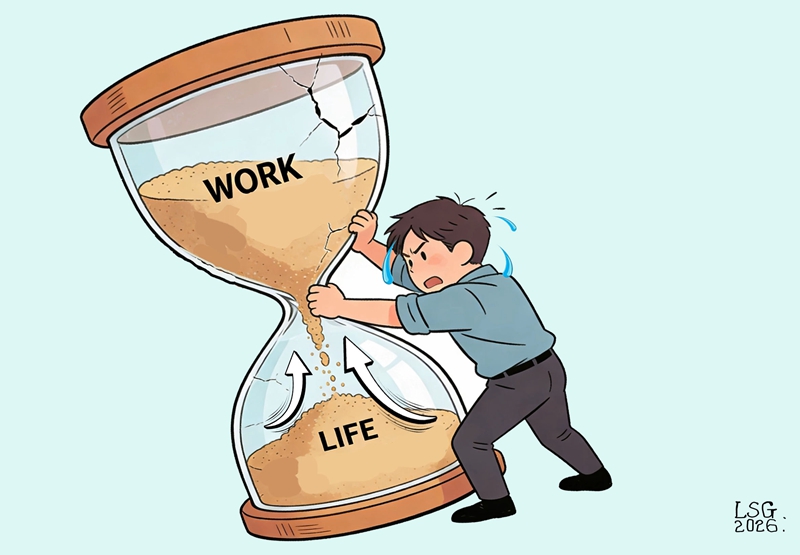 Recently, a 32-year-old information technology engineer in Guangdong Province died suddenly on a weekend. Medical records cited the cause of death as "sudden respiratory and cardiac arrest." His family later revealed that while he was undergoing emergency treatment, his company's technical group sent him a message on super app Weixin: "Mr. Gao, please help handle this order." Eight hours after he had been pronounced dead, another work-related message arrived on his phone: "There's an urgent task Monday morning. Today's inspection didn't pass. This needs to be modified." Gao's family believes his death resulted from prolonged overwork and intense job pressure from a work culture that never switches off. His tragic passing has ignited widespread online discussion. While some argue that overtime may be necessary for business survival in a competitive market, many netizens contend that corporate efficiency should not come at the expense of employees' rights, health or lives. Liu Siyuan (Rednet.com): Companies today increasingly use digital tools to overcome the spatial limitations of the traditional office, yet corresponding labor protections often remain inadequate. This 24/7 model shifts business risks onto employees, trading their long-term wellbeing for the short-term corporate gains. "Putting people first" is a foundational principle of modern society. However, the rise of "invisible overtime," enabled by digital technology, puts performance over workers' physical and emotional needs. Gao's case exemplifies this distortion: He was added to a Weixin work group while undergoing emergency treatment and received work messages even after being declared dead. Such a work culture not only equates "long hours" with "hard work," but also promotes harmful values, sacrificing health for performance and rights for profits. In the long term, this approach will only intensify social anxiety and drain the creativity and vitality essential to a thriving society. After all, without healthy workers, there can be no sustainable growth for any company. Xin He (The Beijing News): Gao's compensation followed a "low base salary, high performance bonus" model. This "more work, more pay" approach is common in the workplace and can, in theory, motivate employees while supporting operational needs. However, when work and overtime are extended without clear limits, it risks infringing on workers' rights, such as the right to rest, and may even cross legal boundaries. According to China's labor regulations, if an employer needs to extend working hours due to operational demands, it must first consult with the labor union and employees. Overtime is generally limited to one hour per day. Under special circumstances, and with safeguards for employee health, extensions may not exceed three hours per day, with a monthly cap of 36 hours. The law, therefore, sets clear limits on overtime management. Gao's company, while offering attractive benefits, also required extensive overtime. It must be emphasized that good benefits do not legitimize excessive overtime. The original purpose of flexible work arrangements was to enhance efficiency. In practice, however, such systems are often distorted into "24/7 availability" and "invisible overtime," creating a gray zone in workplace norms. Employees are the foundation of a company's growth. The ideal outcome is a win-win dynamic between the organization and its staff. When overtime is necessary, companies should actively balance operational needs with employees' legitimate rights, especially the right to rest. This is not only a legal obligation but also a strategic choice for sustainable development. BR Copyedited by Elsbeth van Paridon Comments to yanwei@cicgamericas.com |
|
||||||||||||||||||||||||||||
|