
|
| China |
| Labor courses are gaining popularity at universities | |
|
|
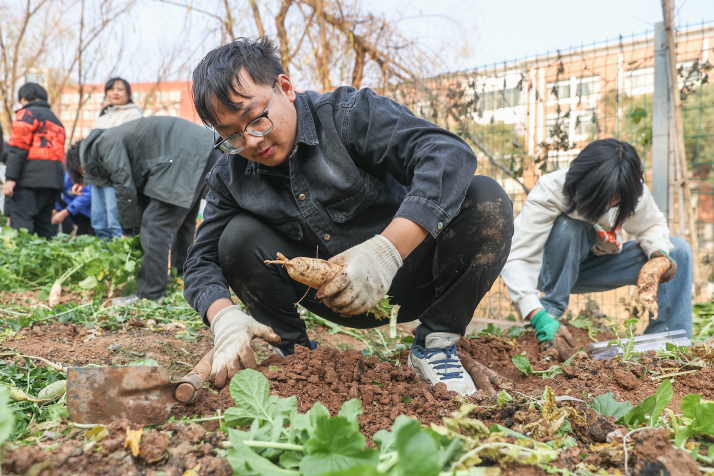 Students harvest radishes they grew themselves at Nanchang Hangkong University in Nanchang, Jiangxi Province, on January 3, 2025 (VCG)
What is the most sought-after course at Renmin University of China (RUC) in Beijing? With only 36 slots available for over 300 applicants, the cooking class boasts a grueling one-in-10 admission probability, cementing its title as the "hardest course to grab" at the university. On one afternoon last September, Xi Xinyuan, a junior student at RUC, logged into the course selection system precisely on time. "Labor education—cooking class—selected!" she exclaimed. The dorm room erupted in cheers; she had successfully secured a spot in the highly coveted class. This was her third attempt, after two failed ones the previous year. "I initially expected the labor course to involve mundane tasks like sweeping floors, weeding or wiping tables. I was stunned when I realized the school was getting genuinely 'serious' with the course," Xi recounted in an article for newspaper China Youth Daily. "Besides the extremely popular cooking class, the university also offers a diverse menu of practical skills for us to learn, including plumbing repair, corn harvesting, building wooden stools and latte art." Why are university campuses now teaching these manual skills, and why are top-tier students fighting to get into these labor courses? According to Xi, the motivation is remarkably tangible. The cooking class doesn't just teach her skills; she can pack up her culinary creations to share with her roommates. "It's fun, the results are delicious and so, naturally, it became the hottest ticket on campus," she explained. This surge in interest follows a big policy shift in China's education system. In 2020, the Ministry of Education issued the Guidelines on Labor Education for Primary, Secondary and Higher Education. These guidelines detailed the aims, components and teaching methodologies for labor education, setting specific requirements for schools, teachers and local educational authorities. The stated goal is to nurture an enthusiasm for hands-on work, fostering a spirit of frugality, diligence, innovation and dedication, while encouraging students to actively engage in practical work and exercise their initiative and creativity. Getting stuck in When Xi first stepped into the cooking classroom on the third floor of the campus cafeteria, the air was thick with the scent of disinfectant. Donning a white chef's coat and facing the array of pots, pans and utensils, she was slightly nervous. Back home, she'd often been told: "You're too clumsy; stop fooling around in the kitchen!" Now, about to genuinely wield a spatula as a novice "master chef," she felt her heart pounding. For the first class, the task was to prepare Yangzhou fried rice, a classic Jiangsu Province dish made with chilled cooked rice and a mix of pork, chicken, shrimp, vegetables and eggs. With patience and precision, Wang Zuorong, Deputy Director of RUC's Food and Beverage Service Center, demonstrated the technique, meticulously dicing a chicken breast. He frequently referenced the display screen behind him to highlight key steps: The heat required precise control, and the broth had to be added in three stages to ensure the rice was moist yet every grain remained distinct. Soon, it was Xi's turn. Paired with a partner, they worked cautiously but clumsily. They poured in the egg mixture and flipped their spatulas—only for the rice to inevitably begin scorching. "From clumsy beginnings to achieving a slight degree of proficiency, I gained far more than just a great meal in the kitchen. Amid the overwhelming pressure of assignments, internships and deadlines, the cooking process—where your effort immediately yields results—offered me the first chance to genuinely relax in a long time," Xi reflected. Bai Yu, a Chinese language and literature major at Beijing Normal University, confirmed the intense demand for practical skills courses. She shared with China Youth Daily that baking and coffee classes are wildly popular at her school. "For the most sought-after labor courses, you must log in exactly at 10 a.m. one week in advance, or you stand no chance of securing a spot," she noted. In her baking class, Bai learned to craft pork floss mini-mochi under the guidance of a highly skilled chef. "I used to think making pastries was too much hassle—too time-consuming, too messy and likely to fail," Bai confessed. "But after the class, I realized: The extra care I poured into that homemade pastry is something you can never replicate with store-bought version." That complex mix of emotions woven through kneading, waiting, trial-and-error, and the final presentation is something rarely encountered in her standard academic coursework. 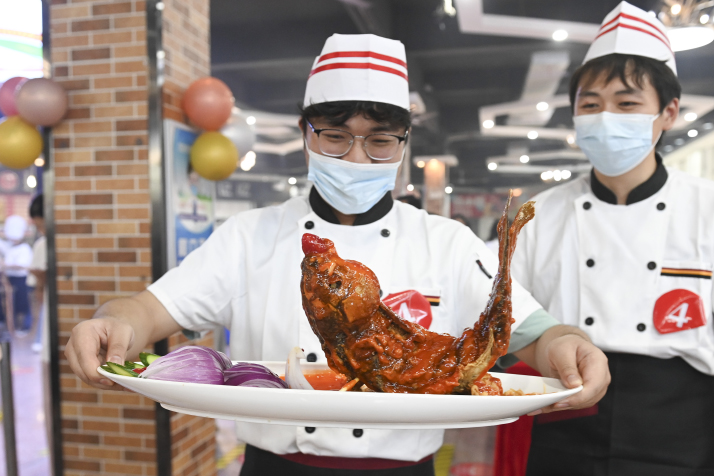 A student proudly presents a sweet and sour fish dish at a cooking competition held at Hunan Agricultural University in Changsha, Hunan Province, on May 11, 2024 (VCG)
Beyond 'manual labor' Labor education, however, is not confined to culinary arts. Li Wei, a senior at RUC, participated in a labor practice activity last October at the university's campus in Beijing's Tongzhou District. "Initially, we gathered around a tree to build stools. We first had to master sawing wood, and then figure out how to assemble the structure," Li explained to China Youth Daily. He realized how demanding the task is only after he started working with the materials. Changjiang University in Hubei Province has established a dedicated Labor Education Base. All undergraduate students enrolling from 2025 onward are required to participate in farming activities. Students are involved in the entire cycle: Turning the soil, sowing seeds, watering and weeding. Beyond the hands-on practice, they must study crop growth patterns and meticulously document their labor experiences. Labor education is also rapidly evolving beyond mere "manual work." Many universities are developing innovative formats that blend industry, academics and practical application. At Changjiang University, for instance, the vegetables cultivated can be sold through market operations or directly served in the school cafeteria. Other institutions offering cultivation-themed courses are guiding students to research solutions for soil pollution or utilize livestreaming to sell the produce they have personally grown. This enthusiastic student response directly addresses a long-standing educational deficiency. As a recent commentary in newspaper Beijing Youth Daily highlighted, "For a long time, labor education has been marginalized in the education system. Many students grow up 'only knowing how to study, but not how to work,' forming a mindset that values 'brainpower over hands-on work.' This has even led to misunderstandings about the value of labor. Some view manual labor as a 'lowly' means of making a living and actively avoid physical work. This perception distorts the true nature of labor and weakens the sense of responsibility and practical skills of young people." The commentary continued: "Now, the phenomenon of university students actively scrambling to snag a spot in a labor course is a powerful correction to this outdated mindset. They no longer see labor as a burden, but rather as a way to hone their overall abilities, nourish their spirits, and an essential course for personal growth." The commentary suggested that universities enrich their labor course content, integrating labor education into specialized studies and daily campus life to prevent it from becoming a fleeting, campaign-style initiative. Concurrently, society at large must cultivate an atmosphere that respects diligence and values technical skills, thereby guaranteeing that every form of labor receives the dignity and recognition it deserves. Copyedited by Elsbeth van Paridon Comments to jijing@cicgamericas.com |
|
||||||||||||||||||||||||||||
|