|
| China |
| Revised funeral and interment regulation emphasizes public welfare and eco-friendly options | |
|
|
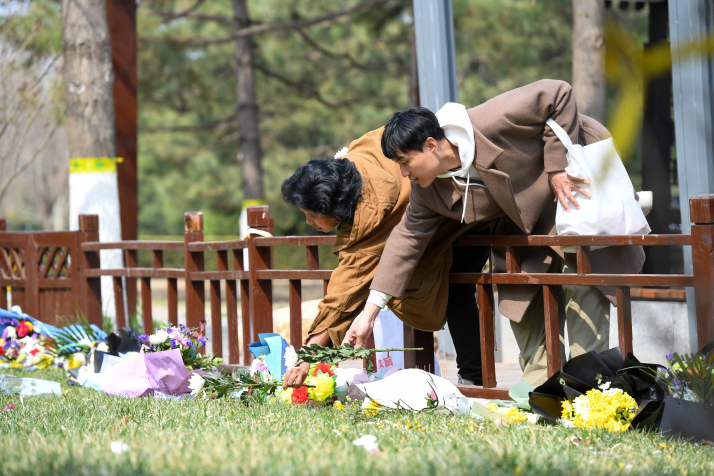 People lay flowers at a cemetery in Beijing on April 2, 2024 (XINHUA)
'Death—what is there to be said of it? The body returns to mountain and hill." Over a millennium ago, Chinese poet Tao Yuanming (365-427) captured the profound philosophical view of death as a natural return to the embrace of the earth. This ancient wisdom is being increasingly embraced by modern Chinese and has been reflected in the recently released Funeral and Interment Management Regulation, unveiled by the State Council, the highest state administrative organ, on January 7. The regulation set the stage for sweeping changes aimed at making end-of-life services more affordable, transparent and environmentally sustainable. The regulation, which will come into force on March 30, is the first comprehensive revision since it was enacted in 1997, responding directly to public concerns over high costs, opaque pricing, and the environmental footprint of traditional burial practices. Welfare for people China's funeral industry is deeply rooted in Confucian culture, which places a strong emphasis on reverence for the deceased and the practice of filial piety. This has given rise to numerous traditional rituals and customs, such as the vigil, the funeral procession and the burial itself. Therefore, reshaping the industry regulations touches upon many complicated cultural issues. At the same time, with the accelerated aging of China's population, the market size of the funeral industry has been growing year by year. As of late 2024, the population aged 60 and above had reached 310.3 million in China, accounting for 22 percent of the country's total population, and those aged 65 and older had exceeded 220.2 million, representing 15.6 percent of the total population, according to a report jointly released by the Ministry of Civil Affairs and the Office of the China National Committee on Ageing. This leads to increasing need for and concern over the funeral industry. At its core, the updated legislation seeks to reinforce the public welfare function of the funeral industry. To curb excessive charges while meeting essential needs, it introduces a clear two-tiered system categorizing services into "basic" and "non-basic" items. A national list of basic services will be established, covering essential processes such as body transportation, refrigeration, farewell ceremonies, cremation and the storage of ashes. Crucially, the regulation also mandates that all newly established funeral service institutions be state-run and operate on a non-profit basis. The national basic list also includes ecological burial options like sea, tree and lawn interments provided by government-run institutions. Pricing for these basic services will be set according to government-regulated standards. Local authorities are permitted to expand this list based on regional circumstances, emergencies, local customs and the preferences of different ethnic groups, while maintaining strict oversight over non-basic service offerings and their fees. Provinces have established their Basic Funeral Services List and a Non-Basic Funeral Services List accordingly, with changes to fees for basic items. For example, the Wuchang Funeral Home in Wuhan City, Hubei Province, now offers 15 funeral service items, among which six are classified as basic. Fees are now either reduced or waived for these basic items, which include corpse transportation, refrigeration, cremation and short-term ashes storage, and an urn is provided free of charge by subsidies from the government. "We have streamlined our service portfolio by removing lesser-used offerings and have proactively lowered the prices of funeral supplies," Chen Junju, deputy director of the funeral home, told China Media Group. "This structured approach is designed to ensure that every family has access to dignified and affordable essential services, while leaving room for personalized choices without falling into commercial exploitation," Xie Zhiyong, Dean of the College of Comparative Law at China University of Political Science and Law (CUPSL), told news portal ThePaper.cn. He noted that previous regulations lacked this explicit public welfare mandate, leaving room for market-driven price surges in essential services. Further cementing the shift toward non-profit operation within the sector, in addition to mandating all new service providers be state-run and non-profit, the new rules require all land for new funeral facilities to be acquired through state allocation rather than commercial transactions. "This effectively blocks the future emergence of new for-profit players in the sector. The incremental supply will be entirely public and welfare-oriented," Deng Zhihua, Director of the Editorial Department of the Shanghai Institute of Funeral Culture, told ThePaper.cn. The revised regulation prohibits hospital morgues from offering funeral services directly, permitting only temporary body storage. This move aims to eliminate shady commercial practices and standardize management across the death-care chain. 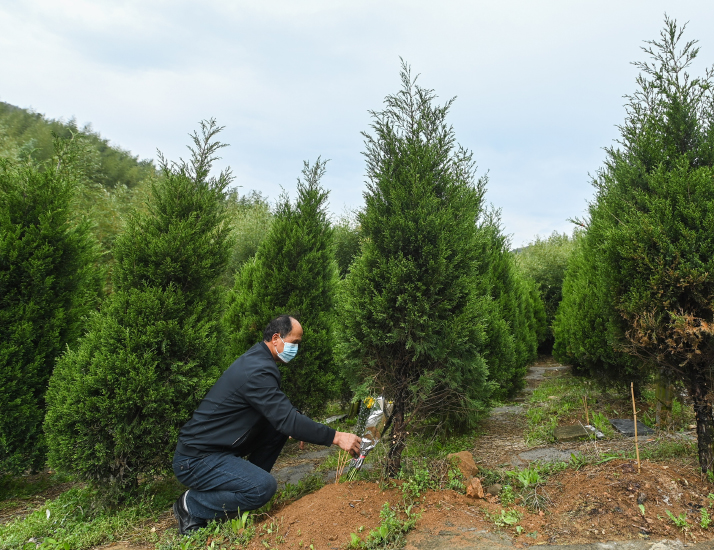 A cemetery staff member places a flower at a tree burial site to pay tribute to the deceased during the Tomb Sweeping Day on April 4, 2023 at Jiu’an Cemetery in Daochang Township, Huzhou City of Zhejiang Province. The local government promotes environmentally-friendly floral tributes and tree burials XINHUA
Implementation and oversight To enforce these provisions, the regulation stipulates the establishment of a multi-department supervisory framework. It clearly delineates responsibilities among civil affairs, development and reform, finance, natural resources, and market regulation authorities. A dedicated supervision chapter mandates coordinated inspections, price monitoring and the introduction of a credit-based management system for service providers. Violations may lead to hefty fines, public credit penalties and even legal action. "By clarifying the process of supervision and enhancing inter-agency collaboration, we can close regulatory loopholes and build a consistent enforcement front," He Bing, a law professor at CUPSL, told ThePaper.cn. "This integrated oversight is crucial to protecting consumer rights and maintaining order in a sector that touches every family in their most vulnerable moment," Tan Zejing, a professor at Changsha Social Work College, told the same media outlet. One of the most forward-looking aspects of the revision is its stronger endorsement of ecologically sustainable burial methods. With land scarcity intensifying and public environmental awareness growing, practices like sea burial, tree burial and lawn burial without tombstone and coffins are receiving unprecedented policy support. The regulation encourages local governments to expand the supply of these options and allows them to provide subsidies to families that choose green interments. According to the Ministry of Civil Affairs, 26 provincial-level regions have now issued detailed implementation guidelines to promote ecological burials, many incorporating financial incentives. In coastal cities like Shanghai and Qingdao, the number of organized sea burials has risen steadily. "For us, an urban family, sea burial is not just an affordable choice; it's a philosophical one—returning to nature, becoming part of something vast and eternal," Chen Hua, a Beijing resident who has arranged sea burials for two relatives, told Beijing Review. However, the transition is not without cultural hurdles. In many rural communities, deep-seated traditions favoring grave-based ancestor veneration persist. Experts argue that overcoming such resistance requires more than just policy; it demands cultural sensitivity and improved service quality. "The challenge isn't just about building eco-burial facilities; it's about embedding them with ritual meaning and humanistic care," Guo Lin, a professor at Huazhong University of Science and Technology, told newspaper Legal Daily. "The promotion of new burial forms must be coupled with ensuring the quality of newly added land-saving and ecological burial facilities and their related services. It is particularly crucial to integrate these with wholesome funeral customs, thereby enhancing the humanistic value of such facilities and services. Additionally, measures like price incentives and financial subsidies should be strengthened to guide the public toward land-saving and ecological burial options," Guo added. Copyedited by G.P. Wilson Comments to zhangyage@cicgamericas.com |
|
||||||||||||||||||||||||||||||
|