
|
| China |
| Emotion-driven purchases top the online shopping trend | |
|
|
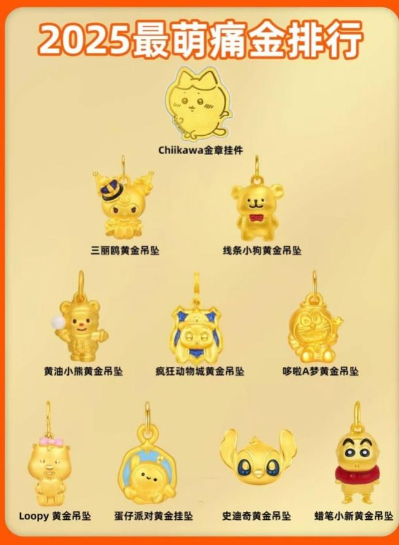 The 2025 top 10 "pain gold" products as voted by users of lifestyle-sharing platform RedNote (SCREENSHOT)
A week before New Year's Eve, 24-year-old Fang Yuxin scrolled through China's largest online marketplace Taobao again, adding yet another item to her cart: a delicate, anime-themed gold bead. She already owned 11 gold luck beads, including a pendant based on Black Myth: Wukong and a tiny charm inspired by Japanese anime Chiikawa. But this one, she decided, would be her "year-end luck bead." "It's like collecting a year of memories made of gold," Fang told Beijing Review. "Every piece represents something I love: a game, a character, a moment. And now, as the year ends, it feels right to add the last one, as it will carry my hopes into 2026." Fang is among the millions of young Chinese regularly making emotion-charged purchases, a trend clearly reflected in Taobao's freshly released Top 10 Products of 2025. The list, unveiled on December 18, includes "pain gold," pixel bead crafts, bag charms, new Chinese-style wellness drinks, thin-soled shoes, car mattresses, quilted down jackets, AI companion dolls, Suchao soccer merch and flash-sale everything. Data from Taobao suggested sales of "pain gold" in 2025 soared nearly 300 percent year on year. The term "pain gold," borrowing from the Japanese "pain" culture, refers to gold jewelry or collectibles featuring characters from animations, comic and other cultural products. The "pain" culture is associated with items like "itabags"—handbags or accessories densely decorated with anime badges and charms to openly display fandom. The character "pain" was used in a self-mocking way to describe exaggerated, cringe-worthy, or eye-catching behaviors or decorative styles. This subculture embraces the idea of "proudly bearing" one's passion, turning personal interests into wearable, shareable statements. Since 2020, Taobao has curated this annual selection based on search trends and sales data. "Taobao, as a national e-commerce platform, forges a profound connection between products and our times," Hong Yong, an associate research fellow at the E-Commerce Research Institute of the Chinese Academy of International Trade and Economic Cooperation (CAITEC) under the Ministry of Commerce, told the news outlet Tide News. "The annual Taobao Top 10 Products list not only mirrors shifts in social sentiment but also highlights the platform's unique ecosystem strengths—built upon a massive and sophisticated digital commerce foundation of 1 billion consumers, tens of millions of merchants and billions of products. The vast volume of consumer behavior enables Taobao to keenly identify common emotional demands and translate national sentiment into waves of new consumption trends, consistently driving business innovation and industrial upgrading," Hong said. Self-care purchases Fang's purchase, a gold luck bead, is about the size of a pea and designed to be threaded onto bracelets or necklaces. In Chinese tradition, such beads are believed to attract positive energy and turn one's fortune—often worn during festivals or transitional moments as a symbolic guardian. What makes this item particularly contemporary is its fusion of Japanese "pain" aesthetics with Chinese cultural symbolism. Beyond luck beads, "pain gold" includes an array of creative forms: slim gold plates that slip into phone cases, collectible gold cards, and even miniature "golden tickets" inspired by anime or gaming franchises. Against the backdrop of soaring global gold prices in 2025, "pain gold" earned a playful yet pragmatic nickname: "the most value-preserving goods." "Generally speaking, the per-gram price of intellectual property (IP)-themed gold luck beads is much higher than that of ordinary gold jewelry. I suspect there's a premium for the collaboration and design costs," Fang explained. "When gold was around 700-800 yuan ($99-113) per gram, I bought this bead at over 950 yuan ($135) per gram. My mother strongly disapproved. She said it was a total waste." "That's why I've been so happy lately seeing the surge in global gold prices," she added. "I never actually thought the day would come when gold prices would catch up to what I paid for my luck bead. I bought it because it can bring me joy beyond what regular gold jewelry could offer, but now it's also proving that gold itself is a truly value-preserving investment." Major traditional gold jewelry brands have keenly identified this consumer trend and are enthusiastically embracing it by launching a variety of IP-themed "pain gold" products targeted at the younger generation. Key industry players, such as Chow Tai Fook, Chow Tai Seng, Lao Feng Xiang and CHJ Jewellery, have entered into numerous collaborations with popular intellectual properties. For instance, coinciding with the release of animated film Zootopia 2, Chow Tai Fook introduced a special collection featuring gold beads and pendants shaped like the film's beloved characters, Nick Wilde and Judy Hopps. "This pawpsicle gold bead from Zootopia 2 is one of December's bestsellers," a staff member at a Chow Tai Fook store in Beijing's Chaoyang District told Beijing Review. The gold bead weighs approximately 0.7 grams and sells for 2,080 yuan ($296). The product also came with a delicate thread. "Many movie fans rushed into the store for this series. It was even sold out in about three days after the movie was released." Handmade happiness If "pain gold" represents a hardcore investment made by young people for their passions and emotional wellbeing, then an affordable handicraft known as pindou or "pixel bead art" has become their accessible comfort after clocking out from work. Tiny, colorful beads are used to make pixel-style patterns and images. Searches for bead craft kits have risen nearly 500 percent over the past year. "After work, I just zone out with my beads and a podcast," Chen Haonan, an office worker in Shanghai and part-time pixel bead art online shop owner on social platform RedNote, told Beijing Review. "It's repetitive and unexpectedly soothing. And at the end, you have something cute to show." Chen began sharing his creations online and now sells custom bead patterns on RedNote, earning over 3,000 yuan ($427.1) a month. These bead art creations can be crafted into small handicrafts such as decorative ornaments. On Taobao, many bead art material kits achieve monthly sales exceeding 100,000 units. This surge has revived struggling handicraft stores and kept upstream bead material production factories operating at full capacity. There are also young people like Chen, who have opened Taobao stores dedicated to bead art, specializing in designing and selling original bead pattern blueprints. By leveraging their wildly creative ideas, they are achieving the modest goal of making some extra cash. Comfort as a statement Fashion, too, is embracing the philosophy of caring for oneself. Thin-soled shoes and quilted-down jackets, once considered "grandma style," are now wardrobe staples, with sales jumping sevenfold and 250 percent, respectively, this winter. The appeal? "They're light, warm and you don't have to suffer for style," said RedNote fashion blogger Cici in a vlog. "There was a time when young people who cared about their heights and style would chase after platform sneakers and dad shoes. Now, it's about being kind to your body." Wellness has also taken a practical, portable turn. New Chinese-style "shot" drinks, like turmeric or apple-astragalus tonics, promise quick immune boosts for busy young professionals. During the Double 11 shopping festival in 2025, from late October to November 11, searches for these drinks rose 13 fold year on year. Catering to the "workplace wellness" trend, established health food and traditional Chinese medicine (TCM) brands are introducing a new generation of convenient, ready-to-drink "TCM shots" for deskbound professionals. "I have Tongrentang tea packs about three times a week (Tongrentang is one of China's oldest TCM brands—Ed.). I don't actually have to treat any diseases, but I'm feeling certain levels of anxiety, tiredness and insomnia after long hours of working. It's more of a health preservation option. Having these makes me feel safe," Shenzhen-based tech employee Du Ning told Beijing Review. "I don't have time to brew TCM herbs like my parents' generation did, but I can grab one pack on my way to work." Copyedited by G.P. Wilson Comments to zhangyage@cicgamericas.com |
|
||||||||||||||||||||||||||||||
|