
|
| China |
| Tea, technology and transformation | |
|
|
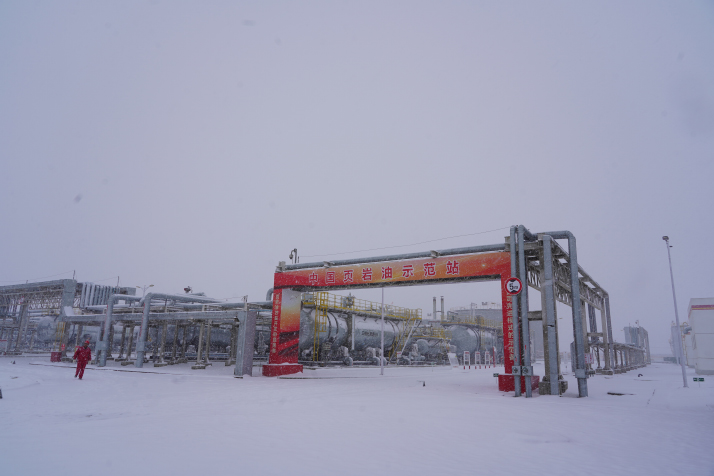 A facility in the Jimusar Shale Oil Demonstration Zone, China's first national-level lacustrine shale oil demonstration zone, on November 25 (MA XIAOWEN)
Jimusar is a county in Changji Hui Autonomous Prefecture, Xinjiang Uygur Autonomous Region, where winter temperatures often plunge to minus 25 degrees Celsius and the Tianshan Mountains command the horizon. Local officials and residents in the county have been working together to create localized solutions to universal challenges. Their approaches are strengthening community ties, improving rural healthcare and fostering sustainable growth in a resource-rich region. What makes Jimusar's approaches notable is not only the solutions themselves but the way they have emerged from practical, locally adapted initiatives that blend tradition with technology to improve everyday life. A potent remedy While winter winds sweep across northwest China, warmth and conversation fill the community center on Wenming Road in Jimusar's urban area. People often cluster around with cups of steaming milk tea, talking, laughing, and also discussing neighborhood issues. This frequent scene is brought about thanks to the Neighborhood Milk Tea Chats initiative. The Wenming Road neighborhood comprises both old residential complexes and standalone buildings, housing over 7,000 people. In the past, people barely knew their next-door neighbors, let alone the others in their buildings. But now, the Neighborhood Milk Tea Chats have reshaped how this community administers itself. "The rule (at the chats) is simple," said Zhang Jun, director of the community, pouring tea for newcomers. "Everyone speaks, everyone listens and we solve problems together." What began as an experiment in late 2023 has become a model of grassroots democracy, tackling issues from misplaced parcels to creating shared spaces for the elderly. The process is practical and swift. When Markfulla Vakas raised concerns about inadequate shade and unclear addresses, the community secured funding and within 10 days, built a 20-meter shaded walkway and installed new address plates. "The speed surprised everyone," Vakas recalled. The milk tea gatherings have also brought neighbors closer. Feng Xiaoyan and Ainur Smay, who live opposite each other in the same building, became "sisters" thanks to these get-togethers. "We'd been neighbors for seven or eight years, but we'd never met until the milk tea gatherings," Feng smiled. Ainur added: "During the Chinese New Year, I make fried sanzi (twisted dough sticks), youguo (fried pastries) and butter cakes for her. When I cook polo (Uygur rice pilaf) or dumplings, I either invite her over or send some to her." These gatherings have evolved into multipurpose forums—bonds are built and wisdom is shared. In an age of social fragmentation, Jimusar has brewed a potent remedy: genuine conversation, served with hospitality. The model has since spread across the county, proving that effective local governance can be as simple as chairs arranged in a circle and shared tea. According to Zhang, Jimusar has held over 2,000 Neighborhood Milk Tea Chats, and about 25,000 people have participated so far. Dual economic engine Beneath Jimusar's frosty surface lie vast shale oil reserves. In the past, extracting this oil was unfeasible due to the complex geology of the region, likened to "squeezing oil from a stone." Today, technology has made extraction viable and Jimusar is now at the heart of China's first national continental shale oil demonstration zone. "The breakthrough came from intelligent extraction," explained Wu Bin, who heads the shale oil central station in the Jiqing Oilfield Operation Area. Wu told Beijing Review that shale oil extraction is far more challenging than conventional crude oil production. Through PetroChina's efforts, the Jimusar Shale Oil Demonstration Zone has become China's pacesetter in unconventional oil development, establishing a new "intelligent regulation plus low-carbon oil recovery" model. The zone integrates subsurface oil extraction with surface tourism, meeting green, smart and economic benchmarks. Notably, its annual output achieved a "Jimusar Leap"—surging from 0.5 million tons in 2022 to over 1 million tons in 2024—with a 2025 target of exceeding 1.7 million tons. "Currently, we've shortened horizontal well drilling cycles from 90 to 31 days, and our platform-based 3D deployment model cuts land use by over 50 percent," Zheng Aimin, foreman of Shale Oil Operation Team 1, told Beijing Review. The Internet of Things system enables unmanned patrols, rodless pumping eliminates spills and leaks, and fracturing fluid recycling saves over 800,000 cubic meters of water yearly—achieving greener shale oil development. While oil extraction advances underground, an agricultural treasure thrives above ground. Farmers in the southern township of Dayou are growing morels, highly prized delicate spring mushrooms known as the "king of fungi" for their flavor and nutritional value. Dayou, with its distinctive microclimate, provides a favorable environment for growing morels. "From harvest to plate, it takes about 15 days," said farmer-entrepreneur Wu Wei, walking through once idle greenhouses now alive with growth. Morels sell for up to 400 yuan ($56.58) per kg in premium urban markets, and its cultivation has revived over 800 abandoned greenhouses in the county and created seasonal jobs for hundreds. While coordination among farmers, cooperatives and enterprises is key to ramping up production, partnership with experts in Xiamen, Fujian Province in southeast China, has boosted processing and storage capacity. Together, they are growing not just morels but a regional brand. Redefined rural living Another striking change in Jimusar is its redefinition of rural living. Xiaofenzi used to be an impoverished hamlet due to its remoteness. It used to take two hours to reach it by winding mountain road from Jimusar's county seat. But today, it is a vibrant Painters' Village, where artists from across the country come to paint, working against the stunning backdrop of the Tianshan Mountains. "It started when the first artist decided to stay," recalled Qi Jirong, whose family now runs a thriving guesthouse. "We began to see our home as they did—not just as poor mountains, but as inspiration." Investments in studios and infrastructure, aided by cross-provincial partnerships with Xiamen, attracted more artists, and their presence drew tourists, then entrepreneurs, then further investment. In 2024, this small village welcomed 300,000 visitors, generating over 8 million yuan ($1.13 million) in tourism revenue. Jimusar is also tackling a fundamental rural challenge: access to healthcare. For isolated villages, seeing a doctor once meant hours of travel—until the Walking Hospital arrived. The Walking Hospital project, implemented in 2022, connects villagers with health experts providing free services, according to Xie Yutao, Executive President of the Walking Hospital. The project provides registration slots at renowned hospitals in Beijing, Shanghai and other places, and also has more than 80 local experts on its panel. Through the Walking Hospital Health 180 service platform, residents can make appointments with doctors via Weixin, the version of social media platform WeChat used within China. They describe their symptoms and local doctors respond to their request within 10 minutes. If no local doctor responds to a particular request, an alarm is triggered, and the operation center manually assigns orders based on location. Users can also book medical appointments on behalf of those without mobile phones, such as seniors and children. When visiting patient homes in person, local doctors carry consultation assistance kits, which are equipped to provide 34 routine tests, including electrocardiograms, ultrasounds, and blood and urine tests. The test data can be shared in real time through the platform. When necessary, medical experts, even those in large cities such as Beijing and Shanghai, can directly view the uploaded electronic images and reports, which has greatly improved diagnostic efficiency. Xu Xiu, the person in charge of the Health Cabin in the Wenming Road community, said that the test kits can check multiple parameters, including blood pressure, blood glucose and uric acid content, and create personal health records including patients' allergy information and disease history. All tests are free of charge. The Walking Hospital project has benefited many local residents, completing over 9,000 medical calls and making nearly 7,000 appointments with experts at remote clinics. Pragmatism as policy Jimusar's successes have been made through adaptations to local conditions, leveraging of appropriate technologies, and focusing on making tangible improvements to people's everyday wellbeing. At a time when many rural communities in the world confront depopulation and declining services, Jimusar shows how these challenges can be met with context-sensitive solutions that respect local wisdom while embracing innovation. BR Copyedited by G.P. Wilson Comments to maxiaowen@cicgamericas.com |
|
||||||||||||||||||||||||||||
|