
|
| China |
| When buzzwords become windows into a country's transformation | |
|
|
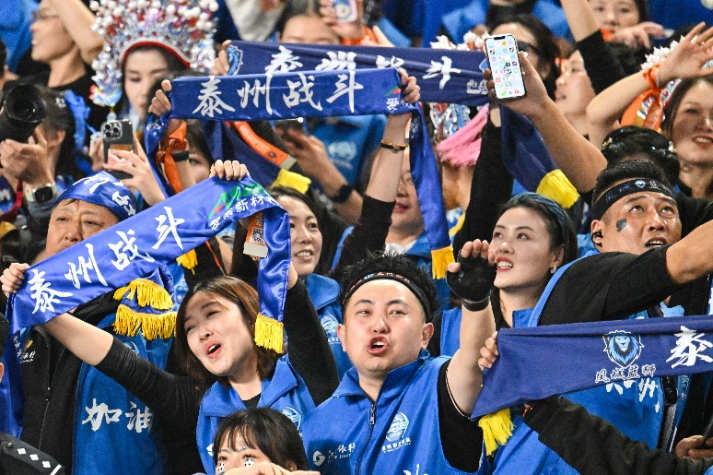 Fans celebrate after the Taizhou soccer team wins the final of the Jiangsu City Football League in Nanjing, capital of Jiangsu Province, on November 1 (XINHUA)
Shanghai-based language and literature magazine Yaowen Jiaozi, literally "biting phrases and chewing characters," recently unveiled its Top 10 Chinese Buzzwords for 2025. Released on December 2, the list spotlights linguistic trends that reflect societal changes. Huang Anjing, the magazine's editor-in-chief, told Jiefang Daily newspaper that this year's word selections mirror the arrival of the "intelligent era," marked by a faster-than-ever evolution of the Chinese lexicon. Many of the chosen terms are tied to AI, highlighting how deeply technology is reshaping language. For example, the inclusion of "Embodied Intelligence" shows AI is not only transforming the world but also actively influencing how people communicate. In terms of social change, as industrial structures evolve and the economy transforms, new employment models have emerged—earning "Digital Nomad" (a person who works remotely using modern information technology) a spot among the trending terms. Top 10 buzzwords for 2025 Renxing ("Resilience") Originally a physics term describing an object's ability to deform without breaking under external stress, "resilience" has evolved to signify a tenacious spirit. As a 2025 buzzword, it is now defined as "the capacity to effectively counter external interference, resist shocks and achieve sustained development." In recent years, amidst rising global unilateralism and protectionism, escalating technological blockades and global supply chain volatility, China has steadfastly managed domestic affairs. By continuously promoting high-level opening up, advancing economic transformation and achieving solid progress in high-quality development, the national economy has maintained a trajectory of steady improvement. Consequently, the term "resilience" has become ubiquitous, with phrases such as "developmental resilience" and "economic resilience" frequently appearing in official documents and media reports. Jushen Zhineng ("Embodied Intelligence") "Embodied Intelligence" refers to an intelligent entity possessing a physical carrier, contrasting sharply with disembodied intelligence like large language models such as Chinese DeepSeek. Embodied intelligence, such as humanoid robots, learns and evolves autonomously through dynamic interaction with the physical environment. Its emergence signals a new phase in AI development. As technological pathways mature and application scenarios broaden, embodied intelligence is poised to drive significant leaps in productivity across sectors, including industrial manufacturing, transportation, logistics and commercial services. Suchao ("Jiangsu City Football League") "Suchao" is the abbreviation for the Jiangsu City Football League. Since its opening match in east China's Jiangsu Province on May 10, the league has rapidly ascended to become one of the most popular mass sports events of 2025 across China. The Suchao phenomenon is attributed to a convergence of factors, including policy backing, economic investment, widespread grassroots participation, high quality of play, robust social media engagement and its success in boosting urban cultural and tourism consumption. The Suchao model has since captivated other Chinese provinces and cities, leading many to host or plan similar local soccer tournaments. Saibo Duizhang ("Cyber Reconciliation") "Saibo" is a transliteration of the English "cyber," indicating concepts related to the Internet. Originating in science fiction and computer science literature, the term has permeated popular culture to denote hi-tech, digital and networked phenomena. "Reconciliation" is used metaphorically here: It describes two parties holding their respective "life ledgers" (personal experiences and observations) to cross-check each other's "data," thereby resolving biases and misunderstandings stemming from information asymmetry. "Cyber reconciliation" specifically describes a cross-cultural exchange between Chinese and U.S. netizens. In early 2025, following the U.S. announcement regarding an imminent TikTok ban at the time, many American users flooded Chinese platforms like Xiaohongshu (RedNote). They shared intimate details of their lives and cultural values, directly engaging with Chinese users and effectively dismantling existing stereotypes about China. This genuine interaction, in turn, provided Chinese netizens with more authentic insights into American society. "Cyber reconciliation" offers an important model for information exchange and cultural dialogue between nations. Shuzi Youmin ("Digital Nomad") This term describes a demographic, predominantly younger individuals, who don't have a fixed office location. They leverage modern information technology to work remotely, possessing strong autonomy and self-management capabilities. These professionals often engage in creative fields such as software development, content creation and design, moving fluidly across regions and transcending the geographic constraints of traditional employment. Frequently, they strategically relocate to lower-cost areas to optimize their financial stability while achieving a sustainable work-life balance. This evolving lifestyle and modality of work are increasingly appealing to young people globally, prompting many countries to introduce specific visa policies and tax incentives tailored for digital nomads. Guzi ("Goods") The term "Guzi" (a homophonic slang for the English word "goods") refers to tangible merchandise infused with elements of ACG (Animation, Comic and Game) culture, such as collectible badges, acrylic figure stands and themed cards. Initially confined to the erciyuan ("two-dimensional space") subcultures, Guzi has recently crossed into the mainstream, attracting a growing number of young consumers. The surge in demand has galvanized an entire industrial ecosystem, the Guzi Economy, spanning design, manufacturing, sales, logistics, exhibitions and collection. Major commercial hubs, including Shanghai, now feature numerous dedicated Guzi venues, drawing young enthusiasts nationwide for shopping and cultural engagement. Yuzhi ("Pre-fabricated") The term "pre-fabricated" (meaning "made in advance") achieved massive popularity in 2025 following a critique from influencer Luo Yonghao on China's microblogging platform Weibo in September. He accused the well-known restaurant chain Xibei of "using premade dishes while charging premium prices." This controversy thrust the issue of pre-cooked food, including concerns over food safety and nutrient degradation, into the national spotlight. The term "pre-fabricated" then transcended the culinary sector to become a potent cultural metaphor. It is now applied to people and things perceived as being standardized and de-individualized in their creation. Examples include "pre-fabricated people," individuals seen as mass-produced by modern education and professional systems, and "pre-fabricated content," which describes cultural products (short videos, online literature and variety shows) manufactured using standardized formulas to maximize traffic and viewership. Huorengan ("Sense of Being Alive") Huorengan, or "sense of being alive," signifies the authentic qualities an individual projects through social media or daily interactions. In the current intelligent era, social feeds are saturated with meticulously edited visuals and formulaic captions, creating an illusion of a "packaged" or "perfect" existence. As AI-generated speech and actions become increasingly sophisticated, the innate, imperfect authenticity of human beings acquires heightened value. The popularity of Huorengan demonstrates a deep desire for simple human warmth and lively, unscripted everyday experiences amid rapid technological advancement. Xx Jichu, xx Bujichu ("If ×× Is Basic, ×× Will Not Be Basic") This versatile phrase originated from a fashion vlogger's video titled "Formula for Making Basic Items Look Expensive," which suggested pairing principles such as: "If the top is basic, the bottom should not be basic." Netizens rapidly adapted this concept into a humorous structural template for discussing all facets of daily life. For instance: "If salary is basic, consumption will not be basic" wryly observes that low monthly earnings do not diminish one's enthusiasm for spending. The structure uses the sharp contrast between "basic" and "not basic" to generate a humorous effect, making it a flexible tool for both playful praise and humorous self-deprecation. Congcong Rongrong, Youren Youyu; Congcong Mangmang, Liangun Daipa ("Calmly, Skillfully; Hurriedly, Scrambling") This evocative phrase gained explosive traction after a public representative from Taiwan Province used highly dramatic body language and emphatic intonation to critique the perceived chaotic municipal management in Taipei City. The account centered on the contrast: "It should have been calm and skillful, but now it's hurried and scrambling." When this video was uploaded, a mainland musician adapted the exact phrasing into a viral song titled "Good for Nothing." The highly addictive melody, combined with the singer's dramatic emotional delivery, rapidly spread online, sparking widespread imitation and "secondary creation" among netizens on both sides of the Taiwan Straits. Consequently, "calmly and skillfully" versus "hurriedly and scrambling" became a popular shorthand to satirize the stark disparity between ideal states and challenging real-life predicaments. Copyedited by Elsbeth van Paridon Comments to jijing@cicgamericas.com |
|
||||||||||||||||||||||||||||||
|