
|
| China |
| Wilderness contest creates viral stars, a booming industry, and debate about its soul | |
|
|
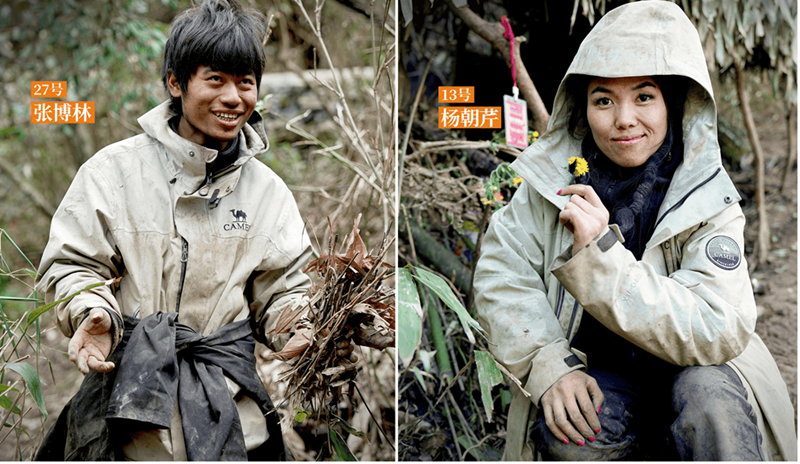 Zhang Bolin (left) and Yang Zhaoqin, contestants of the second season of the Extreme Wilderness Survival Challenge in the Qixing Mountain Scenic Area in Zhangjiajie, Hunan Province (SCREENSHOT)
When Yang Zhaoqin signed up for the second season of the Extreme Wilderness Survival Challenge in the Qixing Mountain Scenic Area in Zhangjiajie, Hunan Province, she had no idea the decision would turn her into an online sensation. A 29-year-old single mother of two young boys, Yang was drawn to the competition partly by the champion's prize: 200,000 yuan ($28,000), double the reward offered in the first season. She submitted her application in September. Back then, the recently concluded first season had generated little buzz, with only scattered online discussions mostly focused on contestants' survival skills. The second season, however, marked a dramatic shift. Organizers launched an aggressive publicity strategy—multi-platform livestreaming, intensive short video coverage and frequent updates on contestants and match progress. This continuous, multi-dimensional content output quickly ignited public curiosity about wilderness survival. The show repeatedly trended on social platforms and amassed over 5 billion views across networks, emerging as an undeniable breakout hit. Among the contestants who reached the semi-finals, several distinctive figures rose from obscurity to overnight fame. Yang, the only woman in the semi-finals, captured overwhelming attention for her unique personal experience and tenacious performance. From wildness to web fame Tian Jianbing, General Manager of the Qixing Mountain Scenic Area, explained that the competition was initially launched to boost the profile of the destination. He noted that Qixing Mountain—with its rare karst mesa terrain, cliffs towering 500 to 700 meters high, deep valleys, dense forests and rich biodiversity—offers an ideal natural environment for wilderness survival challenges. "The outdoor resources here are incredibly abundant, and wilderness survival is an activity that ordinary visitors can also take part in. We hope tourists won't just be spectators—we want them to become future participants," he told China National Radio. Contestants must survive in the wild with no external supplies, relying only on minimal basic equipment—during the semi-finals, each was provided with just a chopping knife. Their tasks included building shelters, purifying water and foraging for edible plants under extreme conditions. Yang was the only woman to reach the later stages of the contest, and also became the first competitor to successfully start a fire using the primitive drill method. She had begun practicing the skill back in September, documenting her attempts on her account on Douyin, the Chinese version of TikTok. When the contest began, she weighed 53 kg, but over just 10 days of living on wild mushrooms, berries, edible plants, roasted grasshoppers and murky water, she lost more than 5 kg. Her fingers and lips became cracked and dry from dehydration. On day 36, she writhed in pain from menstrual cramps and broke down in tears, yet still refused to quit. Amid her rise to fame, her striking eyelash extensions and pink manicure captured attention. She explained that she had the lashes professionally done before the contest, asking the technician to "make them extra durable." She also got gel nails to prevent dirt from accumulating under her natural nails. This distinctive style earned her the online nickname "Cold Beauty." She lasted 37 days in the contest in total, becoming the longest-standing female contestant. However, during a physical examination arranged by organizers on November 14, she failed to meet several health indicators and was forced to withdraw from the competition. She was admitted to the hospital for recovery, by which point her weight had dropped to just 42.3 kg. During her hospital stay, she opened an account on the lifestyle app Xiaohongshu, which had attracted over 70,000 followers by November 26. She even livestreamed from her hospital bed to interact with netizens, with each session drawing more than 20,000 viewers. During these interactions, she expressed that her participation was not just about the prize money but also about challenging herself and proving that women can be equally resilient in the wild. Although she didn't win the 200,000-yuan prize, she earned over 40,000 yuan ($5,600) from other awards within the competition. Additionally, she was invited to become a tourism ambassador for Zhangjiajie. Another contestant who gained popularity through the competition was Zhang Bolin, known by his online name "Lin Bei." Born in 2000 and hailing from Sichuan Province, he was the youngest contestant this season and a graduate of Chengdu University of Traditional Chinese Medicine. During the competition, his "primitive" behaviors—such as climbing trees while mimicking monkey calls and foraging for mushrooms—combined with his infectious laughter, captured widespread attention. He skillfully applied his pharmaceutical knowledge to identify edible and medicinal plants like lilies and Solomon's seal to replenish his energy. On the 27th day of the competition, severe salt deficiency led to symptoms like fluid retention and fatigue, but he managed to recover by consuming purslane, crickets and leeches. During the contest, he also expressed from afar his love for his girlfriend of five years. His social media following grew by hundreds of thousands throughout the competition. On November 14, he celebrated his 25th birthday in the wilderness, with wild yams he dug up himself serving as his birthday meal. More fortunate than "Cold Beauty," Zhang advanced to the finals, continuing his extraordinary journey in the wilderness survival challenge. The boom and concerns On November 21, the Qixing Mountain Scenic Area officially opened registration for the third season of its wilderness survival challenge. The on-site sign-ups saw an overwhelming surge. With the champion's prize this season dramatically raised to 500,000 yuan ($70,000), the competition is drawing wider public attention. Participants cited a wide range of motivations for joining: Some hoped to lose weight, others were drawn by the thrill of experiencing wilderness life firsthand, while many were attracted by the high prize money or the opportunity to gain online fame and monetize their presence through livestreaming. The success of the competition has quickly inspired other nature reserves and scenic spots across China to enter the arena. A number of similar wilderness survival projects are now in preparation or have already been launched in various regions. "We are seeing this niche market become crowded at a staggering speed," an anonymous tourism investment analyst told Shandong-based Dazhong Daily. "Homogenization is the biggest risk. When viewers repeatedly see similar survival shows with identical challenges and social media content editing styles, they will quickly lose interest." He outlined two potential paths forward: becoming a professional sport that attracts elite global survivalists—though this may sacrifice mass appeal—or fully embracing entertainment with celebrities and scripting for faster profits, which risks alienating core fans by abandoning the "hardcore survival" spirit. Liu Yujing, a special commentator for Hebei Daily, pointed out that the true appeal of wilderness challenges lies in showcasing authentic human survival capabilities in nature and promoting practical outdoor knowledge. However, in reality, many competitions have drifted from this essence, devolving into tests of "who can endure hunger the longest" or "who can hold out under extreme conditions." She warned that when starvation endurance becomes a metric and dangerous stunts turn into clickbait, such events risk slipping into the territory of "self-punishment performance," especially when pushing physical limits is glorified as perseverance. To ensure the healthy and sustainable development of wilderness survival competitions, she urged organizers to stay true to the original purpose and set clear safety and social media content boundaries. "First, we must move away from dangerous gimmicks and refocus our criteria on true survival skills and emergency response," she said. "Second, safety can never be compromised for clicks. Our livestreams should prioritize practical knowledge, giving audiences real value." Copyedited by G.P. Wilson Comments to yuanyuan@cicgamericas.com |
|
||||||||||||||||||||||||||||||
|