|
| Business |
| Putting down roots in China | |
|
|
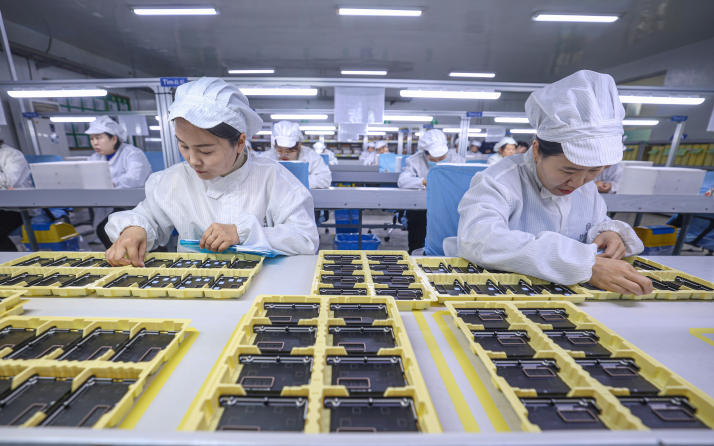 Workers operate at full capacity at a foreign-invested electronics plant in Rongcheng, Shandong Province, on December 31, 2025 (XINHUA)
At a time when businesses around the world are reassessing supply chains, investment strategies and potential markets, the Seventh Qingdao Multinationals Summit in Qingdao, Shandong Province, offered an important window into China's economic priorities for the next five years. Co-hosted by the Shandong Provincial Government and China's Ministry of Commerce, the summit brought together 576 corporate executives, policymakers, diplomats and scholars to discuss how multinational companies can align with China's innovation-driven, high-quality development agenda during the 15th Five-Year Plan period (2026-30). Over the three days of the summit, from June 15 to 17, participants engaged in more than 50 events focused on investment, trade, innovation and industrial collaboration, underscoring China's commitment to high-level opening up and international economic cooperation. One of the summit's flagship agreements was a $110-million strategic cooperation project between Shandong Public, a Shandong-based public service company, and SUEZ, a global leader in circular solutions for water and waste management, focused on urban wastewater treatment and environmental protection, supporting China's dual-carbon goals of peaking carbon emissions before 2030 and achieving carbon neutrality before 2060. Presence in China During the summit, senior executives from global companies shared their perspectives on navigating China's increasingly competitive market and the opportunities presented by the country's green transition for those willing to invest in innovation and local partnerships. Andrea Maganzani, Asia Pacific CEO of the Italian tire manufacturer Pirelli, told Beijing Review that China is a big market in terms of volume, but also very selective in the kinds of products it will consume. Companies need to find their niche and come prepared with quality products and innovation, as China is a very demanding market and it is becoming increasingly competitive, he said. According to Maganzani, competition is no longer just about cost. "It's also about the quality and the technology of all these products," he said, adding that Chinese products are becoming very challenging for firms that do not invest enough in innovation. Eric Lai is vice president and senior regional sales director in China and the Asia-Pacific region for Danish pump manufacturer Grundfos IND, and also chairman of the Danish Water Alliance in China. "China is not just one of the many markets for us. It's actually a home market," he told Beijing Review. For Grundfos, China represents far more than a typical overseas market. The company's 31-year track record in the country, including two production plants and its largest research and development hub outside Denmark, speaks to its enduring strategic focus on the region, according to Lai. "Multinationals like Grundfos should not just be beneficiaries of globalization. We must become co-creators of local value," Lai said. Gianni Di Giovanni, Executive Vice President of Italian energy company Eni's China Branch Office, told Beijing Review that the company has focused on China's decarbonization path. "Decarbonization is underway and China decided to do that very seriously and brightly," he noted, adding that this is good news not only for China but for the rest of the world. Almatis, a global leader in aluminium oxide production, has reinforced its commitment to China with the upcoming launch of its fourth plant in Qingdao by the end of this year. Charles Thompson, Chief Commercial Officer of Almatis, told Beijing Review that the company's partnership with Qingdao began in 1998. "Qingdao is a great partner for us. We are happy with how our development has gone, and how the relationship has been. We see faster progress here than anywhere else in the world," he said, adding that the company intends to continue investing in its Qingdao site. Thompson also highlighted Almatis' strategy to cope with global volatility by producing and supplying locally wherever possible. The company's strategy is to have smaller plants located in all regions of the world, closer to customers and to suppliers to reduce risks, he explained. "In China, this works well because of the large customer base that values local supply chains, and it aligns with the broader push for technological advancement and self-reliance," Thompson said. Ahmed Almehmadi, COO of Saudi Arabian company EXPORTech, which is the Chinese e-commerce giant Alibaba's channel partner in the Middle East and Africa, said in an interview with Beijing Review that his company initially operated in traditional import-export and real estate, but surging logistics costs during the COVID-19 pandemic triggered a strategic shift. Shipping a container from China to Saudi Arabia could reach $15,000-20,000, making the original business model increasingly difficult to sustain. The firm then pivoted toward e-commerce by partnering with Alibaba, according to Almehmadi. "The move to digital trade quickly proved effective, as customers who had previously hesitated began engaging once the new channel was established," he said. According to Almehmadi, his company's role extends beyond facilitating transactions, focusing instead on helping businesses build long-term partnerships and expand across markets. New drivers, new prospects As China begins the implementation of its 15th Five-Year Plan this year, many business leaders agreed that the country's accelerated shift from quantity-driven growth to a development model powered by innovation, quality and resilience poses both challenges and opportunities for multinational companies. Attendees said they believe success in China will increasingly depend on innovation rather than manufacturing capacity alone. At a forum on high-quality development of multinationals, Hyukjoon Lee, President of Hyundai Motor Group China, described the coming five years as a decisive period for the global automotive industry. With electrification, intelligent technologies and the application of hydrogen energy accelerating, he emphasized that China remains the core growth pole of Hyundai's global strategy. China is not only the world's largest automobile market, but also a global center for technological innovation and consumer trends, Lee said. Simon Lichtenberg, founder and CEO of Swedish outerwear maker Tretorn Group, said at the forum that China has evolved from a manufacturing base into a leading innovation hub, digital economy powerhouse and talent center. "Coming to China today is not just about selling—it is about learning," he said, citing China's strengths in execution speed, digitalization and green development. Clemens Brenner, a member of the Executive Board of the Heraeus Group, a Germany-based tech company, also told the forum that investment in China today increasingly means investment in innovation, research and talent development. Innovation-driven development presents enormous opportunities for industrial transformation, he said. "We see opportunities in the 15th Five-Year Plan for advancing our manufacturing, for advancing how we incorporate data into our manufacturing process, and for looking for future investments of having a more digitally automated facility," Thompson said in the interview. BR (Reporting from Qingdao, Shandong Province, with contributions from Peng Jiawei and Shang Zhouhao) Copyedited by G.P. Wilson Comments to lixiaoyang@cicgamericas.com |
|
||||||||||||||||||||||||||||||
|