|
| Business |
| New growth momentum builds against sluggish global investment | |
| Global cross-border investment continues to face headwinds, yet new sources of momentum, particularly from the digital sector and emerging economies, are becoming increasingly visible | |
|
|
|
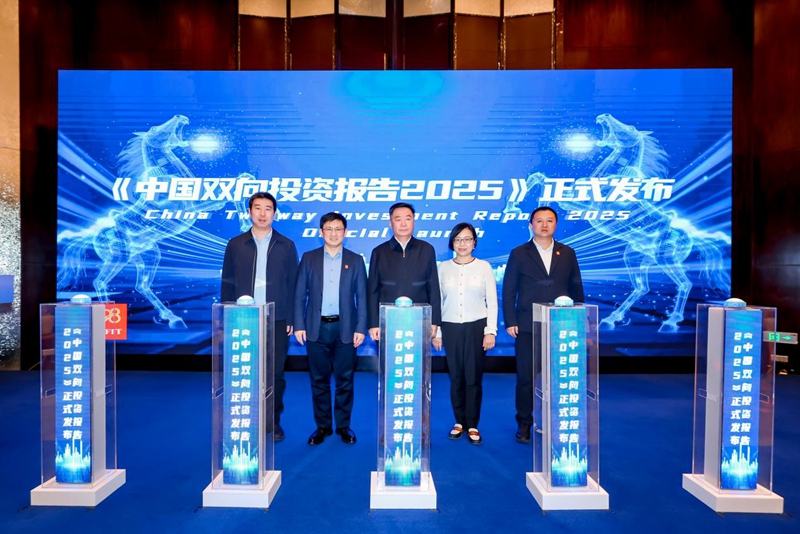
The release of the China Two-Way Investment Report 2025 in Beijing on February 3 (COURTESY PHOTO) Global cross-border investment continues to face headwinds, yet new sources of momentum, particularly from the digital sector and emerging economies, are becoming increasingly visible, according to a newly released investment report. The China Two-Way Investment Report 2025 was jointly released in Beijing on February 3 by the Organizing Committee of the China International Fair for Investment and Trade (CIFIT), the Information Center of the Development Research Center of the State Council (DRC), and the Department of Foreign Economic Research of the DRC. This official version is an update of an earlier version released in last September during the 25th CIFIT in Xiamen. The report highlights two defining shifts in global foreign direct investment (FDI): an accelerated structural shifts toward digital and services sectors, and an increasingly fragmented regional landscape—characterized by inward-looking blocs—driven by geopolitical tensions and protectionist policies. Structural shifts The United Nations Conference on Trade and Development said last November that global FDI continued to decline in the first half of 2025, with full-year FDI projected to fall by 3 percent year on year, extending the downward trend that began in 2023. “Against this backdrop, cross-border investment in the digital economy has stood out as one of the few areas still capable of attracting long-term global capital,” said Chai Haitao, a national high-end think tank expert at the Chinese Academy of International Trade and Economic Cooperation under the Ministry of Commerce and its former president. According to the report, the value of announced greenfield projects in the global digital sector reached $360 billion in 2024, up 107 percent year on year, accounting for 28 percent of total global greenfield investment. The report also noted a shift of investment toward services. It revealed global trade in services reached $7.5 trillion in 2024, contributing 58 percent of overall global trade growth. In China, the proportion of foreign investment flowing into the services sector in 2024 was already twice that of manufacturing. Regional landscape The impact of “America First” trade and economic policies has become the most influential variable affecting current global cross-border investment, Chai said, adding that trade and investment patterns across North America, Latin America, and the Caribbean are expected to undergo profound changes, while competition among major powers is becoming more intense and complex. In the period ahead, he added, the tendency for the three major economic circles, Asia, Europe, and the Americas, to form more inward-looking groupings is likely to become more pronounced. At the same time, however, countries worldwide are competing more actively to attract investment, Chai said, unlike the early stages of the anti-globalization backlash, when external FDI policies generally tightened, a new trend has emerged toward expanding incentives for investors. The report showed that in 2024, 83 countries introduced a total of 147 investment-related policy measures, 78 percent of which were favorable to investors, with incentive-based policies accounting for 45 percent of the total. “This represents a new dynamic,” Chai said. “While certain major power pursues monopolistic interests, many countries are expanding openness. This is a clear example of opportunity emerging amid crisis.” Meanwhile, global manufacturing investment is increasingly shifting toward Asia, particularly the Association of Southeast Asian Nations (ASEAN). According to the report, Asia remained the world’s largest recipient of FDI in 2024, absorbing about 40 percent of global inflows. In recent years, manufacturing investment in developed economies has generally declined, while emerging economies have seen growth, most notably China and ASEAN countries. Five years ago, ASEAN accounted for just 9 percent of global manufacturing FDI; that figure has now risen to 28 percent. The report also noted that despite a decade-long decline in global FDI, the rise of multinational enterprises from emerging and developing economies has injected new vitality into cross-border investment and production. Significance for China Wang Hongxia, a researcher at the Chinese Academy of International Trade and Economic Cooperation, said both inward and outward investment are integral to China’s open economy and key pillars of international economic and trade cooperation. Wang added that they play an important role in upgrading China’s industrial and supply chains, fostering new quality productive forces, and advancing Chinese modernization. New quality productive forces are economic drivers based on cutting-edge innovation and advanced technologies. The recommendations of the Central Committee of the Communist Party of China for formulating China’s 15th Five-Year Plan (2026-30), adopted in October 2025, call for expanding two-way investment cooperation. This is of major significance for pooling global resources, responding effectively to changes in the international economic and trade landscape and geopolitical challenges, and building a new development paradigm in which the domestic market is prioritized as the mainstay of the economy while the domestic and international markets reinforce each other, she added. Looking ahead, Chai suggested that China should adapt to emerging trends in which foreign investment is increasingly asset-based and service-oriented. He called for stronger efforts to attract service-sector investment, better integrate foreign capital into China’s domestic economic cycle, and leverage investment to boost consumption. He also emphasized the need to further expand opening up, ensuring that both market access and operational conditions are aligned, a task that ultimately requires deeper institutional reforms to match a more open border regime. On outward investment, Chai said priorities should include closer integration of trade and investment, improved comprehensive overseas service systems, stronger cooperation with Global South countries, and enhanced protection for overseas rights, interests, and personnel. The key to expanding two-way investment cooperation lies in securing a leading position in future industries, especially in the digital economy and artificial intelligence, he added. Copyedited by G.P. Wilson Comments to zhangshsh@cicgamericas.com |
|
||||||||||||||||||||||||||||||
|