
|
| Business |
| How China is tackling rat-race competition | |
|
|
 A humanoid robot on a walk at a robotics industrial park in Yizhuang, Beijing, on February 24, 2025(XINHUA)
When prices don't rise, is the economy stable or stuck? For much of 2025, China's consumer price index (CPI) hovered near zero, while the producer price index (PPI) remained in negative territory. The trends kept overall inflation consistently below the government's annual target of an improvement of around 2 percent, set at the beginning of the year. While CPI tracks the prices households pay for goods and services, PPI measures price changes at the factory gate. Together, their sustained weakness raises questions about demand, industrial profits and the nature of economic growth itself. At a press conference on January 20, Wang Changlin, deputy head of the National Development and Reform Commission, the country's top economic planner, said price dynamics are closely linked to both overall economic performance and people's livelihoods, and should therefore be viewed in a balanced way. A rapid rise in prices will push up living costs, while falling prices may help reduce household spending in the short term. However, persistently low price levels are not conducive to corporate profitability, which could in turn slow job creation and income growth, and impede economic development. "For these reasons, promoting a reasonable rebound in prices is an important objective of macroeconomic policies," he said. But how can prices rebound? Curbing rat-race competition has been highlighted as a key approach. "Rat-race competition typically intensifies in late-maturity industries facing slow demand growth and excess capacity," Hu Qimu, Deputy Secretary General of Forum 50 for Digital-Real Economies Integration, a Beijing-based think tank platform focusing on the deep integration of digital technologies with the real economy, told Beijing Review. The term refers to competing by reducing costs through measures that degrade existing value, such as lowering product quality, without corresponding technological or process innovation. This form of competition fails to enhance long-term industrial progress or foster healthy sector development. "By curbing rat-race competition, outdated capacity will be phased out, new technologies and products will be encouraged and new demand will be created," Hu explained. He further stressed that these measures will not automatically drive up prices; they target distorted competitive mechanisms rather than prices themselves. Price changes are more likely to be a market-driven outcome of improved supply quality and industrial upgrading, he added. To curb rat-race competition, China will formulate regulations for building a unified national market, regulate the conduct of local governments and enterprises, strengthen market-based survival-of-the-fittest mechanisms and facilitate the exit of outdated capacity, Wang said. A primary task In late July 2024, a central leadership meeting called for stricter industry discipline and curbing rat-race competition, drawing widespread attention to the issue. In response, more targeted measures were launched, including imposing capacity controls in saturated industries like photovoltaics and cement, establishing price-monitoring mechanisms for new-energy vehicles (NEVs) and accelerating the phase-out of outdated industrial capacity. Last July, measures ranging from product price monitoring to quality inspections were announced at a meeting on regulating NEV market competition, convened by the Ministry of Industry and Information Technology, the National Development and Reform Commission and the State Administration for Market Regulation. It urged efforts to promote lawful, fair, honest, proper and well-ordered competition in the sector. The national market regulator has also urged three major players in the food delivery market to adjust their promotional activities and adopt a more rational approach to competition. This move followed an episode of fierce discount competition in 2025, in which the platforms had attracted customers by offering massive, and ultimately unsustainable, "free meal" subsidies. Furthermore, at the Central Economic Work Conference held in December last year, an annual meeting outlining development priorities for the year ahead, tackling rat-race competition was identified as a key task for 2026. From a policy perspective, efforts against rat-race competition primarily aim to address market failures, including corporate monopolies or situations where inferior products drive out higher-quality ones, according to Hu. "By correcting distorted competition mechanisms, related policies raise market entry thresholds and push out low-end capacity that relies on price-cutting rather than innovation to win customers. At the same time, they encourage leading firms to achieve technological breakthroughs, enhance performance and move into new competitive arenas," he said. For example, some companies that once focused on producing video compact disc (VCD) players in the late 1990s later upgraded to produce higher-end digital devices. Rather than remaining trapped in rat-race competition within the VCD segment, they moved on to a new stage of development, he explained. Rather than locking competition into outdated technologies, the emphasis should be on driving technological upgrade and innovation, Hu said. 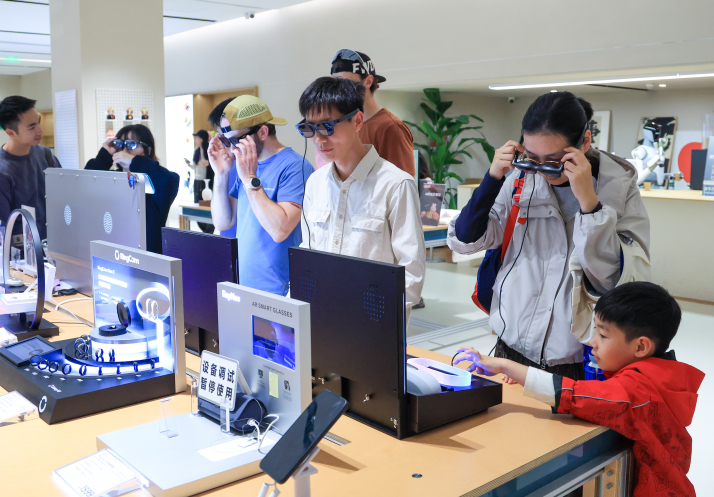 Visitors try on smart glasses at a store in Shenzhen, Guangdong Province, on January 18(XINHUA)
Positive feedback Li Yunfei, electric vehicle producer BYD Group's brand and public relations general manager, said at a media event in Beijing on January 26 that the company views the efforts to curb rat-race competition as highly positive for the long-term development of the domestic NEV market. China's automotive market is vast and highly competitive, with nearly all major global brands present alongside rapidly rising domestic players. That mix has intensified competition and, inevitably, exposed the need for clearer rules. In response, the government has strengthened regulatory requirements in areas including intelligent driving services, vehicle safety and standards across the industrial chain, according to Li. "While the short-term impact may vary by company, these measures will support the industry's healthy and sustainable development in the medium to long term," he said. Similar processes have taken place in mature markets in Europe, the United States, Japan and the Republic of Korea. In China, however, they are unfolding more rapidly due to the market's scale and the simultaneous shifts toward electrification and intelligent upgrading. "Embracing innovation and competition is both a challenge and an opportunity, as well as an essential step toward building world-class automotive brands," Li added. "For enterprises, innovation is always the core source of competitiveness" Hu said. "They need to be willing to bear the cost of patience: In the early stages, investment may exceed returns, but this should be assessed from a medium- to long-term perspective, with a strong emphasis on sustainable development." He also warned that some local governments have acted against sustainability principles in developing industrial parks, by subsidizing industries that the market would otherwise have phased out. "Such subsidies should be directed toward strategic, emerging and future-oriented industries, even though these sectors may currently require heavy investment and generate limited profits," Hu concluded. (Print Edition Title: From Price to Productivity) Copyedited by Elsbeth van Paridon Comments to taoxing@cicgamericas.com |
|
||
|
||||||||||||||||||||||||||||
|